
Scottish police officers call for more powers to tackle e-bikes after 1,000 seized this year

The Scottish Police Federation said the number of existing options is ‘extremely limited’
Scottish police officers have called for more powers to tackle antisocial behaviour linked to e-bikes, with more than 1,000 seized so far this year.
The Scottish Police Federation (SPF), which represents rank and file officers, said the number of existing options is “extremely limited”.
It came as it warned families against buying e-bikes as Christmas presents for children.

Holyrood’s criminal justice committee recently announced it is carrying out an inquiry into crime and antisocial behaviour associated with e-bikes and e-scooters.
Last month, SNP Justice Secretary Neil Gray revealed the government is considering introducing balaclava “exclusion zones” in Scotland.
He pointed to action taken in Nottingham, which recently became one of the first cities in the UK to introduce restrictions on balaclavas, allowing police and council officers to require people to remove a face covering where their identity is being concealed to commit crime or behave antisocially.
David Threadgold, chair of the SPF, said: “The increased antisocial use of e-bikes and e-scooters has been a real concern for communities in Scotland and a real challenge for the police to deal with.
“The number of options the police have to deal with people who are riding these types of vehicles dangerously is extremely limited.”
He said police need the power to stop and require people wearing face coverings to remove them, adding: “The risk presented to the public and to police officers trying to stop it means we have to deal with this very quickly.”
Many modified e-bikes are too powerful to qualify as an electrically-assisted pedal cycle and instead fall under laws for motorcycles and mopeds, requiring a licence and insurance.
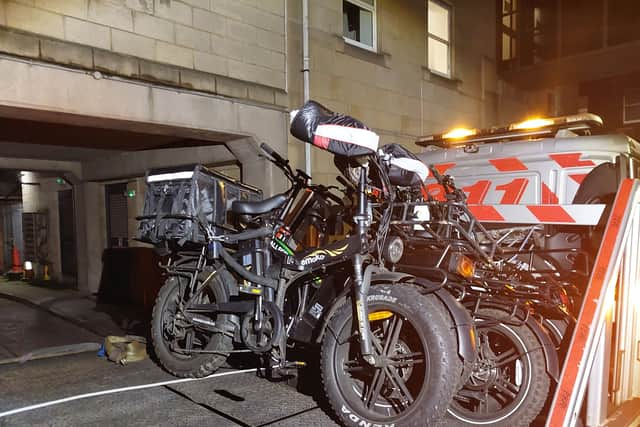
The number of e-bikes and e-scooters seized by Police Scotland has risen by more than 60 per cent in a year. As of October 16, the force had confiscated more than 1,000 of the vehicles in 2026 – 561 e-bikes and 441 e-scooters.
The previous year 373 e-bikes and 196 e-scooters were seized.
Various campaigns have taken place across the country, including Operation Armour in Aberdeen, resulting in e-bikes being seized and dozens of people charged.
Speaking to 1919 magazine, which is published by the SPF, Mr Theadgold said: “Parents need to be aware of the risks attached to buying any motorised vehicle.
“There are very clear conditions about where and when these things can be legally used. The challenge comes more when these things become modified past the speed limit.”
Inverclyde Community Safety Partnership – which brings together police in the area with other public bodies – has also urged parents to ensure that “any vehicle is being used appropriately and lawfully, and that young people understand the risks associated with riding in public spaces”.
It added: “We would encourage all parents to fully understand the legal position, safety risks and potential liabilities associated with e-scooters and electric bikes before making any purchase decision.”
Police Scotland has said that e-bikes can legally be used on public roads if they meet specific requirements, including that the motor should not be able to propel the bike when it is travelling at more than 15.5mph and must have a maximum power output of 250 watts.
Vehicles that exceed these limits are considered motor vehicles and are subject to the Road Traffic Act, meaning the rider must hold a full UK driving licence, wear an approved helmet and have insurance.
Police warned those failing to comply with the legal requirements could face enforcement action under the Road Traffic Act. Officers also stressed e-scooters are not permitted on public roads, pavements or other public spaces, as they do not meet the necessary legal standards.
Their use is only legal on private land with the landowner’s consent.
READ MORE: Government and councils must work together to tackle scourge of illegal electric bikes and scooters
Scottish Conservative North East MSP Liam Kerr told 1919: “As we’ve seen in Aberdeen the police can have success with dedicated operations and resources. We need to see this now on a wider scale and replicated across the country.
“This is an emerging problem which creates misery for communities, and we need to give police what they need to get on top of it. I hope both the UK and Scottish governments can work together to do just that.”
SNP community safety minister Kirsten Oswald has already told how the Scottish government wants to “increase the powers police have to seize and retain e-bikes and e-scooters that are being used for antisocial or criminal behaviour”.
Ms Oswald stated: “It is illegal to use a privately owned e-scooter on public roads or pavements in Scotland, and e-bikes modified beyond the legal limit can be seized by police.”
But she added: “The law on road traffic, and the rules on what can be imported and sold in this country, sit with Westminster.
“We’ve written to the UK government to urge it to take further action on licensing off-road vehicles, to help Police Scotland track down and detain the people breaking the law, and the vehicles they are using.”
A UK government spokesperson said: “Privately owned e-scooters remain illegal on roads, pavements and other public spaces, and we’re bringing forward new laws to make their use safe.
“Illegal e-bikes that can reach dangerous speeds also have no place on our roads and pavements.”
Last month, Police Scotland carried out a “week of action” targeting the illegal use of e-bikes and e-scooters, with 142 seized. It said all the vehicles will be destroyed.
Comments
Want to join the conversation? Please or to comment on this article.