
Sandie Peggie NHS Fife tribunal: 'Mass discrimination' legal action warning if nurse wins case over Beth Upton
Repercussions of high-profile employment tribunal hearing involving nurse Sandie Peggie and trans doctor Beth Upton could be far reaching, say campaigners.

It has been one of the most contentious and high-profile employment tribunals in modern British legal history and its outcome could wield significant influence at a time when policies and guidance around gender are in a state of flux.
All eyes are on the Dundee employment tribunal that has heard every blow and counter in the case brought by Sandie Peggie against NHS Fife. In legal proceedings that have made headlines around the UK, the nurse is pursuing a claim for sexual harassment, belief discrimination and victimisation against both the health board and Dr Beth Upton, a trans woman colleague at Kirkcaldy’s Victoria Hospital with whom she clashed over a women’s changing room.
With the final evidence sessions concluding last week, the legal teams of those involved have until August 25 to provide any supplementary statements effectively summarising their case. The tribunal will then briefly reconvene at the start of September for two days for oral submissions alongside any legal questions.
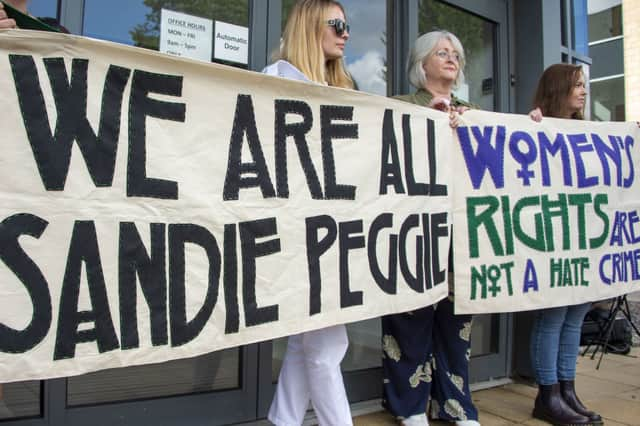

Only then will the panel, helmed by employment judge Sandy Kemp, be in a position to issue a written ruling.
But while many tribunal judgements are given relatively quickly after the final submissions have been made, the intricacies of this particular case mean it could be weeks, if not months, before a legally binding decision is announced. One source indicated “the end of 2025” as a “likely timeframe”, given the panel has to consider not just the evidence from more than 15 witnesses, but thousands of pages of documentation.
When the moment eventually arrives, the implications could well be far reaching. Around the UK there are a number of ongoing employment tribunals and other legal cases which span the kind of gender-critical and trans issues that have been discussed at length throughout the Peggie tribunal.
And according to gender-critical campaign and advocacy groups involved in various legal activities, there is likely to be similar employment tribunal cases in Scotland - and potentially, even a large, class-action style legal action.
‘There are more employment tribunals’
Susan Smith, co-founder of For Women Scotland, the gender critical group that successfully fought the Scottish Government all the way to the Supreme Court over sex-based protections, said there were other women planning legal action around such issues. She indicated there may also be cases similar to the judicial review brought to the Court of Session in April by parents in the Scottish Borders, which ultimately led to a judge ordering that Scottish state schools must provide single sex toilets for pupils.
Ms Smith said: “I know there are more employment tribunals. It’s always hard to say how many, because people are at different stages of the process, but I understand there are a couple of court dates that have been set.
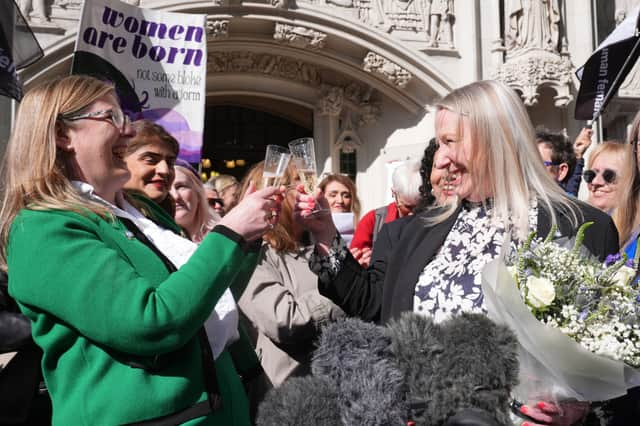
“There is also consideration underway about whether judicial reviews will be brought against anyone at any point for not adhering to the law. It can be a difficult process, but ultimately, we’re not going anywhere. And if things aren’t being done, we’re keeping an eye on what we need to think about doing.”
Maya Forstater, chief executive of the Sex Matters group, stressed the law on single sex spaces was “already clear” in the wake of April’s landmark Supreme Court ruling. The court decision set out the terms ‘woman’ and ‘sex’ refer only to a biological woman and biological sex in the Equality Act.
But should the Dundee tribunal find in Ms Peggie’s favour, Ms Forstater said it would “help bring home to foot-dragging employers all over the country that complying is not optional”.
“Any employer that continues to flout health and safety regulations concerning toilets, changing rooms and washing facilities is putting itself at risk not only of a high-profile legal case involving a single brave claimant like Sandie, but a mass discrimination and harassment case taken jointly by large numbers of female employees,” she said.
Appeal could lead to legal precedent being set
As is to be expected, the extent of the repercussions of the Peggie case depends on the ruling the Dundee tribunal issues, which could be fully or partly in favour of one side or the other, and the similarity of circumstances in future cases.
Either way, the outcome will be consequential, not least because there is little in the way of existing case law around the question of workplace changing rooms. And although judgements in Scottish tribunals are not binding in England, Wales or Northern Ireland due to the separate legal jurisdictions, they can be used as persuasive arguments by the parties involved.
One legal source familiar with the Peggie case said in the event the judgement goes to appeal - a process that could end up in the Supreme Court - the outcome could set a legal precedent similar to that seen in the case of Ms Forstater’s High Court appeal win against an employment tribunal in 2021, which found her gender-critical beliefs fell under the Equality Act. Above all, the source said, the Peggie case would be a “cautionary example” to public bodies “not to play fast and loose with the law and its interpretations”.

Such developments could prove important in a case such as that brought to a Newcastle tribunal by a group of nurses, who are challenging the decision by the NHS foundation trust in County Durham and Darlington to allow one of their trans colleagues to use female changing rooms. The group has filed claims at an employment tribunal on the grounds of sexual harassment, discrimination, victimisation and breaches of the right to a private life, under article eight of the European Convention on Human Rights.
The case is not scheduled to be heard until October. But it has been reported the Royal College of Nursing has urged the trust to comply with statutory provisions laid down in the Workplace (Health, Safety and Welfare) Regulations 1992, which require all changing rooms to be male or female-only except when they are “single lockable rooms”.
Ms Smith said if Ms Peggie wins her case, it will become all the more important for health boards, and Scottish ministers, to ensure they are complying with existing legislation.
“The immediate implications for the NHS in Scotland will be to ensure that they have lawful policies,” she said. “It might focus minds at health boards that they are going to have to take some responsibility for sorting things out. They can’t leave these kinds of policies to graduates with no background in law or human resources, and they’re going to have to review all their policies for staff and patients.
‘They are responsible whether they like it or not’
“Ever since the Supreme Court ruling, we have been pushing the government on policies which we don’t regard as lawful, especially around schools and prisons. Their argument a lot of the time is that these organisations, like the NHS, are arms-length and that it’s not up to the government to provide guidance, even though they’ve done just that in the past. They are responsible whether they like it or not.”
Ms Smith added: “A lot of organisations are putting off any changes because of the false narrative that’s been created, which says the ruling is not law until the statutory guidance is approved by Parliament. But that’s utter rubbish - the law is what the Supreme Court says it is. Unfortunately, a lot of people choose not to believe that.”

Ms Smith also suggested the intense scrutiny of NHS Fife’s processes and practices may prevent other public bodies from contesting similar cases raised at employment tribunals in the future, describing it as a “real embarrassment” for the health board.
“Even if they were to win at this stage, which I don’t think is likely, I am sure it would go to appeal, and ultimately, they would lose,” she said. They have spent a vast amount of taxpayers’ money on this, and it’s been humiliating to hear some of the evidence, and the gossiping and bitchiness in the workplace.
“I think there’ll be more cases and I think there will be more settlements. Wiser lawyers will be telling their clients that it is better for them to swallow whatever disadvantage comes from settling, because they’re not going to win in the long term.”
Political pressure and cost concerns
The Peggie judgement will also have repercussions for NHS Fife. Already, senior figures in Scotland and elsewhere have reflected at length on the case, with many calling for changes even before a judgement is issued.
As part of cross-party condemnation of the health board, Scottish Conservative leader Russell Findlay is among those who have said senior managers should step down over its handling of the case, while SNP MSP Michelle Thomson has called on the members of NHS Fife’s board to consider their positions. Elsewhere, Scottish Labour’s Carol Mochan has said Holyrood’s health committee should investigate the way in which the health board has handled the case.

That criticism is likely to continue, especially as the costs of defending the tribunal case mount up. NHS Fife has confirmed that as of the end of June, it had spent more than £258,000 on legal costs relating to the tribunal - a sum that includes counsel fees and services provided by NHS Scotland.
But given the hearings that have taken place since then, one source suggested the total bill could reach in the region of £500,000 to £700,000 if not more. That sum would exclude any remedy made in Ms Peggie’s favour should the health board lose its case.
“The costs of defending such a case, and eventually paying compensation, is likely to be enormous,” Ms Forstater said.
“Even setting aside the enormous financial cost to NHS Fife and the Scottish taxpayer, no employer should want to risk such serious reputational damage. Bosses need to stop listening to the demands of activists in both external groups and internal networks, and instead ask their general counsels to set out how to follow the law and risks of not doing so.”
Comments
Want to join the conversation? Please or to comment on this article.