
Rachel Reeves left in an 'uncomfortable' place - but the outlook is far worse for the SNP Government
Chancellor Rachel Reeves has achieved her immediate goal with the Spring Statement - but at what cost yet to come?
Rachel Reeves achieved her key goal in the Spring Statement of not making it a ‘fiscal event’.
A variety of non-tax related tweaks left the public finances largely unchanged and her fiscal targets, just, met. There endeth the good news.
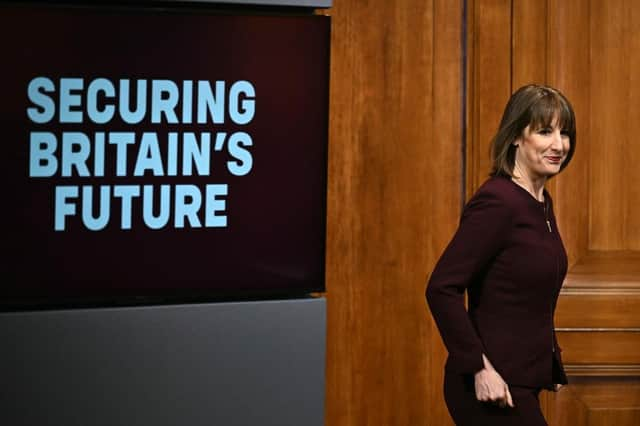

The underlying reality is the Spending Review (SR), due in June, just got a little tougher - at least for unprotected government departments - and some difficult decisions for the Treasury and the Office for Budget Responsibility (OBR) have been pushed back to the autumn.
In terms of the SR, the annual increase in the resource - day-to-day spending - budget is now down to just 1 per cent a year in real (i.e. after adjusting for inflation) terms. That’s not much lower than the previous 1.3 per cent a year, but every little bit less puts more pressure on unprotected budgets, as the massive spend on the NHS will rise by well over 1 per cent.
It doesn’t help that UK debt interest payments have surged past £100 billion a year, over twice the size of the Scottish Government’s day-to-day spending budget.
These OBR forecasts are the figures the Chancellor will have to use when pulling together the SR, so they are important. There won’t be any helpful upgrades that give her a little more room to boost spending for future years. Hence, the front-loaded boost in spend for the next financial year will soon give way to more belt tightening thereafter.
The OBR has actually aided the Chancellor by pushing up economic (GDP) growth in later years, which helps compensate for the halving of growth - from 2 per cent to 1 per cent - in 2025.
As such, the growth path set by the OBR is still on the hopeful side, compared to those set out by other economic forecasters, particularly the Bank of England. This is largely due to the OBR being more optimistic about productivity recovering.

Over the past decade the OBR has been forced to reduce its estimate of medium-term annual productivity growth from around 2.2 per cent to 1.25 per cent, but this is still at the high end of the forecasting range.
Its ‘good times just around the corner’ approach is not made any more convincing by the fact that UK productivity fell by 0.4 per cent in 2023 and by 1 per cent in 2024, with 2025 expected to just creep into positive territory, at 0.2 per cent.
Such nuances are important as rising productivity - back to around the 2 per cent a year mark ideally - is the key to a faster growth rate and rising living standards. At present, the risk is the OBR will be forced to cut its medium-term productivity rate further in the autumn, to not be seen as an unconvincing outlier in its approach.
The root problem with the public finances position, and the reason the Chancellor will continue to struggle to keep to her fiscal rules, without more tax rises, is the Labour Party’s pre-election promises.
Reeves based her ‘no return to austerity’ approach on a wholly unrealistic view of how the economy was going to recover its mojo, as many, including the Institute for Fiscal Studies (IFS), pointed out at the time.
This may - or may not - have won a few extras seats at the election, but at a cost of any raised expectations over faster growth in the economy, in living standards and in public spending being quickly dashed and an unhappy electorate feeling short changed.
So, all in all, a pretty tough position looking forward, but it looks even tougher from a Scottish perspective.
Within the very tight 1 per cent a year rise in day-to-day spending post 2026/27 for English and UK wide departments, John Swinney’s Government also needs to find money to help pay for a variety of Scottish exceptionalisms, often relating to big ticket issues.
These include: free university tuition; higher and additional social security payments; and for more public service workers per head of population; and who are, on average, higher paid.
The two best ways out of this bind are for the Scottish economy to grow faster than the UK economy or for the tax differential with the rest of the UK to continue to grow.
On the first route, at least the UK government has a plan for higher growth, even if its not particularly convincing and it will take some time to bear fruit. In contrast, Scottish Government plans to improve the economy are everywhere and yet nowhere. Lots of platitudes and strategies, but little real intent or interest across the Parliament as a whole. Draw your own conclusions.
On the second route, both the First Minister and his Deputy have recently commented this differential may be near its productive limit. This leaves the Scottish Government in a difficult position ahead of its own Spending Review, due in the summer, and with precious little insight into how it might resolve the situation or where any zeal for radical reform might erupt from.
Overall, we remain where we have been for some time now, in an uncomfortable spot, with debt near 100 per cent of GDP and needing to start to fall, taxes already at a post-war high and spending insufficient to reverse Covid problems and to match future pressures relating to demographics, climate change and defence.
This is the modern world and it looks like it’ll be around for a while.
Comments
Want to join the conversation? Please or to comment on this article.