
NHS came 'close to collapse' during the pandemic, says Covid inquiry chair
Baroness Hallett said on the release of a new report into healthcare systems that the health service “coped, but only just”.
Baroness Hallett said on the release of a new report into healthcare systems that the health service “coped, but only just”.
The report also said the NHS in Scotland pausing “non-urgent elective care” during the pandemic suggests parts of the system were “overwhelmed”.
It also revealed that some 27 NHS Scotland workers died due to Covid-19.
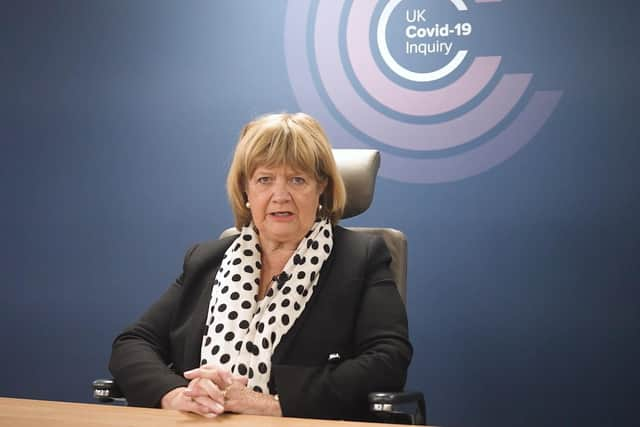

Baroness Hallett said: “This third UK Covid-19 Inquiry report concerns the impact of the pandemic on the UK’s healthcare systems. I can summarise that impact as: we coped, but only just.
“The healthcare systems came close to collapse. Healthcare workers carried the burden of caring for the sick in unprecedented numbers. It came at a huge cost to them, their families, their patients and the loved ones of patients.
“Collapse was only narrowly avoided thanks to the extraordinary efforts of all those working in healthcare across the UK.”
The report suggested that Scotland’s NHS had become overwhelmed by the pandemic.
It said: “In March 2020, across the UK, all non-urgent elective care was paused, with only urgent care and ‘essential services’ to continue.”
It continued: “In Scotland, in addition to pausing non-urgent elective activity, the five adult screening programmes (including cancer) were also paused. Jeane Freeman MSP, Cabinet Secretary for Health and Sport in the Scottish Government from June 2018 to May 2021, said that these measures were all undertaken to: ‘free resource and redeploy staff to ensure we were able to cope in the acute setting including in ICU and HDU [high dependency units]’.
“While the postponement of non-urgent elective care helped to free up healthcare workers to be redeployed to support, in particular, critical care, determining precisely how many beds it freed up is not straightforward as projected additional bed numbers were often based on all the other steps being taken to increase capacity.
“While the decision itself may have been a reasonable one in light of the very real risk that demand would exceed capacity, there can be no doubt… that the repercussions of this decision were significant. Further… delaying treatments for patients in need suggests that the system had in many respects become overwhelmed.”
The report revealed the extent to which people stopped using the NHS because the stay at home messaging used “sent the message that healthcare was closed” - with Scotland having a 15.8 per cent decline in heart attack admissions in 2020/21 compared with 2018/19.
The report also added that 27 NHS Scotland workers died due to Covid-19.
It said: “The Scottish Government kept data on the number of deaths of healthcare workers from Covid-19, which were provided to it by the territorial health boards.47 From 13 April 2020 to 20 July 2022, the Scottish Government was notified of 27 deaths of NHS Scotland workers caused by, or suspected to be related to, Covid-19. It was noted that the source of the infection may be difficult to determine.”
The report also said that visits for dying patients should be “facilitated as far as possible” due to the “devastating impact” of restrictions which led to many dying alone.
Visiting restrictions became some of the “most contentious” measures taken to reduce the spread of the virus and led to “deeply distressing” experiences for patients, family and friends.
The probe found that while restrictions “may be unavoidable” in a pandemic, visits for dying patients should be suspended “for the shortest time possible” and that alternative ways of making contact should be provided.
Margaret Waterton, of Scottish Covid Bereaved, said: “When I was with mum, I would talk with her and hold her hand. I could not hug her as I was not allowed to.
“Wearing full PPE, all that mum could see of my face were my eyes. I had to make sure that I spoke as clearly as possible through the mask and visor.
“Holding hands when wearing double gloves is far from the ‘skin to skin’ contact that is so comforting.
“Those would be the last things my mum would see, me dressed in full PPE, not able to hug her or kiss her or properly hold her hand.”
Comments
Want to join the conversation? Please or to comment on this article.