
Key takeaways from the UK Covid-19 Inquiry report released today
Former first minister Nicola Sturgeon featured heavily, and was praised by the chair as a “serious and diligent leader”.
After hours of hearings with a host of different witnesses, Baroness Hallett released her second report as part of the UK Covid-19 Inquiry on Thursday.
The report has looked into decision-making and political governance. Former first minister Nicola Sturgeon featured heavily and was praised by the chair as a “serious and diligent leader”.
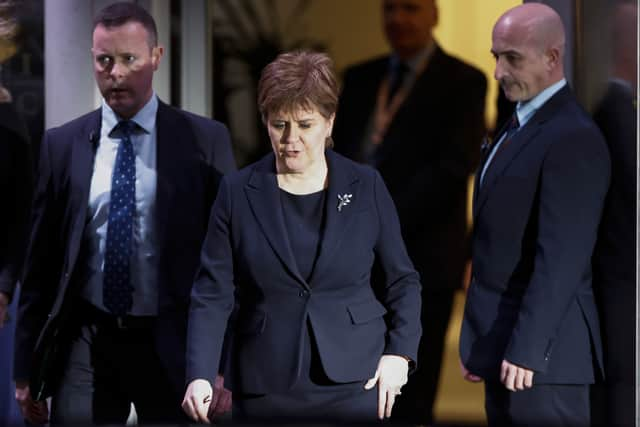

But there was also plenty of criticism, particularly for failing to prepare, failing to delegate, Ms Sturgeon’s zero Covid strategy and having a poor relationship with Conservative prime minister Boris Johnson.
Failed to prepare
One of the most damning parts of the report was Baroness Hallett saying that all four governments in the UK did not “take a grip of the situation” in the early days of the pandemic.
It said the “failure” to prepare was “inexplicable”.
The report said: “The four governments knew enough to spur them into action. Accordingly, the inquiry finds that the lack of urgency (particularly during the mid-February school half-term holidays) and the failure of the four governments to take a grip of the situation and make adequate preparations are inexplicable.
“They failed to anticipate the scale and speed of the oncoming pandemic and to act accordingly.”
Taking aim at the Scottish Government, the report said that between January and March 2020 “there appears to have been no real strategy other than monitoring the situation”.
Zero Covid strategy
Baroness Hallett also took aim at the Scottish Government for suggesting it would be able to “eliminate” the virus north of the Border. “The idea of eliminating the virus from Scotland was inappropriate and destined to fail,” the report said.
The report said the language used by the SNP administration “risked giving the impression to the Scottish public that the emergency was almost over and that life could return to normal imminently”.
It added this “resulted in the public wrongly gaining an overly optimistic impression of the course of the pandemic and an underestimation of the significant impact of the second and third waves in Scotland”.
In turn, this “created a risk that the public’s trust in the Scottish Government’s messaging would be damaged, and that levels of compliance with public health regulations would be affected”.
Sturgeon and Swinney made decisions
The report said that, in theory, the Scottish Cabinet was making decisions, but that in reality the decisions were being made solely by the former first minister.
The chair said this should not have happened, adding: “The Scottish Cabinet should have been involved to a greater degree in decision-making in Scotland.
“This would have ensured greater transparency and enhanced accountability for decisions taken by the Gold Command and, increasingly, Ms Sturgeon.”
The report also added that public communications should have been delegated more widely, rather than Ms Sturgeon doing almost all of it.
“Sharing the burden of public health communications more widely among senior decision-makers and advisers would also reduce the risk of polarisation among members of the public, either along political lines or through perceptions of an individual politician,” the report said.
Poor Sturgeon-Johnson relationship
The report was highly critical of the relationship between the heads of the Scottish and UK Governments at the height of the pandemic.
It described the relationship between the two as “poor, and the approach adopted by Ms Sturgeon and Mr Johnson did nothing to improve it”.
There was also “constant tension and a degree of lack of trust between the UK and the Scottish governments at the highest level”.
The chair said “in any future pandemic, political antipathies or discord need to be set aside to better address the exigencies of the emergency”.
Comments
Want to join the conversation? Please or to comment on this article.