
John Swinney’s critics should bite their tongues and get behind him
After a period of chaos in the SNP, the election of John Swinney as leader was supposed to bring calm to a party heading for electoral humiliation.
With his bank-managerly demeanour, he was the opposite of his predecessor, under whom the nationalists had grown increasingly divided.
It did not take long, however, for the Swinney project to begin falling apart and, after a poor election result, calls for his resignation grew so loud that he could not credibly ignore them.
I write, of course, not about current events but about the end of Swinney’s first spell in charge of the SNP which ended, after four years, in 2004, paving the way for the return to the leadership of Alex Salmond.

History has a habit of repeating itself.
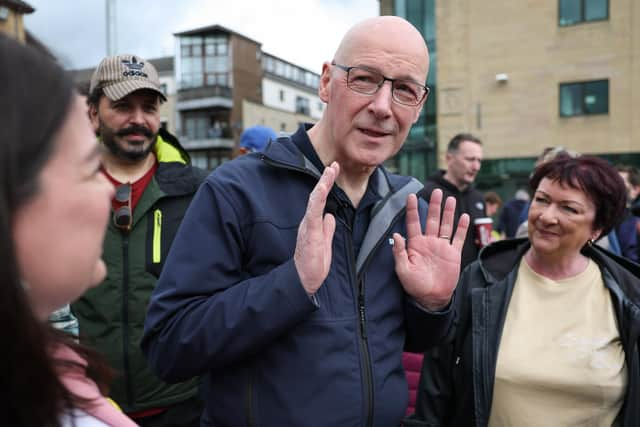
Today, little more than a year after succeeding Humza Yousaf as leader of the SNP, Swinney finds himself in what must be uncomfortably familiar territory. Defeat for the SNP in the recent Hamilton, Larkhall, and Stonehouse by-election has triggered a crisis in his leadership. There have been calls – both anonymous and public – for his resignation. The sense that he is losing his grip on the SNP grows stronger by the day.
Just as he did in 2004, Swinney has decided to fight on.
Responding to reports that a group of colleagues had met to discuss a leadership challenge during the SNP’s annual conference in October, the First Minister said he did not think that would be a good idea.
Swinney told BBC Radio Scotland that he had returned to the SNP leadership in order to help his party “recover” from what he described as “a very, very difficult situation in the spring of 2024” and that he remained focused on the job in hand. He was not, he added, worried “in the slightest” about the briefing against him.
If you say so, First Minister.
Swinney’s characterisation of the state of his party when he took over last year is correct. Former FM Humza Yousaf’s decision to end the power-sharing agreement between the SNP and the Greens had blown up in his face, leaving him without the parliamentary support needed to get things done, and the nationalists had descended into the sort of in-fighting that had, for many decades, kept them on the fringes of our politics.
Given the circumstances, Swinney’s flaws became his advantages. The SNP – and, indeed, the country – very much required a period of calm after years of stormy political weather. Steady old John was just the captain his party needed.
However, Scottish nationalists are not, by nature, patient. Swinney may have been elected to be a safe pair of hands but, already, he’s under pressure to be more radical, with a number of critics inside the SNP demanding he push harder for a second independence referendum.
In response to these briefings, Swinney declared that, after returning stability to his party, he planned to “open up a conversation about independence”.
For some of Swinney’s critics – one thinks, for example, of former health secretary Alex Neil, whose contempt for the First Minister dates back decades – this will never be good enough. Scotland will never gain its “freedom” through conversations. Rather, the break-up of the Union will require something more radical than a cosy chat.
It is perfectly understandable that those SNP members now agitating for Swinney to either change course or quit, want to see a new strategy for independence. Having been told, for years, that defeat in the 2014 vote was a bump in the road on the way to nationhood, they believe they have been badly let down in recent years.
I’m not at all sure, however, what Swinney could be doing differently to advance the cause of independence.
Former FM Nicola Sturgeon spent nine years telling SNP members that “Indyref2” was on the horizon. A rush and a push, lads and lassies, and the land that they stood on would be theirs.
But reality – in the shape of continuing minority support for independence and the Scottish Government’s lack of power to call a referendum – got in the way of Sturgeon’s plans.
The authority to stage another vote remains with the UK Government.
Recent polls suggest support for independence is rising and that, if there were another referendum tomorrow, the Union would come to an end.
This, says one senior Swinney ally, is something for which the First Minister deserves some credit.
I have some sympathy for that view. Do those now agitating for Swinney to go really think that their party – and their cause – would be in ruder health had Humza Yousaf remained in post?
With the next Holyrood election just 11 months away, the last thing the SNP needs is another destabilising leadership contest. Polls may show increased support for independence but Swinney knows – because the focus group data he reads tells him so – that the constitution does not top the list of voters’ priorities.
Swinney is every bit as fanatical about independence as those now whispering about a leadership challenge – many years ago, one of the SNP leader’s aides told me he “would live in a cave to be free” – but the First Minister’s zealotry is tempered by a degree of common sense. He knows and accepts that the time is not right for another referendum.
Swinney also knows that the slight recovery his party has made under his leadership is still fragile.
The SNP is – as was perpetually the case for decades before the party unified under Alex Salmond in 2004 – divided and fractious.
Any Scottish nationalist who thinks it’s now time exacerbate that division is a fool.
John Swinney is a flawed politician, for sure, but if his critics within the SNP want to win the next Scottish Parliamentary election, they’ll bite their tongues and get behind him.
Comments
Want to join the conversation? Please or to comment on this article.