
Swinney confirms GPS tracking pilot for domestic abusers and new laws to tackle violence against women



The First Minister confirmed new legislation will be brought forward to help protect women and girls from violence.
John Swinney has confirmed a pilot of GPS tracking for men accused of domestic abuse will begin next year amid calls for more action to tackle violence against women and girls.
The First Minister also told MSPs in Holyrood that the Scottish government will bring forward legislation that could hand the Crown the powers to issue non-harassment orders as an alternative to prosecution instead of being dished out by the courts.

The legislation could propose a new offence which would address issues around the use of AI tools to create intimate images without consent and criminalising digital tools that are designed solely to generate intimate images and videos.
Leading a debate at Holyrood, Mr Swinney repeated his warnings about an “epidemic of violence against women and girls”, arguing that “increased priority and leadership had to be given to address this situation”.
It comes as reports of sexual violence and domestic abuse have soared while rape crisis centres have seen their funding frozen for the last five years.
Greens justice spokeswoman, Maggie Chapman asked Mr Swinney whether he would commit to “inflation -matched funding over successive years” for rape crisis centres who she warned “effectively face a funding cut”.
In response, Mr Swinney said that Deputy First Minister Jenny Gilruth was “wrestling” with increased funding as part of her upcoming budget.
Tory justice spokesperson, Stephen Kerr, called on Mr Swinney to “restore the stronger bail protections for repeat violent and sexual offenders”.

Despite Scottish Parliament legislation essentially weakening the bail conditions, Mr Swinney argued they were “fundamentally issues for the judiciary to determine”.
Speaking at Holyrood, Mr Swinney said: “Over the summer we consulted on more legal protections for women. This will inform our work on a Violence Against Women and Girls Protections Bill which we will bring forward later in this parliament.
“We will also work within our devolved powers to improve online safety and combat technology-facilitated violence against women and girls.”
He added: “Before recess in October, we will lay regulations to enable the piloting of GPS monitoring for individuals on bail, including those suspected of domestic abuse.
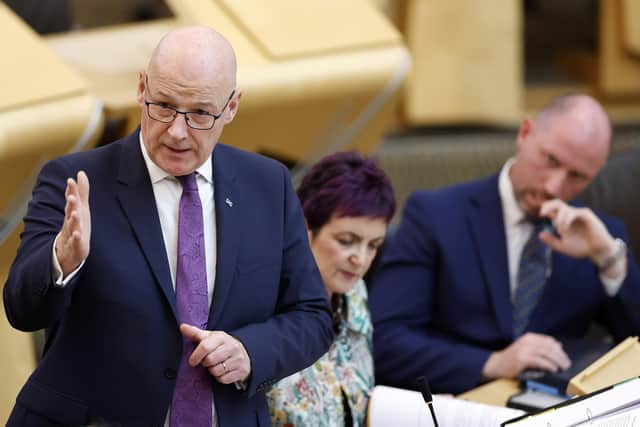
“The pilot will be led by Sheriff Principal Wade in the Tayside Central and Fife Sheriffdom. Subject to robust local arrangements put in place to ensure public safety, we anticipate the pilot being able to commence next year.”
He later clarified that he hoped the pilot could begin “by the New Year”.
Scottish Labour acting leader, Jackie Baillie, called out Reform UK for spreading "misinformation" around race and opposing all men being confronted about behaviours causing violence against women and girls.
Dame Jackie, who earlier this month called for tagging to be used, warned that “Community Justice Scotland first called for GPS tracking a decade ago”.

She added: “We have promises in place in Scotland, but it is all about delivery.
“We all remember the horrific murder of Stacy Hunter earlier this year - killed by her abusive partner who was not being properly tracked while on bail.
“Her family have bravely led the calls for GPS implementation and I’m glad that John Swinney has listened to them.”
But she warned that “the government has been slow to act”.
Dame Jackie said: “We must move beyond warm words and instead act now before it is too late for other women.”
Carol Eden, head of external affairs at Victim Support Scotland, warned that GPS tracking was “not a catch-all solution”.
She added: “We reiterate our deep concerns about the safeguards in relation to bail, specifically the removal of Section 23D of the Bail and Release from Custody Act. Clearly, more needs to be done to protect women who are subject to domestic violence in particular, including strengthening risk assessments and incorporating victim feedback.”
Rape Crisis Scotland external affairs manager, Nicola Love, stressed that the “tangible crisis” of violence against women and girls “needs a tangible response”.
She added: “While the Scottish government has committed to putting laws into action and increasing support for frontline services, there is still a gap where clear funding commitments and timescales for implementation should be.
“While the confirmation of overdue safeguarding measures such as GPS bail monitoring being piloted is welcome, we remain seriously concerned about the implications of early prisoner release proposals – both in terms of survivors’ safety and their overall confidence in the criminal justice process.”
Comments
Want to join the conversation? Please or to comment on this article.