
John Swinney 'very concerned' about Russian threat in North Atlantic and UK Government's ability to respond

Three Russian submarines conducted a ‘covert’ operation on UK subsea infrastructure, according to the UK defence secretary.
John Swinney says he is concerned the UK Government “doesn’t have the capability” to deal with the Russian threat in the North Atlantic.
The First Minister said he has had no briefing on the threat from the UK Government, and has made his “frustration” at the lack of cooperation between the two governments on this issue clear.
On Thursday UK Defence Secretary John Healey said three Russian submarines conducted a “covert” operation on cables and pipelines in northern UK waters. A British warship and aircraft were deployed to deter the vessels, and the defence secretary told Russian President Vladimir Putin that attempts to damage key subsea infrastructure “will not be tolerated and will have serious consequences”.
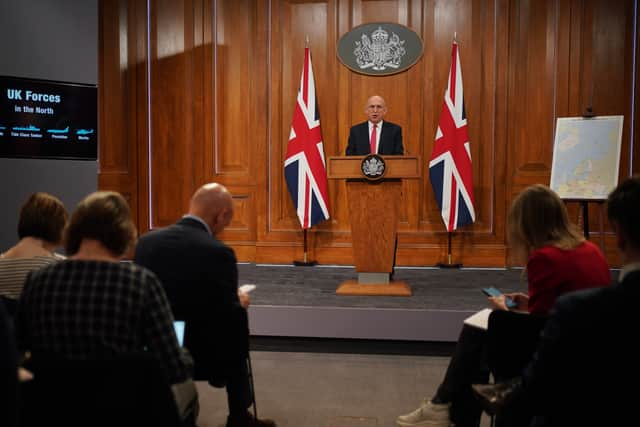

Mr Swinney said he is “very concerned” about Russia’s presence in the North Atlantic, as the subsea infrastructure is “vital to our interests”.
Speaking during a campaign visit in Inverness, Mr Swinney said: “I am very concerned about the presence of Russian vessels in the North Atlantic.
“There is significant communication and energy infrastructure that is vital to our interests that need to be protected from threats levelled by the actions of the Russian navy who can damage the infrastructure of our country.”
He said he has had “no briefing from the UK Government on this threat”, but has asked for better cooperation between the two governments on defence.
Mr Swinney said: “I’ve made it clear my frustration at the level of interaction between the Scottish and UK governments on the issue of national security.

“I benefit from individual briefings which I am grateful for, but there needs to be more partnership and more dialogue.
“Look at the Bella-1 tanker - it didn’t take long for an issue in the high seas to come to the Moray Firth.”
His comments refer to a tanker linked to Venezuelan oil which was accused of breaking US sanctions on shipping Iranian oil and was intercepted in waters between Scotland and Iceland earlier this year.
It was since moved to the Moray Firth and US authorities later took control of the vessel and moved it to the US.
Mr Swinney added: “I am concerned the UK Government doesn’t have the capacity to deal with the threat in the North Atlantic. We should be investing in protecting our infrastructure rather than in nuclear weapons we can’t use and which are prohibitively expensive.”
Defence secretary Mr Healey said Russia sent an Akula class submarine as a diversionary tactic, allowing two GUGI spy submarines to carry out surveillance of the UK’s undersea cables, which carry more than 90 per cent of the UK’s daily internet traffic.
It is understood the attack submarine left the UK waters and went back to Russia, but the two surveillance submarines remained.
The Royal Navy deployed frigate HMS St Albans, fuel tanker RFA Tidespring, and anti-submarine Merlin helicopters to track all three submarines. Other nations, including Norway, were also involved in tracking these submarines.
However Moscow state news agency Tass denies these claims and reported the embassy said Russia was “not threatening underwater infrastructure, which is truly critical to the UK - we are not using aggressive rhetoric in this regard”.
Comments
Want to join the conversation? Please or to comment on this article.