
John Swinney urged to ditch 'eye-watering' mansion tax plans

The First Minister’s programme for government includes legislation to introduce two new council tax bands
John Swinney has been urged to ditch plans for “eye-watering” council tax hikes for Scots in high-value properties.
The First Minister’s programme for government confirms legislation will be introduced in the coming months to bring in two new bands for properties worth more than £1 million by April 2028.
But the Scottish Conservatives warned the move would do "lasting damage to the housing market” while raising only a “tiny amount”.
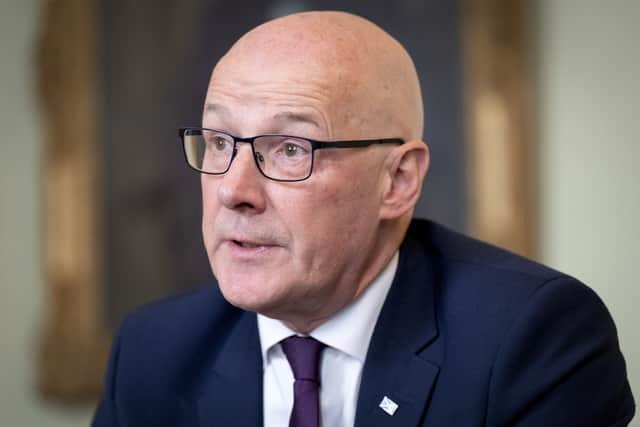

The so-called “mansion tax” was first announced in January and could see Scots in properties valued at more than £2 million facing an annual charge of £7,650.
Homes are currently put in bands A to H for council tax purposes, but the change would see the creation of Band I for properties classed as being worth between £1 million and £2 million, and Band J for those worth more than £2 million.
Residents in such homes could find themselves having to pay an annual council tax bill of “around £4,770” for Band I, with this rising to “around £7,650” in Band J, modelling shows.
Due to the relatively small number of properties involved, the new bands are estimated to raise between £12 million and £16 million per year. This compares to the £3.5 billion expected to be raised in council tax this year in total.
Scottish Conservative finance spokesman Craig Hoy called on Mr Swinney to ditch the “performative proposals”.
He said: “The SNP are clearly hellbent on pressing ahead with these punitive measures that will deliver eye-watering increases in council tax bills for many Scots.
“Their plans for hiking council tax simply do not stand up to scrutiny. Even their own consultation plans revealed the tiny amount it will raise for our struggling public services.
“And the nationalists could go even further. They are looking into revaluing all council tax bands meaning higher bills could be on the way for all taxpayers.
“Introducing new taxes is the nationalists’ only answer to try and plug the £5 billion gap they have created in Scotland’s finances.
“Hard-pressed Scots have had enough of always paying more but getting less in return when it comes to local services.
“Swinney needs to ditch these performative proposals and instead focus on finally delivering a fair funding deal for cash-strapped councils, by cutting his ballooning benefits bill.
“These plans could also do lasting damage to the housing market and put off people from investing in Scotland, which would be a hammer blow for Scotland’s economy which is already stagnating under the SNP’s high-tax policies.”
The programme for government says the Council Tax (Scotland) Bill will address “a longstanding concern that the highest-value properties can currently pay the same level of council tax despite substantial differences in market value”.
It adds: “It therefore improves fairness and proportionality at the upper end of the tax base whilst affecting only a small proportion of properties.
“The legislation also provides an opportunity to modernise aspects of the council tax framework and increase local flexibility through discretionary powers for local authorities.”
A consultation published earlier this year said properties valued at more than £1 million would pay around £720 more per year under the plans, with those worth more than £2 million charged an extra £3,600.
A Scottish government spokesperson said it has “delivered a range of improvements to make council tax fairer and more affordable, including supporting those on the lowest incomes through the council tax reduction scheme, with around 460,000 households saving £900 per year on average”.
They added: “Ministers have also enabled councils to increase charges for second properties.
“The introduction of a mansion tax on the most expensive properties will raise millions in additional funding each year for local public services by requiring those who have the most to contribute more.
“Council tax reform requires political consensus and the Scottish government is working cross party to build a shared agreement on the future of council tax in Scotland.”
It came as Mr Swinney admitted job losses are inevitable as he embarks on a programme of major reforms to the public sector.
However, he insisted there is “no question” of workers facing compulsory redundancy as he seeks to slash Scotland’s NHS boards from 14 to two.
Unions accused the First Minister of setting out a "slash and burn programme" that will inevitably result in "swingeing cuts and thousands of job losses".
Unite warned it would not stand by and allow its workers to be “attacked”, paving the way for potentially disruptive industrial action.
But Mr Swinney said the Scottish government would “work very closely” with unions as it embarks on the changes.
“I have said that for all the time I have been First Minister there will be a need for public sector employment to fall,” he told BBC Radio Scotland’s breakfast programme.
Mr Swinney refused to be drawn on how many jobs could go, but insisted ministers would “work collaboratively” with trade unions as the country moves “toward the two-board approach”.
He said: ”We have got to make sure is that we work with the trade unions to undertake a reform programme.
“That will mean a reduction in public sector employment and that is part of what we have face up to as we adapt the health service to meet the needs of the population.”
Elsewhere, Jenny Gilruth, the Deputy First Minister and Finance Secretary, said drafting the next Scottish budget will be “extremely challenging” amid tight fiscal conditions. The Scottish Fiscal Commission has warned the funding outlook for the next financial year is “exceptionally tight”.
Speaking to journalists, Ms Gilruth said: “It will be extremely challenging, and I don’t shy away from that challenge. The SFC are correct to point to the challenges.
“I would also say there are great opportunities in the budget to improve the lives of the people of Scotland, the people we all represent.”
Comments
Want to join the conversation? Please or to comment on this article.