
Exclusive:Scottish elections: John Swinney poised to shun Reform MSPs at Holyrood if SNP returned to power
The SNP could refuse to work with Reform MSPs through previously-established Holyrood cross-party working conventions if John Swinney is returned to power


John Swinney has vowed he will shun Reform MSPs outwith any official parliamentary “duties” if he is re-elected and Nigel Farage’s party sees MSPs enter Holyrood.
The SNP leader is poised to shut out Reform MSPs from any cross-party workings or arrangements as he moves to distance himself from the controversial right-wing party.
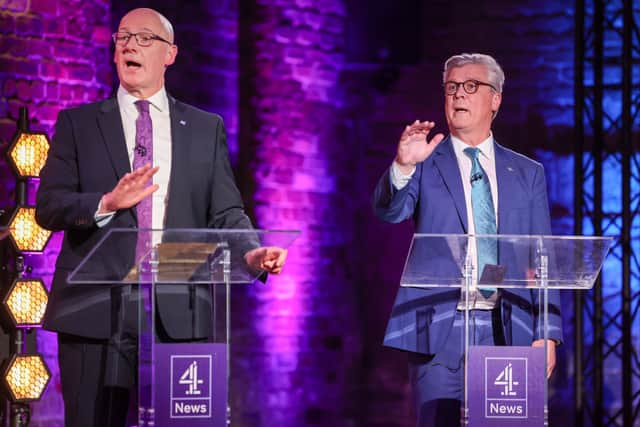
The vow comes as polls show Reform could secure as many as 20 seats in the next Scottish Parliament and could form the second biggest party behind the SNP, according to some forecasts.
Amid speculation during the campaign that Scottish Labour leader Anas Sarwar could do a deal with Reform UK Scotland leader Malcolm Offord to become first minister in a pro-unionist bloc, Mr Swinney told The Scotsman that outwith his official duties in the ministerial code and the Scottish Parliament standing orders, the SNP will not engage with Reform politicians if they are re-elected to office.
Mr Farage has previously suggested the Scottish Parliament should be defunded and Mr Swinney has branded Reform “a threat to devolution”.
Follow The Scotsman’s LIVE blog bringing you all the results from the Scottish Parliament election 2026
Normally, the first, second and third biggest parties at Holyrood are given roles such as convening the Scottish Parliament’s committees or cross-party working groups and boards.
This had previously been arranged in deals between the parties.
But before Holyrood dissolved for the election, MSPs passed rules that conveners will be elected by politicians. The Scottish Parliament’s standing orders state that “in proposing a member to be a committee member”, the cross-party parliamentary bureau “shall have regard to the balance of political parties”.

Opposition parties are also given an allocation of parliamentary debate time in agreement with the bureau, but the SNP and other parties could block Reform from being able to set the Holyrood agenda.
A senior SNP source has suggested the party would shy away from giving Reform parliamentary debate time and responsibilities established through convention.
Asked by The Scotsman if in the next parliament the SNP under his leadership will engage with Reform outwith required duties, if he is returned to office, Mr Swinney said: “I’ll have to fulfil my duties in terms of the ministerial code, which requires me to answer questions, to engage in parliamentary debates and all the requirements of the ministerial code.
“I can’t avoid that because I’ll breach the ministerial code.”

He added: “On the whole area of policy agreement or co-operation, I won’t be co-operating with Reform in any way, shape or form.”
If returned to office, Mr Swinney and SNP ministers would be required to answer official parliamentary questions put to them by Reform politicians, as well as dealing with the party as part of legislative processes.
A senior SNP source said: “We’ve said we won’t engage with Reform.”
They added: “We’re not obliged to engage with them and we won’t.
“They have a right to come in and do their function as MSPs. Ministers will be obliged to answer questions and FMQs. We’re not obliged to engage with them.
“We are not in the business of engaging and doing deals with Reform, whether it’s in a convention setting, whether it’s sought-for votes or unsought-for votes, we’re not in that business.”
Scottish Labour leader Anas Sarwar has insisted he will not work with Reform, stating he hopes “Reform get pumped” at the election. The Scottish Conservatives have also distanced themselves from any tie-up with Mr Farage’ party, while the Scottish Greens and Scottish Lib Dems have also indicated that they would turn their backs on working with Reform.
Earlier this week, Mr Sarwar branded Reform UK as “a bunch of cranks and rejects” after being “disgusted and repulsed” by the party’s ideas.
Mr Sarwar said Reform did not have a “serious or credible plan for change” as he accused the party of “playing on people’s legitimate concerns for their own political ends”.
Reform has caused controversy during the toxic election campaign for its plans, particularly around immigration and asylum, a policy reserved to Westminster - previously criticising children in Glasgow for being bilingual and this week planning to set up detention centres for irregular migrants in constituencies that elect Green representatives.

Reform candidate for Glasgow, Thomas Kerr said: “It speaks volumes that not a single vote has been counted yet John Swinney has come out saying he refuses to engage and cooperate with another democratically elected party.”
“I’ll survive without a few new crackpot pals anyway - we’re going in to shake the place up, not join Swinney’s cosy consensus.”
A projection by the pollster Diffley Partnership predicts the SNP will fall nine seats short of a majority but will be the largest party by far, with 56 MSPs.
But the Scottish Parliament would have a pro-independence majority as the Greens have 16 MSPs.
The projection collated five polls from earlier days leading up to the election.
The SNP was predicted to be well ahead of Reform in second on 19 MSPs. Labour was one behind on 18, with the Greens two behind in fourth.
The Conservatives dropped to fifth with 11 seats and the Liberal Democrats were predicted to win nine.
If the projection is correct, it would mean the SNP has lost eight seats compared to 2021. Labour would be down four, and the Conservatives would be down 20 MSPs.
The Greens would double their numbers from eight and the Lib Dems would gain five.
Mr Swinney yesterday voted in Burrelton in Blairgowrie with his wife Elizabeth.
Mr Sarwar voted at Pollokshields Burgh Hall in Glasgow, accompanied by his wife Furheen and their two sons.
Mr Offord cast his ballot at St James’ Church in Edinburgh, and Scottish Liberal Democrat leader Alex Cole-Hamilton was at Davidson’s Mains Parish Church in Edinburgh, accompanied by wife Gill and dog Bramble.
Scottish Conservative leader Russell Findlay arrived by bicycle at the polling station at Cleveden Secondary School in Glasgow.
And Gillian Mackay, co-leader of the Scottish Greens, voted at Laurieston Community Hall near Falkirk, accompanied by her partner Alex and their son.
Before the polls opened, Mr Swinney said the election was “Scotland’s opportunity to choose a better future by voting SNP for real action on the cost of living, to lock Nigel Farage out of power, and to secure a fresh start with independence”.
SNP Westminster leader Stephen Flynn – who is a candidate for Holyrood – said the ballot offers people the prospect of the “fresh start of independence”.
Mr Flynn said: “The increasingly unaffordable cost of living in the UK has defined this election. Brexit Britain is broken, and Scotland is trapped in a never-ending cycle of soaring bills and constant chaos under Westminster control.
“The fresh start of independence is the opportunity Scotland can’t afford to miss.”
Comments
Want to join the conversation? Please or to comment on this article.