
John Swinney refuses to rule out freezing income tax thresholds in Scotland

The First Minister said he would not comment on the Scottish Government’s tax and spending plans
John Swinney has refused to rule out freezing income tax thresholds in the upcoming Scottish Budget.
The First Minister said he would not comment on the Scottish Government’s tax and spending plans ahead of time.
However, he said they will be “hugely influenced” by the decisions taken by UK Chancellor Rachel Reeves in her autumn statement at the end of this month.
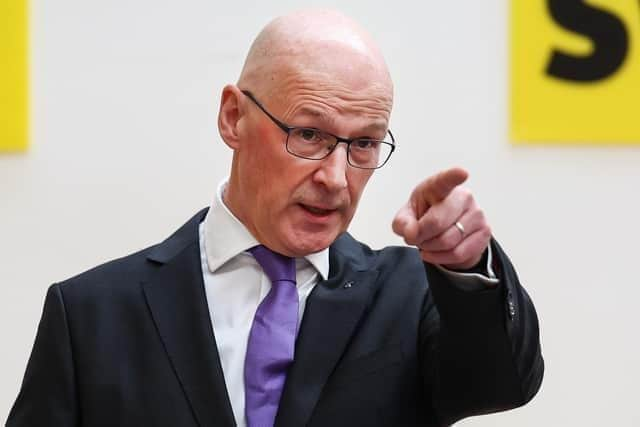

Speaking at an event at the Edinburgh Futures Institute, Mr Swinney said the rest of the UK should mirror Scotland by raising taxes on higher earners.
He also called on Ms Reeves to change her fiscal rules to allow for more borrowing to fund public services. He said the Chancellor should raise the 3 per cent cap on public sector borrowing, and warned an austerity approach would be “disastrous”.
Shona Robison, the SNP finance secretary, announced up to £500 million of cuts in the summer to plug a financial black hole in Scotland’s finances. Meanwhile, Ms Reeves has said she faces a £22 billion budget black hole left over by the previous government.
Speaking to journalists after a speech in Edinburgh on Monday, the First Minister was asked if he could rule out freezing tax thresholds in Scotland.
“I’m not going to rule anything in or out about the Budget,” he said. “We’ve obviously got a process to go through which is hugely influenced by the outcome of the UK Budget process.
“What I will say is that there is a clear interaction between where the UK Government is, what choices it faces, and the issues that we are wrestling with. And obviously we’ll consider all these issues in the period up until December 4 when we set our Budget.”
In last year’s Scottish Budget, the thresholds at which people start to pay the lower bands of income tax rose in line with inflation but the thresholds for the higher rate - £43,662 - and top rate - £125,140 - were maintained at current levels.
This was the fourth Budget in a row in which the higher rate was frozen, meaning more Scots were dragged into paying more tax as wages rose.
Asked if he accepted that freezing thresholds would in effect be raising taxes on workers, Mr Swinney said: “Obviously there will be some people that are impacted as a consequence of that, yes.”
Ms Reeves is looking to raise up to £40 billion through tax hikes and spending cuts in her autumn Budget at the end of the month. But she has faced a backlash from within her own party with some ministers unhappy at being asked to reduce spending by as much as 20 per cent.
The Chancellor said the final settlements had been confirmed but acknowledged it had been “right for all Cabinet members to want to get the best settlement for their departments”.
She added that settling departmental budgets was “an important achievement and shows the determination of this Government to get a grip of the public finances, and shows that we are as one, united in fixing the mess that the Conservatives left for us”.
Ms Reeves said her Budget would be “honest” about the state of the public finances and what needed to be done to put them “on a firm footing”, while doing “everything within our power” to protect living standards and the NHS.
The health service is one of the few departments expected to emerge as a winner from the Budget process, with reports suggesting it will receive a significant real-terms increase in funding.
Elsewhere, the Chancellor is reportedly considering increasing national insurance contributions for employers. The Labour manifesto had ruled out raising national insurance, income tax or VAT – but it stressed that it did not want to raise taxes on “workers”.
Mr Swinney warned against an increase in employers’ national insurance without compensation for public bodies. He said any increase would mean public bodies – such as the NHS or councils – paying a higher tax bill.
He said: “I can see where the UK Government is going, but I am simply making the point that if they are going to go there, they’ve got to be open with people that they’re either increasing public expenditure to take account of that or they’re essentially undermining public expenditure by the back door.
“Because if employers’ national insurance contributions go up in the United Kingdom then that will have to be paid for by public sector bodies. And unless public expenditure goes up to an extent to compensate for that and more we’re actually no better off as a consequence.”
Earlier, Mr Swinney said the UK Government should copy Scotland by raising taxes on higher earners.
“There’s no easy way through this,” he said. “More revenues have got to be raised, and I think they have to be raised through taxation.
“If the UK Government echoed the steps that we have taken in Scotland, I would estimate they would probably raise about £20 billion.”
The last Scottish Budget introduced a new 45 per cent tax band for those earning between £75,000 and £125,140, while also adding 1p to the top rate.
Anyone earning more than £28,867 in Scotland pays more than they would elsewhere in the UK. Those earning £50,000 pay £1,542 more.
Earlier this month, the governing body for London's financial district urged SNP ministers to narrow this tax gap between Scotland and England.
Chris Hayward, policy chairman at the City of London Corporation, told The Scotsman there were ongoing concerns within the financial sector over the tax regime.
He previously said the tax disparity north and south of the Border was a source of “significant concern” in the financial sector and a “risk to Scottish jobs”.
Comments
Want to join the conversation? Please or to comment on this article.