
John Swinney drops commitment not to increase income tax in Scotland

The First Minister was repeatedly asked about possible tax increases in Holyrood
John Swinney appears to have dropped a commitment not to increase income tax in Scotland next year, citing “changing circumstances”.
The First Minister repeatedly failed to rule out tax hikes when quizzed by Scottish Conservative leader Russell Findlay in Holyrood on Thursday.
Mr Findlay accused him of “plotting yet another income tax raid on hard-working Scots”.
It comes amid speculation Chancellor Rachel Reeves could be preparing to increase the basic rate of income tax down south.


Income tax rates and thresholds are devolved to Holyrood, but such a move could still have a big impact on Scotland’s block grant.
An additional 2p on the UK basic rate would cost the Scottish Government £1 billion next year, according to the respected Fraser of Allander Institute (FAI).
Last week, Mr Swinney ruled out any changes to income tax in the Scottish Budget, which is due to be published in January.
He told journalists: "We've said that there won't be any changes to income tax in the remainder of this Parliament. The Finance Secretary made that commitment at the Budget last December, so I'm very happy to reinforce that point today."
However, he notably failed to repeat this pledge during First Minister’s Questions in Holyrood.
In an analysis published last week, the FAI said there was “no free lunch here”, adding: “If UK income tax rates are raised, either the Scottish Government will have to spend less or Scottish taxpayers will also have to pay more tax – it’s just arithmetic.”
Mr Findlay said tax rises would be “a hammer blow to Scottish workers”, adding: “Labour are doing the same as the SNP have done for the past decade. Most workers in Scotland pay more than those in the rest of the UK who do the same job and earn the same amount.
“The SNP has increased taxes, driven away aspirational workers, damaged business confidence and held back Scotland’s economy. People deserve a break.
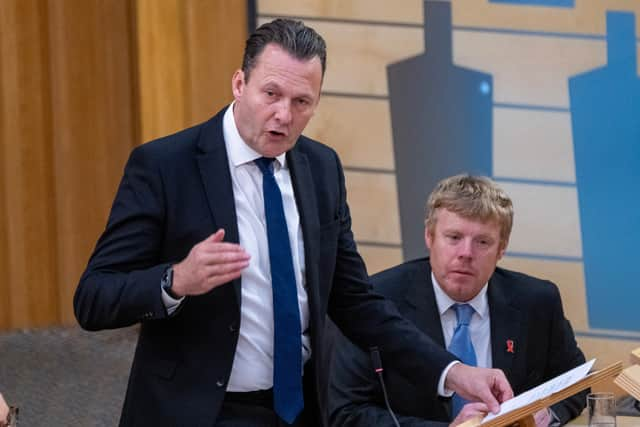
“So will John Swinney give a cast-iron guarantee of no further tax rises - income, business and property - in the Scottish Budget?”
The First Minister replied: “Mr Findlay won’t be surprised to hear me say that these questions will be answered in the Budget, when the Scottish Government sets out to Parliament the commitments that we are going to make.
“And, of course, we have asked some people in Scotland to pay more in taxation. But what I would say is that the independent Scottish Fiscal Commission has confirmed that the majority of taxpayers in Scotland are set to pay less than they would elsewhere in the UK this year.”
Anyone earning more than £30,318 pays more income tax in Scotland than if they lived south of the Border. Someone earning £50,000 pays £1,527 more, and a person earning £100,000 pays £3,331 more.
Mr Swinney said these taxes helped to pay for different provisions in Scotland, adding: “They mean that there are no tuition fees paid in our universities by university students. They mean that there is free bus travel for under-22s.
“They mean that there are no prescription charges levied in Scotland. They mean that the Scottish Child Payment is helping to keep children out of poverty with a falling level of child poverty in Scotland.”
Mr Findlay accused the First Minister of “spinning like a washing machine”.
He said: “John Swinney’s answers today won’t reassure any Scottish worker, homeowner or business owner. He won’t rule out increasing the tax on buying a home, he won’t rule out raising taxes on businesses, and it seems that he’s plotting yet another income tax raid on hard-working Scots.
“And on top of all that, the SNP’s plans could result in massive rises to council tax - reportedly as high as £6,500 a year.
“Raising taxes every year is not sustainable. Workers and businesses can’t afford it. People deserve to keep more of their own hard-earned cash.”
Mr Swinney said council tax in Scotland was lower on average than in England, and accused the Tories of not being prepared to engage “in the tough judgements about delivering for public services”.
Speaking to journalists afterwards, the First Minister said circumstances had changed.
“We are dealing with a huge amount of speculation about the UK government’s position and that raises uncertainties for us about what the tax position may well be after the UK Budget,” he said.
“So what we say in tax strategy is we do not plan any increases in rates or bands during this parliamentary term. But we also need to look at the context of what we face, which is what we are doing and we will set that out in the budget.”
Mr Swinney added: “That’s the policy position of the Scottish Government, but we also have to recognise the changing landscape around about us, which is being fuelled by the Chancellor.
“As Russell Findlay said in comments today, in her Budget last year she said she wouldn’t come back to make any other changes during this Parliament.
“That was my understanding of her position and there has been a tremendous moving of the ground since then, so we need to look at the changes and the changing circumstances.
“Our income tax position and tax bands will be set out in January and that is when you will get answers.”
The First Minister continued: “We’re simply looking at the changing lie of the land and finding ways for the Scottish Government to respond to that.”
Mr Findlay said these comments rendered worthless the pledge Mr Swinney made a week ago.
“His latest tax U-turn will strike fear into the hearts of workers who are constantly forced to pay more while getting less,” he said. “They will see through Swinney’s excuse for his U-turn.”
Comments
Want to join the conversation? Please or to comment on this article.