
John Swinney did not raise Covid exam results scandal with SQA despite warnings
The First Minister was warned in a July 2020 letter that the poorest Scots would be punished by the SQA’s moderation system - but did not speak to the SQA about it.


John Swinney did not raise the Covid exams scandal with the Scottish Qualifications Authority (SQA) despite being warned about it weeks before the results were published.
The First Minister was warned in a July 2020 letter the poorest Scots would be punished by the SQA’s moderation system.
But in a hearing at the UK Covid Inquiry on Thursday, Mr Swinney admitted he had not raised the problem with the SQA “because I was taking the view that I had essentially commissioned the SQA to undertake the design of an alternative certification model”.
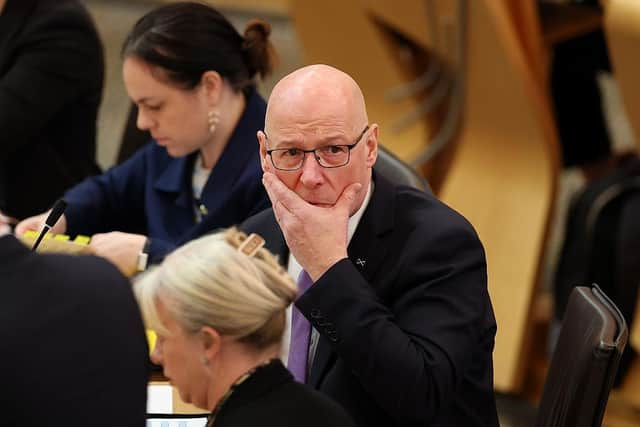
Mr Swinney was accused by KC Clair Dobbin of being a “bystander”, but said he “wouldn’t characterise it as that”.
Some 125,000 estimated Scottish exam grades were lowered by the SQA when the results came out in August 2020.
Previous results were taken into consideration, meaning that schools in more affluent areas had their results bumped up, while those in poorer areas were punished.
The results were upgraded a week later after a public backlash during which Mr Swinney faced calls to resign as education secretary. The results had been moderated because no exams had taken place due to the Covid pandemic.
During the hearing at the UK Covid Inquiry, Ms Dobbin raised a letter from then Labour MSP Johann Lamont, who had written to the First Minister to warn him about the grading system.
Ms Lamont said in her letter, which detailed comments from her constituents: “The SQA is going to change pupils grades to ensure attainment is in line with the ‘prior attainment’ of that centre.
“This will disproportionately punish schools in more deprived communities whilst simultaneously over rewarding schools in more affluent communities. This is because the pass rate in the former is historically lower than the latter.”
When asked if the issue had been drawn to his attention in July 2020, Mr Swinney replied: “Yes.” Ms Dobbin said: “This isn’t any sort of complicated issue about an algorithm is it?
“What’s being pointed out to you is a principled problem with the approach that was going to be taken, correct?”
Mr Swinney said: “I think that’s a way of describing it, yes.”
Ms Dobbin said: “It would appear that Ms Lamont’s constituents were able to point out this problem to you, yes?”
Mr Swinney replied: “Yes. But I think that if ... going back to the point that was made earlier about the communication from the SQA, I think that it was far from certain that that would be the case. Or that could not be demonstrated at that time.”
Ms Dobbin said: “Did you raise this concern with the SQA? Did you say ‘look, ordinary people are pointing out there’s a problem with the approach you’re taking. can you tell me about it?’”
Mr Swinney said: “I don’t recall doing that because I was taking the view that I had essentially commissioned the SQA to undertake the design of an alternative certification model.
“And to make sure that all of principles that we rehearsed earlier on about fairness, about the delivery of reliable qualifications, about the reflection of attainment, that the SQA would be operating to fulfil that mandate.”
Ms Dobbin said: “So you’re a bystander essentially. People can tell you there’s a problem here and you can do nothing about it. Is that right?”
Mr Swinney replied: “I wouldn’t characterise it as that. It’s respecting the fact that there is an approach taken in Scotland, which was that we should have qualifications certificated by an external body and that external body should apply professional judgment to enable that to be undertaken in the interests of fairness to all learners.”
Comments
Want to join the conversation? Please or to comment on this article.