
Inside the political web spun by Sarwar on that seismic Monday afternoon
Three competing comms operations swung into action around Sarwar’s bombshell call for Keir Starmer to resign - the third being deployed at remarkable speed to save the PM, writes Alan Roden
It was 12.44pm last Monday when all hell broke loose within the Labour Party.
A short ‘operational note’ to the media, which stated simply that Anas Sarwar would be holding a press conference, sent the UK’s political establishment into meltdown.
For a few short and compelling hours, there was a very real possibility that the Prime Minister of the United Kingdom would be forced to depart Downing Street.
Yet nearly a week on, today he will feel more secure in his role than he has for months.
This is the remarkable tale of three competing comms operations – all within the same political party – which shaped British political history within a few hours on one dramatic Monday afternoon.
Frustration with Keir Starmer had clearly reached boiling point the previous Thursday.
Anas Sarwar had once again made life deeply uncomfortable for John Swinney at First Minister's Questions in Holyrood with his forensic questioning about the cover-up at the Queen Elizabeth University Hospital.
But conversations on the doorsteps with voters were focused elsewhere: Mandelson, Epstein, and Starmer.
Behind in the polls, Sarwar decided enough was enough.
Conversations were held with only a very small number of confidantes before the ‘op note’ was issued on Monday afternoon.
Most MPs and MSPs were in the dark, as were staff.
Once the decision was made, which was Sarwar’s alone, there was time for a few phone calls: chiefly to the Prime Minister, which must have been an extraordinarily difficult conversation for the two men.


The op note told its own story; and the comms team around Sarwar was silent enough to give journalists the confidence they needed to know a bombshell announcement was coming.
As it was a Monday, many members of the Scottish lobby were already in Glasgow – others were seen running from Holyrood to make a ScotRail train to the west.
Shortly after 2.30pm, Sarwar stepped out to face the media – with a speech he penned himself.
“The leadership in Downing Street needs to change,” he told the assembled media.
It was a bold comms operation, entirely separate to the frenetic activity in Westminster that it triggered.
While it may have been rushed, the press conference had all the hallmarks of Sarwar’s pitch to voters: a giant Saltire and more mentions of the word ‘Scotland’ than anyone can be bothered to count.
The commentariat watching on from Westminster didn’t get it.

But this was a decision made with a laser-like focus on the Holyrood election, and what the party believes voters in Scotland want to hear. The coming weeks will determine whether Sarwar has made the right call.
Most Scottish Labour MPs remain adamant – in public anyway – that it was a mistake.
So when the op note on Monday was issued, the WhatsApps were flying between MPs trying to figure out the game plan – and some tried phoning Sarwar to urge him to change his mind.
Meanwhile, a separate – but supportive – comms operation kicked into gear.
It is no secret that Wes Streeting wants to be PM.
His Westminster backers were thrilled when news broke of Sarwar’s impending announcement and believed this would bring down Starmer within hours.

The PM, a thoroughly decent public servant, would reflect very carefully on Sarwar’s words – or so they thought.
What was supposed to happen next depends on which version of events you believe, but Westminster insiders claim some junior government resignations were expected, perhaps an intervention from the Welsh First Minister, and then Starmer’s fate would be sealed.
Sarwar was not part of any plan – but it’s clear that a separate comms operation had quickly formulated in Westminster around his decision.
There was, for an hour or so, a firm belief within the ‘bubble’ that the Prime Minister would be gone by the evening.
But as the political web was spun, this second comms outfit underestimated a third comms team that had been deployed in the heart of Downing Street.
Whether ministers were ordered to tweet or face the sack is disputed, but the pace at which the Cabinet came out in support for Starmer was remarkable.
Giddy Westminster journalists had barely built their spreadsheets before the entire Cabinet had rallied behind the PM.
They did so, deliberately, on the X social media platform: that’s where the political journalists reside who shape the narrative.
It was a comms fightback unrivalled in British politics in modern times. And by mid-afternoon, Starmer was safe.
Even Streeting told the media: “The Prime Minister has got my full support.”
Starmer went to a meeting of the Parliamentary Labour Party (PLP) a few hours later to be met with a standing ovation and loud applause.
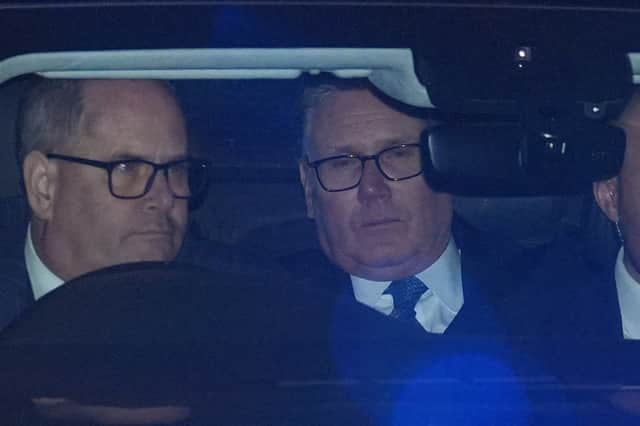
And the remarkable tale of three competing comms operations – all within the same political party – came to an end just as quickly as it had started.
The winner? Starmer – for now anyway. Until memoirs are published, we will never quite know what happened behind closed doors to ensure that a full Cabinet came out so quickly in support of the PM.
But we do know it was decisive. Whether it is just a ‘stay of execution’ will become clear in the weeks ahead.
The immediate loser? Streeting. The comms operation led by his allies didn’t even get going before it was snuffed out by a nimbler outfit in Number 10.

As for Sarwar, the jury is out. It was a bold move, deploying all the modern comms tactics of ‘flooding the zone’ to get attention, yet laced with risk.
Viewed through a Westminster lens it has been depicted as a ‘failed coup attempt’, but from a Holyrood viewpoint it truly is unprecedented. Can you imagine Jack McConnell telling Tony Blair to go?
What the past few days have confirmed is that Sarwar is his own man, and he will say whatever he believes is in the best interests of Scotland and the campaign he is running north of the border.
But it’s not until May 8, when the votes are counted, that the impact of those seismic few hours on a Monday afternoon in February will become clear.
Alan Roden is co-founder of political communications agency Quantum Communications and a former communications director for Scottish Labour
Comments
Want to join the conversation? Please or to comment on this article.