
Economists accuse Holyrood parties of 'collective bout of fiscal denial' amid 'unfunded' SNP vows
Economic experts have lambasted all parties vying for votes at next month’s election of failing to fully cost their plans amid a bleak financial backdrop.

Scotland's political parties have been accused of a "collective bout of fiscal denial" after economists warned spending plans put to voters do not add up.
The Fraser of Allander Institute (FAI) at Strathclyde University has warned that the SNP’s manifesto, unveiled by John Swinney in Glasgow on Thursday, contained “several billion pounds’ worth of unfunded pledges”.
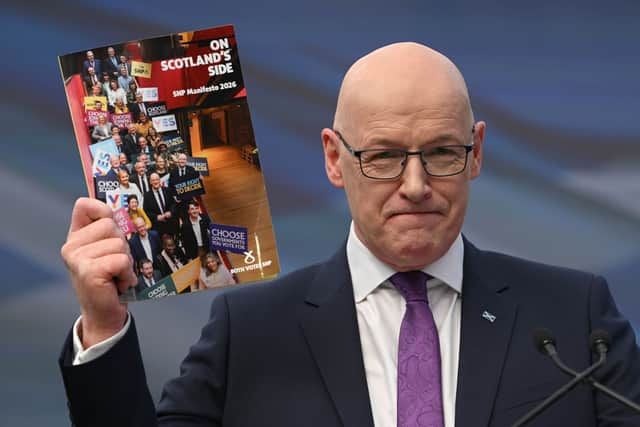

The economists also argued that “it’s almost certain that the Scottish Government does not have the powers to implement” the SNP’s controversial essential food price cap policy.
In a scathing assessment of the SNP and other political parties ahead of next month’s Holyrood election, the FAI economists said Mr Swinney’s spending blueprint was “another manifesto consistent with a collective bout of fiscal denial displayed by Scottish parties across the board”.
They added: “Whether it’s tax cuts paid for by optimistic growth figures, increased spending with no plan for balancing the budget or implausible efficiencies, parties have refused to confront the reality of a Scottish budget already stretched and in need of action to bring it back into structural balance.
“It is possible to spend more with higher taxes, or to cut taxes by reducing the set of public services delivered. But the solution is unlikely to be only on one side of the ledger.”

The stark FAI analysis highlights the SNP’s vow to spend £200m a year to cut NHS waiting times, an increase of £90m to deliver a commitment that no patient will wait longer than 26 weeks for treatment.
Public Health Scotland data indicates that as of February 2026 more than 20,000 patients were waiting more than 52 weeks for treatment.
The FAI warns that the SNP manifesto “does not address where the additional £90 million will come from”.
It adds: “Given the minimal change to tax policy proposed, this implies either reallocation from elsewhere in the budget or a degree of optimism about efficiency savings that is not explained.”
The SNP has also vowed to invest £4.9bn in housebuilding over the next four years.
The FA has cautioned that the party’s manifesto “does not clarify whether this is additional funding or a continuation of existing capital commitments”.
The analysis adds: “Given that the SNP have failed to deliver their previous housebuilding target with the existing budget it raises the questions as to whether the 2032 target is achievable either, without additional funding.”
Mr Swinney also announced plans to cap all bus fares at £2, but the FAI has warned the policy is “an ongoing revenue commitment whose annual cost is not quantified”, adding that “the manifesto does not identify a funding source”.
The analysis adds that the SNP’s plans contain “several billion pounds’ worth of unfunded pledges, which are yet to be recognised and prioritised”.
The FAI highlighted Labour’s health spending plans, warning that “the absence of any clear account of how individual policies within the £25 billion envelope are prioritised or funded makes it difficult to assess whether the package as a whole is deliverable”.

The economists added that Labour’s manifesto “seems implausible” that all the policies “could be implemented, especially within the spending envelope that the manifesto implies would be stuck to”.
The FAI said that Labour not claiming it can spend additional funding from more efficiencies was a “welcome grounding in reality”.
The economists said the Conservatives’ plans to cut benefits and boost efficiency savings “lack details”, adding that “efficiency plans seem extremely ambitious, especially while protecting frontline services”.

The FAI warned that there were questions over whether Reform’s plans to cut taxes “add up”, stressing that it was “disheartening to see the mantra of tax cuts paying for themselves with no evidence and little understanding of the constraints of the fiscal framework”.
The Scottish Greens’ were criticised for “a complete lack of costings throughout the manifesto “.

The analysis added: “ As a set of coherent policies, the Scottish Greens’ manifesto is unserious at best.
“The lack of even a cursory attempt at adding up the price tag of such a large change in tax and spending policy makes it impossible to scrutinise its fiscal responsibility in a meaningful way .”
Speaking yesterday, Mr Swinney said his manifesto contained “a range of measures…all about making sure that we take the action we can within our responsibilities”.
Comments
Want to join the conversation? Please or to comment on this article.