
Hamilton by-election: Polls close in crucial Scottish Parliament battle that will shape party fates
All eyes are on Hamilton, Larkhall and Stonehouse, as counting gets underway

It has been called the most important by-election of the devolution era. And for once, that doesn't feel like an exaggeration.
The result in Hamilton, Larkhall and Stonehouse, which is due to be announced in the early hours of Friday morning, will set the scene for next year’s Holyrood election.
The vote is taking place following the death of the SNP MSP Christina McKelvie, who was receiving treatment for breast cancer. She had held the seat since 2011, winning it comfortably in the 2021 Scottish election with a majority of 4,582 over Labour.

Her party is expected to win again, but not because of any real enthusiasm for the Nationalists. Rather, there are wider issues at play. Scottish Labour is suffering because of the unpopularity of Keir Starmer’s UK government.
This is exactly the sort of Central Belt constituency the party needs to win if its leader, Anas Sarwar, is to become the next first minister. But the keys to Bute House, once tantalisingly within reach, seem to be slipping further from his grasp with every passing day.
Labour’s candidate, Davy Russell, has not helped matters. An excruciating interview with STV, in which he was asked 11 times if he backed his party’s winter fuel payment cuts, was widely ridiculed on social media.
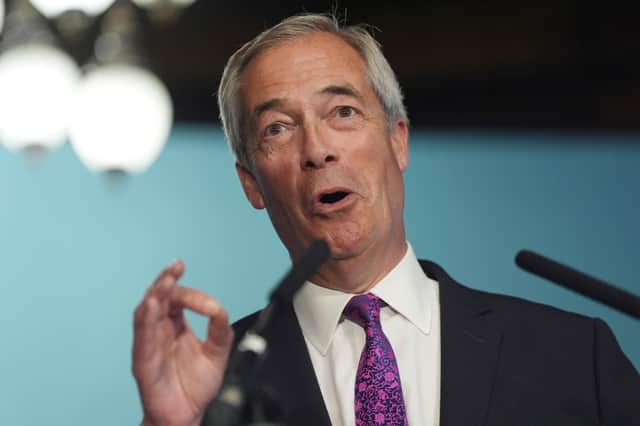
Then there is the rise of Reform UK. Few expect Nigel Farage’s party to win - the man himself called this “improbable” during his trip north on Monday - but it has undoubtedly become a force to be reckoned with in Scotland.
Indeed, the spectre of Mr Farage has dominated the by-election campaign. First Minister John Swinney has repeatedly framed it as a two-horse race between the SNP and Reform.
Mr Sarwar insists this is rubbish. “Don’t believe the spin and the nonsense of John Swinney – this by-election is a two-horse race between Scottish Labour and the SNP,” he told voters.
Meanwhile, a Reform advert claiming Mr Sarwar wanted to “prioritise the Pakistani community" sparked a racism row.
The most likely result is an SNP victory with Labour in second place. However, there is widespread speculation Reform could finish ahead of Mr Sarwar’s party.
That would be a remarkable result and would signal a breakthrough at next year’s Holyrood election. Polls already suggest Reform is on course for upwards of a dozen MSPs.
An outright victory for Reform, of course, would hit Holyrood like an earthquake.
Elsewhere, the Scottish Tories are widely expected to suffer at the hands of Mr Farage, whose party is further splitting the unionist vote, potentially helping the SNP to victory.
Turnout will be key. Will those voters who are sick of the mainstream parties, and who view Reform as a chance to make their anger felt, actually head to the polling booths?
By-elections can be hard to predict. They don’t always match the national narrative and there are local issues to consider. But sometimes they take on a significance that echoes far beyond their constituency boundaries.
You don’t even have to look far for an example. After all, Winnie Ewing’s victory for the SNP in the Hamilton by-election of 1967 went down in Scottish political history.
Comments
Want to join the conversation? Please or to comment on this article.