
Glasgow University student has bid to evacuate family from Gaza rejected by UK government

David Lammy has spoken on a case involving a Gaza woman who is due to study a PhD at Glasgow University.
Deputy Prime Minister David Lammy has blamed Israel for the UK government’s decision to block a Glasgow student’s bid to evacuate her children from Gaza.
Manar al-Houbi has a place to study for a PhD at Glasgow University and had completed visa applications for her husband and three children, who are aged three, five and ten.
However, just days before her evacuation from Gaza, Ms al-Houbi was told her family would no longer be able to travel with her to Scotland.
Mr Lammy has refused to say whether he will overturn this decision. He said it was a decision for the Home Office on a case-by-case basis.
Speaking to BBC’s Sunday with Laura Kuenssberg, Ms al-Houbi said: “This is very, very late after completing all the visa steps for my husband and my three children.
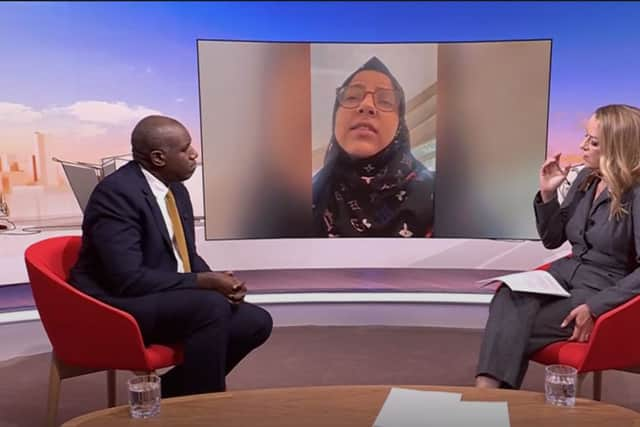

“I was told just days before our evacuation when I received an email from the Foreign, Commonwealth and Development Office.
“I trust that the UK government will make the right decision. Please don’t let me choose between my family and my education, because it is impossible for me to be separated from them.”
In response, Mr Lammy said: “For months, since the Prime Minister announced this, we’re been trying to bring scholars and students to the UK and to bring children in medical distress to the UK for treatment.
“It is important to understand that we are dependent on Israeli permissions to bring these people out and that is not easy to get.
“Thirty-four [people] have come in the last few days, subject to our immigration rules on a case-by-case basis.”
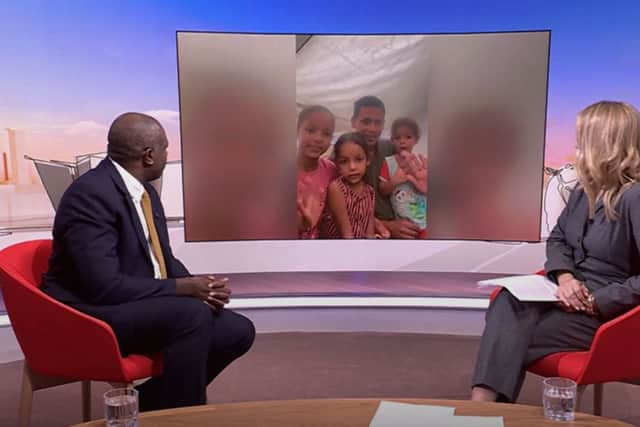
As home secretary, Yvette Cooper had agreed to allow some families to travel to the UK to allow a parent to study.
Mr Lammy said: “Every family is different and I don’t know the circumstances of each individual family. The home secretary makes that decision, but that sits behind decisions we might or might not get from Israel.
“I don’t want to cut across the decisions the new foreign secretary and home secretary are making, but they will have seen this broadcast and seen what the Refugee Council is saying. I know the intent is to bring people here to be able to study and not cause further pain and hardship.”
Around 40 students from Gaza are due to start studying at Scottish universities this academic year. Earlier this week, Education Secretary Jenny Gilruth said: “The Scottish Government will work to ensure every eligible Gazan student with the offer of a scholarship is able to get to Scotland, where they will be warmly welcomed.”
Stephen Gethins, the SNP’s foreign affairs spokesman, told the BBC: “Having students from Gaza in Scotland’s world-leading universities is talking about solutions by training the future generations to build peace.

“It was outrageous and devastating for Scottish universities when we stopped allowing dependents to come from countries that were not in conflict, but it is right to raise this personal case.
“We are hearing about kids being left behind by mums and dads, very small children in warzones where their parents don’t know if they are safe or not. At a human level, it is outrageous. Let the kids come out and be with their mums and dads.”
Mr Gethins said the UK Home Office “panders in some of its rulings”. But he said on a “human level”, children should be allowed to be evacuated from warzones so their parents can study in Scotland.
“It is beyond me,” he said. “Why can’t they be removed from Gaza when they are under threat? I’m sure parents watching would be devastated to leave their kids behind, so I appeal to the Home Office to let these kids come with them.
“At a very human level, it’s something people can understand.”
A Glasgow University spokesman said: “As a university of sanctuary, we recognise the desperate situation for students in Gaza who have applied for UK universities, including Glasgow.

“We want to ensure that anyone with the drive, determination and desire to pursue a university degree is empowered to do so.
“The university currently offers a number of scholarships for Palestinian nationals and has recently committed to further funding to support conflict-affected applicants. We will continue to consider additional support for displaced students.
“We are currently liaising with the UK government to enable students to safely travel and take up their places.”
Comments
Want to join the conversation? Please or to comment on this article.