
Equality Act 'a grey area', says NHS Fife manager who lifted Sandie Peggie's suspension

The ongoing employment tribunal heard the nurse was not deemed to be a risk to trans patients.
The Equality Act is a “grey area”, according to the NHS Fife manager who lifted nurse Sandie Peggie’s suspension.
The ongoing employment tribunal between the nurse, trans doctor Beth Upton, and NHS Fife was also told Ms Peggie was not deemed to be a risk to trans patients.
Lottie Myles, service manager at NHS Fife, was questioned by the tribunal on Monday. Ms Peggie is suing the health board and Dr Upton after she was suspended following a row between the pair over Dr Upton’s use of the female changing rooms on Christmas Eve, 2023.
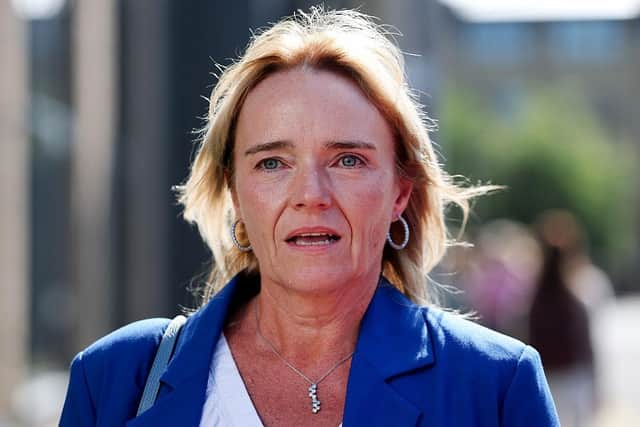

During her evidence, Ms Myles said she had researched the Equality Act 2010 for a better understanding of the law, but admitted “it is a grey area within a lot of workplaces”.
She added: “I felt reassured in my research that the elements regarding gender recognition say we are to treat the person in the sex they identify as. I didn’t want to breach legislation and I wanted to have both parties treated fairly and equally.”
In April, the UK Supreme Court ruled that the terms “sex” and “women” refers to biological sex only. Transgender remains a protected characteristic under this legislation.
Ms Peggie was suspended over allegations of bullying and harassment just days after the changing room incident on Christmas Eve.
Ms Myles told the tribunal she could understand how the suspension was embarrassing for Ms Peggie and was affecting her mental wellbeing as she had been a nurse for 30 years with an “unblemished” record.
At this point Ms Myles decided to lift her suspension as she felt “reassured” she was not a risk to trans patients in the emergency department. She said: “I felt reassured she wouldn’t treat them differently.
“Sandie has been a nurse for 30 years - I’m sure in that time she has dealt with transgender patients.
“I felt there were no safety concerns.”
She added the return to work meeting between her and Ms Peggie was “difficult because it was emotional for Sandie Peggie”.
Initially Ms Myles suggested Ms Peggie be moved to a different department within the hospital, but Ms Peggie objected to this as emergency nursing is her “bread and butter”. There were also suggestions Ms Peggie, who had worked night shifts, be moved to day shifts so she could be supervised by senior nursing staff. Ms Peggie also objected to this as she needed a shift pattern that worked around her dog at home.
A compromise was then found where Ms Peggie and Dr Upton were never on the rota at the same time.
However, numerous members of staff within the emergency department then said they “weren’t happy” with Ms Myles’s decision to allow Ms Peggie to return to work.
Ms Myles said that Dr Kate Searle and Dr Maggie Currer both objected to her decision, while senior nurse managers Esther Davidson and Louise Curran “similarly expressed” objections, but were not able to give an “accurate response” regarding alleged patient safety concerns.
She said she told Ms Peggie verbally on March 7 and in writing on March 12 that the suspension would be lifted. However, it was later reinstated due to issues with looking after the nurse’s dog, and she returned to work around April 12 2024.
Ms Myles said that “usually we don’t like to suspend” and she believed there were no patient safety issues, the tribunal heard.
However she said that she “wasn’t impressed” by allegations made by senior medics and warned them to comply with correct protocols and policies.
Ms Myles said: “When I explained to staff members they weren’t particularly happy with my decision initially.”
She said she visited Dr Searle’s office to co-ordinate a rota and was met with further objections, but warned the consultant she was “culpable” if allegations were not reported correctly, the tribunal heard.
Ms Myles said: “Kate Searle expressed unhappiness that we were taking Ms Peggie back into the workplace and made a comment saying there had been patient safety issues, there had been other behaviours towards a doctor. I asked if this had been investigated and reported appropriately, and she said no.
“I said that if these events had happened and they had not been reported, you were culpable.”
She added: “They weren’t happy but it was my sole responsibility to review the suspension. My primary concern is to make sure patients are getting seen.”
The witness said she did not know “what the indicators were… to be suspended in the first place” and felt there “was no risk”, the tribunal heard.
Ms Myles said: “I wasn’t impressed; if someone wants to raise patient safety concern it should go through correct process and be escalated at the time the incident happened. My stance was: ‘If you have not followed correct protocol and policy you are culpable’.”
She said that Ms Davidson alleged that a doctor had been subject to a racist slur by Ms Peggie, which is denied by the nurse. And she branded allegations by Ms Curran that the nurse shared Donald Trump’s views on gender “tittle-tattle”, the tribunal heard.
Ms Myles said: “It was very similar, tittle-tattle of being a supporter of Donald Trump and sharing his views on gender. That’s somebody’s personal view and as long as it doesn’t impact on workforce or patients or cause harm, people are entitled to have their private views.”
She said she perceived Dr Upton to be “a female colleague”, but said: “I do believe we should make alterations to support everybody, but how we do it is completely out of my remit.”
Comments
Want to join the conversation? Please or to comment on this article.