
Good Law Project given go ahead to challenge EHRC's single-sex spaces guidance in High Court
Campaigners have warned businesses and organisations to ‘hang fire’ over implementing guidance that would exclude trans people from certain spaces ahead of legal action.

Organisations and businesses that exclude trans people from spaces have been warned they risk “legal error” ahead of campaigners challenging controversial guidance in court drawn up in the wake of a ruling on single-sex spaces.
The Equality and Human Rights Commission (EHRC) published interim guidance that set out advice for public bodies to enforce the Supreme Court ruling confirming the definition of a woman in the Equality Act is a biological woman. This publication comes before final guidance was signed off by the UK government.
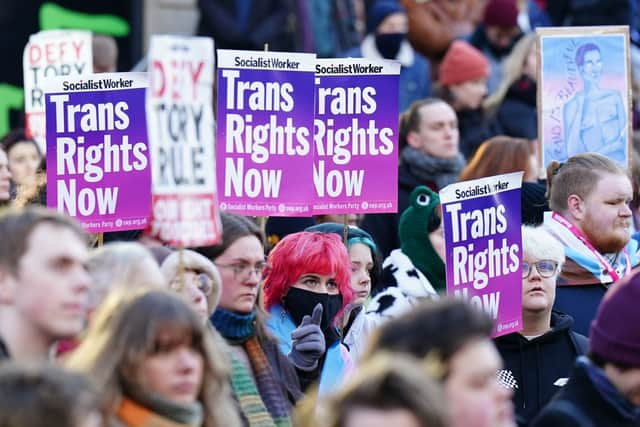

The interim update, published without consultation, included stating that in some settings such as hospitals, trans women “should not be permitted to use the women's facilities".
The EHRC also said “in some circumstances” trans women should not be able to use men’s facilities. The equalities watchdog was forced to revise its interim guidance, abandoning a previous recommendation that employers must provide single sex toilets.
READ MORE: Supreme Court fallout: How campaigners plan to take UK government to court over trans human rights
Now, the Good Law Project is challenging the guidance, with a court date set for November. The Good Law Project has been asked to clarify their case, according to the EHRC.
In May, the Good Law Project teamed up with two trans people and a person who is intersex to challenge the EHRC’s update, arguing the update goes far beyond what the Supreme Court judgment requires.
The Good Law Project has warned the guidance amounts to a bathroom ban for trans people and risks violating people’s right to privacy in their everyday lives.
READ MORE: Scottish Trans warns 'urgent' UK gender law change needed if single-sex guidance not revised
First Minister John Swinney has repeatedly warned that guidance should not be implemented until signed off by UK ministers.
Jess O’Thomson, Good Law Project’s community outreach lead, has warned that ahead of the court hearing, businesses and services should “hold fire, or find themselves in hot water”.
She said: “The EHRC’s guidance could be leading people into legal error.
“A narrative has been spun up about the ‘clarity’ brought by the Supreme Court judgment, but the legal situation is actually very complex. Anti-trans actors have taken this as a green light to try and strip away trans rights, but that’s just not how the law works. Businesses are taking a big risk by rushing ahead without the full picture.
“Trans people still have human rights protections in this country, and at the Good Law Project, we plan to defend them.”
EHRC chairwoman Baroness Kishwer Falkner said: "The court has not granted permission for this claim to proceed. It has deferred its decision to a later hearing, requiring the claimants to amend their claim to clarify what they are challenging and on what basis.
“The claimant’s case challenged our interim update. We published this following the Supreme Court’s judgment in For Women Scotland v The Scottish Ministers to help organisations understand their legal obligations. Whilst not a comprehensive statement of the law, it provides an accurate summary which is consistent with the Equality Act 2010 and Human Rights Act 1998.
"We will continue to focus on updating our statutory Code of Practice on Services, Public Functions and Associations following our recent public consultation."
Comments
Want to join the conversation? Please or to comment on this article.