
Babcock trying to 'contain' delays to warships being built in Rosyth
Babcock’s Sir Nick Hine said the first ship will be late for ‘a whole bunch of reasons’

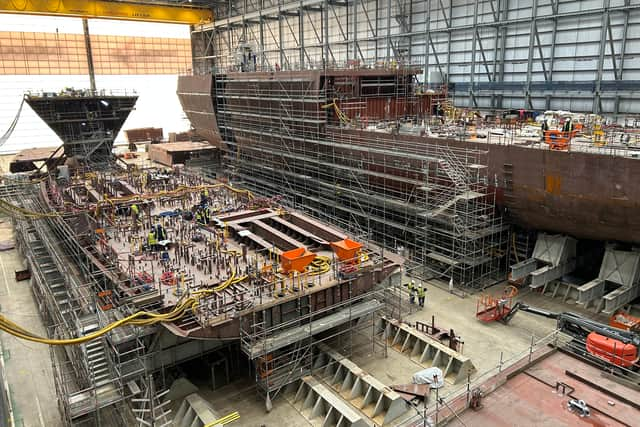
Defence giant Babcock has said it is trying to “contain” delays to five state-of-the-art Royal Navy warships under construction at Rosyth Dockyard.
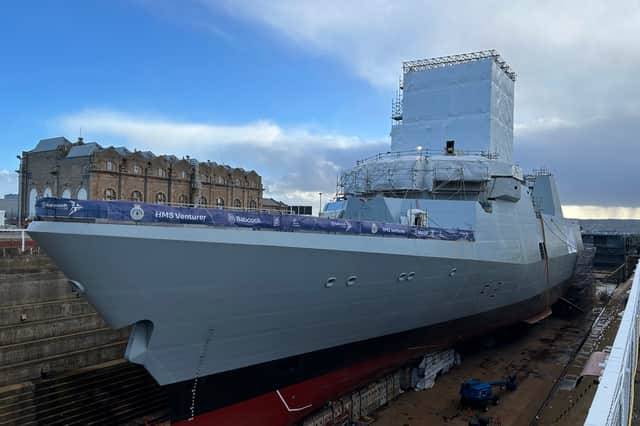
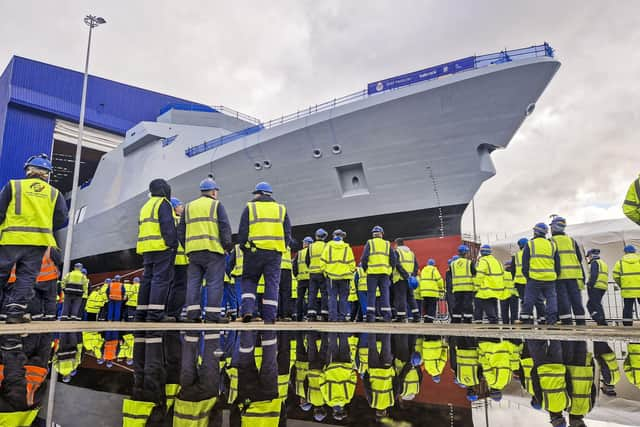
Sir Nick Hine, chief executive of the FTSE 100 firm’s marine sector, said the first frigate, HMS Venturer, will be late for "a whole bunch of reasons".
However, he said plans to deliver a "hybrid navy" using autonomous, unmanned vessels will now be pushed forward in the same timescale.

Elsewhere, the former Second Sea Lord suggested defence spending needs to be reformed as it is not currently providing value for money.
It comes amid concerns over the Royal Navy’s capabilities in the face of the rising threat from Russia.
Chancellor John Healey is to set out how the UK will reach its target of spending three per cent of national income on defence by 2030 at next year’s spending review.
Babcock is building five Type 31 frigates for the Navy at Rosyth, which it describes as “state-of-the-art warships”.
It was originally hoped HMS Venturer, the first of the five vessels, could go into service in 2023, although this was later pushed back to 2027 and then “by the end of the decade”. The Royal Navy says all five ships are planned to be in service by the early 2030s.
Speaking to Scotland on Sunday, Sir Nick said the ships will be “critical”. He said he was responsible for “pushing them into the system” when he was still in the Navy, “because I saw then that the Navy needed to be capitalised”.
He added: “We need to give them to the Navy as quickly as we can because the Navy needs its ships.”
The UK government recently said the Type 31 programme was experiencing “inflationary pressures across a number of areas”.
Sir Nick said there had been “a whole bunch of things that have taken place that you couldn’t foresee”, pointing to the impact of events such as Covid, Brexit and the war in Ukraine since the contract was signed in 2019.
“Now, none of those are excuses,” he said. “They’re just things that nobody foresaw that have added inflationary pressures, supply chain costs, energy costs, labour costs have all risen over that period of time.
“So they’re all challenges. If you’ve got a programme that is fixed in terms of how much money you’ve got to spend, and you’ve got inflationary pressures, the only thing that shifts is time, particularly when you’ve got to deliver a given set of performance.
“So the only thing that moves is time. So I’ve been really clear, I can only do what I can do within the envelope I’ve currently got. I would love to go faster, but that requires more money.”
He said time “has shifted by a couple of years effectively for the first platform,” HMS Venturer.
“The total programme hasn't shifted by that much, although that will depend again on whether or not we can actually have the conversation with the customer [the Navy] about how quickly we can introduce these into service,” he said.
“We will still continue to deliver these platforms [ships] as fast as we can to the Royal Navy because it needs its platforms. I would like to be able to deliver them faster, but I'm sort of a bit hamstrung in terms of how much flexibility I've got in the programme.
“It's a matter of common record that we've taken a financial hit as a company on these platforms already.”
Earlier this year it was reported “higher than expected levels of rework” on two of the ships had cost Babcock £140 million.
Asked about delays to the programme as a whole, Sir Nick said: “There’s going to be a period of somewhere up to about two years in terms of that whole programme.
“But I’m trying really hard to contain that by, as I say, if I can get the conversation with the Royal Navy in terms of delivery more quickly, then actually I can reduce the impact at the back end of the programme by having that activity.”
He said the “biggest danger” to Rosyth is not delivering the ships late, but “actually making sure that you've got more platforms to build and you don't lose all of the skills etcetera that you've already developed”.
Sir Nick has championed plans for a “hybrid navy” combining traditional crewed warships with unmanned, autonomous vessels, with the former effectively acting as command centres.
“I’ll deliver HMS Venturer in 2028 and I’ve made it clear - my view is I’d like to deliver HMS Venturer and a large USV [uncrewed surface vessel] together,” he said.
He added: “So let’s try and shift the narrative a bit to say, look, I’m late on the first platform. I’m late on the first platform for a whole bunch of reasons, but I’m going to try and move that forward to say I’m going to deliver you the first elements of hybrid navy in the same timescale.”
Elsewhere, he suggested defence spending should be reformed.
“We keep talking about input metrics,” he said. “We keep talking about how much money we’re spending on defence.
“Well, actually, what we should be talking about is what we’re getting in terms of value.
“So, if we’re spending £60, 68 billion of taxpayers’ money on defence, that’s a lot of money.
“Are we getting £68 billion worth of value? And I’m not sure that’s necessarily true. So defence reform is really important in terms of how you get the money to be spent more agilely, for want of a better term.”
He also hailed a "significant shift" in the attitude of the Scottish government towards the defence sector under John Swinney.
“We get more vocal support,” he said. “We get more attention. We’re getting more interest in terms of what we do.
“We have the ability now to have a proper conversation about what long term investment might look like, what the skills base needs to be, how they might help us with apprenticeships and those sorts of things in terms of skills and training. I think that’s a noticeable shift over the last, you know, two years.”
Comments
Want to join the conversation? Please or to comment on this article.