
St Andrews academics' ‘Indiana Jones’ moment as team finds secret tomb at world heritage site

A ground-breaking discovery of a secret tomb at one of the new seven wonders of the world has been made by a team of researchers, including academics from the University of St Andrews.
Professor Richard Bates, from the St Andrews School of Earth and Environmental Science, was part of a collaboration carrying out research at Al-Khazneh, the Treasury Building, at the World Heritage Site of Petra, Jordan.
The team found a long-buried tomb with the remains of 12 ancient skeletons beneath the iconic building where more than a million visitors a year come to visit and the unexpected discovery now features in a new Discovery Channel documentary.
The ground-breaking excavation is revealed in Excavation Unknown, a two-part programme aired this month on Discovery Channel with adventurer Josh Gates.
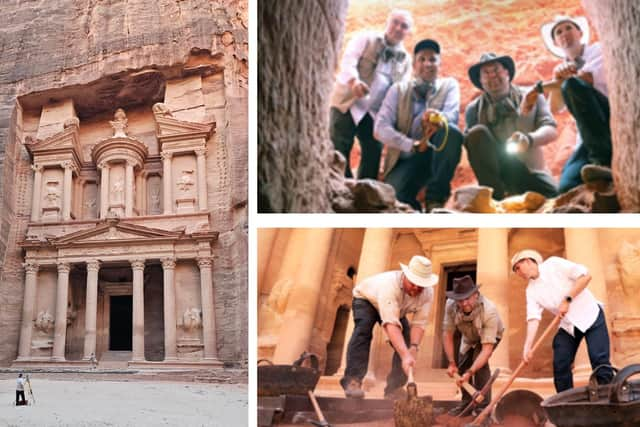

The Treasury sits at the centre of an entire city carved by hand into the walls of a desert canyon by the people of the Nabatean Kingdom, 2000 years ago. Famous as the cinematic resting place of the Holy Grail in Indiana Jones and the Last Crusade, the true purpose of the Treasury remains a mystery.
The team was given permission to conduct a remote sensing scan and then dig beneath it. Professor Bates said: “The discovery is of international significance as very few complete burials from the early Nabataeans have ever been recovered from Petra before. The burials, their goods, and the human remains can all be expected to help fill the gaps of our knowledge in how Petra came to be and who the Nabaraenas were.”
Dr Tim Kinnaird from the University of St Andrews School of Earth and Environmental Sciences was brought in to sample and date the sediment surrounding the burials and also to sample material from the tomb enclosure. This information provided crucial dates for construction of the walls within the tomb of mid 1st century BC to early 2nd century AD.
Dr Kinnaird said: “It is fantastic that we now have the pottery, ecofacts and sediments to date when the treasury was constructed. Previously we've worked on assumptions and conjectures - to have a definitive date will be a monumental achievement for us all.”
One skeleton in the chamber was found clutching a ceramic vessel.
Adventurer and presenter Josh Gates said: “When we spotted what looked like a chalice, all of us just froze. It looked nearly identical to the Holy Grail featured in Indiana Jones and the Last Crusade, set in the ancient building directly above the tomb. It was the ultimate moment of life imitating art.”
Professor Bates added: “It was an incredible privilege to be able to survey at such an iconic site and to have the geophysics verified with an excavation so soon is a rare opportunity. The extent of the discovery was so unexpected but will likely shed light on not only the Treasury building but also on the whole of the Nabatean society.’
Archaeologist Pearce Paul Creasman, executive director of ACOR, said: “There is so much that we have yet to learn about The Treasury. When was this remarkable structure built, and why? Little did we know that this dig might completely change what we know about The Treasury and help solve the mysteries of the Nabataean people. With the support of the Jordanian government, this excavation is bringing us closer than ever to answers.”
Comments
Want to join the conversation? Please or to comment on this article.