
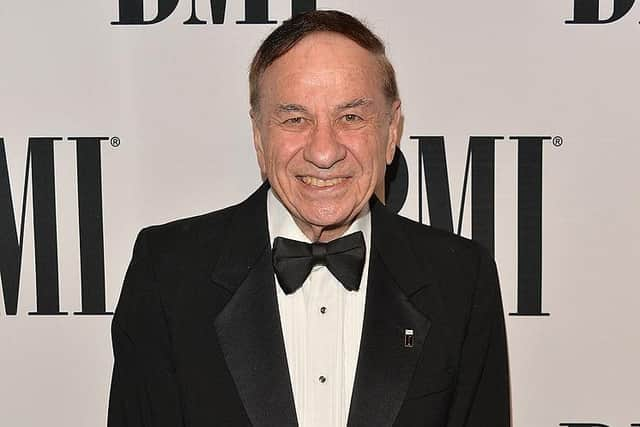
Scotsman Obituaries: Richard Sherman, co-writer of scores of classic songs from Disney films


Richard Sherman, songwriter. Born 12 June 1928 in New York City. Died: 25 May 2024 in Los Angeles, aged 95.
When the Sherman Brothers went up to collect their second Oscar of the night in 1965 they could think of only one word to sum up their feelings. And this is how it goes – supercalifragilisticexpialidocious. Robert did the first half of the word, Richard the second.
Robert and Richard Sherman were two of the most distinguished names in Disney musical history, having composed songs for Mary Poppins, The Jungle Book and The Aristocats and Chitty Chitty Bang Bang. They had already won the Academy Award for best original score for Mary Poppins when they went back on stage to get the statuette for best song. They won it for Chim Chim Cher-ee, but really it could have been for any of half a dozen songs, including most obviously Supercalifragilisticexpialidocious, A Spoonful of Sugar, Jolly Holiday and Feed the Birds.
They would receive a further seven Oscar nominations, though surprisingly never added to the Poppins brace. In more recent years they saw both Mary Poppins, the story of a flying nanny, and Chitty Chitty Bang, the story of a flying car, turned into hit stage shows in London and on Broadway.
Mary Poppins was the film that established them as Disney’s top songwriting team, but it was a struggle to get it made at all. The 2013 film Saving Mr Banks chronicled the protracted campaign by Walt Disney to persuade the irascible author PL Travers to entrust him with the film rights. Saving Mr Banks highlighted the opposition they faced at every turn. Travers (Emma Thompson) complains about them making up a word in one song and Richard (Jason Schwartzman) silently tucks away his score for Supercalifragilisticexpialidocious.
The Sherman Brothers reported directly to Disney, played in the film by Tom Hanks. They were involved from the outset in planning how to adapt the book, selecting episodes, collaborating on sketches and working up musical ideas. The continuing appeal of Mary Poppins probably has as much to do with the Sherman Brothers as Travers or Disney or original film stars Julie Andrews and Dick Van Dyke.
Born in New York City in 1928, Richard Morton Sherman was the son of Jewish emigrants from Eastern Europe. His father Al Sherman was also a professional songwriter. Sherman’s elder brother Robert was born in 1925. The family moved to California when the boys were young.
Sherman attended Beverly Hills High School and showed early musical talent, playing several instruments. He was a contemporary and rival there of Andre Previn. And more than 30 years later, when the Shermans won their Oscars for Mary Poppins, Previn picked up an Academy Award for My Fair Lady.
Sherman studied Music at Bard College, New York, and subsequently began writing songs with his brother. Disney child star Annette Funicello had an American Top Ten hit with their song Tall Paul in 1959. The Shermans also wrote the song You’re Sixteen, a hit for Johnny Burnette in 1960 and a US No 1 and UK No 4 for Ringo Starr in 1974.
The Funicello link brought the Shermans to Disney’s attention and they began working virtually exclusively for Disney in the early 1960s. Summer Magic served as a vehicle for the first of the Shermans’ classic Disney songs – Ugly Bug Ball, a song tinged with folk and folksy philosophy and memorably sung by Burl Ives. Disney reputedly disliked the notion of a song about insects going to a dance, until the Shermans persuaded him that bugs were not ugly to other bugs and the message was that beauty was in the eye of the beholder.
The following year Mary Poppins cemented their preeminent position in the studio. It won five Oscars, including two for the Shermans and the best actress award for Julie Andrews in her film debut.
Their most celebrated songs were the upbeat, happy, downright silly ones that brought a smile to faces young and old. They also demonstrated a tremendous facility for using what seems like vocal nonsense to reflect the very essence of a scene.
Disney originally commissioned Terry Gilkyson to write the songs for The Jungle Book, but was not entirely happy with them, so he called in the Shermans. Ironically the one Gilkyson song in the film – The Bare Necessities – is probably the best and best-known. The Shermans wrote the rest, including I Wanna Be Like You.
One of their best-known Disney songs was not actually written for any of the movies. The shamelessly repetitive and extremely catchy It’s a Small World (After All) was written to accompany one of the Disney rides. It has been infuriating parents since it debuted at the World’s Fair in New York in 1964.
After Disney’s death in 1966, the Shermans also worked for other producers and companies. Cubby Broccoli had made a fortune with the James Bond books of Ian Fleming, he saw similar potential in an adaptation of Fleming’s children’s book Chitty Chitty Bang Bang and approached the Shermans. The film reunited them with Dick Van Dyke and they provided another highly memorable and enduring series of songs that includes the title song, Toot Sweets, Me Ol’ Bamboo and Truly Scumptious. They wrote several new songs for the 2002 stage version.
Boosted by the publicity around the new theatre production, Chitty Chitty Bang Bang was Number One in a 2003 poll to decide the top ten children’s films of all time, with The Jungle Book at 7, Mary Poppins at 8 and The Aristocats at 9. The stage version of Mary Poppins premiered in 2004.
The two brothers did not get on particularly well outside of work and tended not to socialise with each other in order to preserve their professional partnership. They were quite different in temperament. Richard was a lot more outgoing. Both wrote lyrics and music.
Sherman is survived by his wife Elizabeth, to whom he was married for more than 60 years, and by three children. His first marriage was short-lived and ended in divorce. His brother died in 2012.
Obituaries
If you would like to submit an obituary (800-1000 words preferred, with jpeg image), contact [email protected]
Comments
Want to join the conversation? Please or to comment on this article.