
Scotsman Obituaries: Oliver Barratt, polymath who fought to save Edinburgh from destructive town planners and developers
Oliver Barratt MBE, campaigner for Edinburgh’s architectural heritage. Born: 7 July 1941 in Northern Ireland. Died: 17 April 2026 in Barrow-in-Furness, Cumbria, aged 84
For Oliver Barratt, family holidays in North Wales in the 1950s invariably involved him cajoling his cousins to visit every railway, castle and old building he could find. This early interest in architecture and railways remained with him for the rest of his life, and was the driving passion he took to his adopted Edinburgh, where as Secretary of the Cockburn Association, from 1971 to 1992, he fought to protect the historic fabric of the city during a period when the value of historic buildings, architecture and the people who lived and worked in them were not as appreciated as they are today.
Moving to Edinburgh as a student in the 1960s Oliver saw at first hand the rapid change that was forcing long established communities out to make way for new developments. This led him to join the Cockburn Association, an organisation set up by Lord Cockburn – one of Edinburgh's first conservationists – in the 19th century, which by the 1970s had seen better times. Setting up an office and raising his own salary from donations, he turned the Association into his vehicle for a decades-long battle for the soul of Edinburgh.
His time saw many notable victories, including forcing the abandonment of the Edinburgh inner ring road scheme that would have driven a motorway through the heart of Edinburgh. The defeat of this scheme spared Edinburgh the fate that befell cities such as Glasgow and Birmingham, victims of the fashion for inner city motorways. In its place Oliver resurrected a 1930s Cockburn plan for an Edinburgh bypass, pushing it through to completion in the 1990s when he proudly hired an open top bus to tour the road before it officially opened.
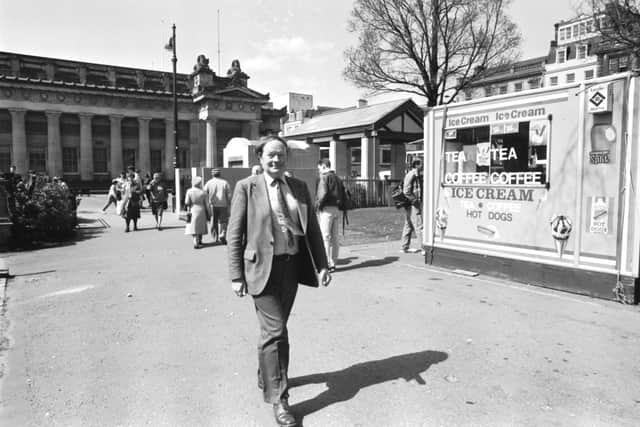

An early focus of Oliver’s was the South Side of Edinburgh, where thousands of people were being moved out of long-established communities to make way for schemes backed by his long-time opponents, the University, the Highways department and the City Corporation. However, his focus was also on small individual cases – buildings such as the Glasite Meeting House and many others were saved and found new roles.
In doing this work Oliver was far from a ”nimby”. He developed his own philosophy of the urban environment. The preservation of communities and people was as important to him as buildings. To this end he established the Edinburgh Civic Forum. Fortunately for Edinburgh, the fashion for large-scale destruction began to turn, so by the time he retired Edinburgh had seen off the worst threats. He left the Cockburn Association, which he had turned into a vital part of Edinburgh civic life, in good health.
The pages of The Scotsman in the 1970s and 1980s were often enlivened by a letter from prolific writer Oliver; he used its pages to campaign against planning decisions, to protect a building or piece of heritage or to adress any number of other topics, one such being a lively correspondence as to whether it was possible to see Northern Ireland from his native Cumbria due to atmospheric refraction. Oliver also liked a stunt – on one occasion stringing a washing line across Waverley Market to show the proposed buildings went higher than that allowed by an Act of Parliament, on another hiring a barrage balloon to good effect.
His influence was not just limited to Edinburgh, he took an interest in projects across Scotland, for instance through his Trusteeship of the Crichton Trust in Dumfries and the Scottish Historic Building Trust, and as a long-serving member of the Council of the National Trust for Scotland, where he put his experience and philosophy to good use.
Oliver was born in 1941 in Northern Ireland, where his father, Roger, was stationed in the Army after returning from the Narvik campaign. The Barratts were a long-established family in Cumbrian mining. His mother Diana While was also a Cumbrian, with the Barrow-in-Furness family firm producing ingot moulds for the steel industry.
Oliver seemed destined to take over the company, and his family background perhaps accounted for his interest in, and sympathy for, industrial archaeology and engineering. But while studying agricultural engineering he developed the intense pride in the city which shaped the rest of his life.
His twin passion to Edinburgh was railways. He never forgave the Conservative Party for the Beeching cuts and travelled to London to see the Euston Arch before it was demolished. Transport and railways were often at the heart of his campaigns. His railway travels took him all across Europe, to Persia and, closer to home, the station cottage on Rannoch Moor that he bought to allow himself to walk in the Scottish Highlands. He was an avid walker, organising parties to climb Munros and stay in bothies, where his skills with cooking on primus stoves came in very useful.
A regular traveller from Oxenholme in Cumbria to Edinburgh, he prided himself on managing to arrange for fish and chips to be delivered to his train at Lockerbie station. The astonishment of his travelling companions always delighted Oliver.
Intensely proud of Edinburgh and his successes, he liked nothing better than to show the products of his work to his friends and relations, but he was also acutely aware of the failures, one being the destruction of George Square to make way for Sir Basil Spence’s Edinburgh Library and many other buildings, despite a tough campaign. Oliver and others fought tirelessly to preserve Princes Street, but their efforts were successful only in part. But he was never downhearted, he was always convivial company and an avid networker in Edinburgh, Scotland and beyond.
Having inherited Cowmire Hall in Cumbria, Oliver set about turning it over to the manufacture of traditional damson gin, which he was proud to sell at Fortnum & Mason and to shops throughout Cumbria.
Later in life he married fellow Cumbrian Vicky Patterson (nee Stanley), who he first met many years previously when she was working at Norway House department store in Edinburgh.
Oliver died on 17 April in Furness General Hospital after a short illness. He is survived by his wife Vicky, his four stepchildren, his two sisters, a brother and many cousins.
Obituaries
If you would like to submit an obituary (800-1000 words preferred, with non-copyright image), contact [email protected]