
Scotsman Obituaries: Jimmy Gibson, Scottish boxer whose professional career was briefer than his talents deserved
Jimmy Gibson, boxer. Born: 8 March 1939, in Lochore, Fife. Died: 24 April 2026, aged 87
Jimmy Gibson was a supremely talented boxer whose dazzling range of skills and precocious success during a comparatively brief career were widely acclaimed by the media, notably by TV commentator Harry Carpenter, who labelled him “The Golden Boy of Scottish Boxing”.
After winning his first senior Scottish amateur title at featherweight aged only 17 – televised live – the Edinburgh Evening News proclaimed: “Jimmy Gibson creates boxing sensation!” Sports writer James Sanderson described him as “The baby faced boy with the ice cold fighting brain” while “TV idol of 1,000s” was another accolade reflecting the extent of TV coverage then. During an honour-laden amateur career, highlights included representing Scotland in international matches over 15 times throughout Europe and once, memorably, in Ghana.
Aged 18, he was a quarter finalist in the 1957 European Championships in Prague, losing creditably to reigning Olympic champion Vladimir Safronov. In 1959, in Ghana, in the space of a week he twice defeated Ike Quartey, West Africa champion, Olympic silver medallist a year later in Rome and Commonwealth Games gold medallist, while against Poland he defeated Jerzy Kulej, a gold medallist twice in European Championships and in the Olympics in the 1960s. Two of Scotland’s all-time greats were unstinting in their praise – Olympic champion Dick McTaggart considered him the best boxer he ever faced at any level, while world champion Ken Buchanan was quoted as modelling his style on Jimmy’s and when training for his world title bout he tried persuading him to come out of retirement for sparring.
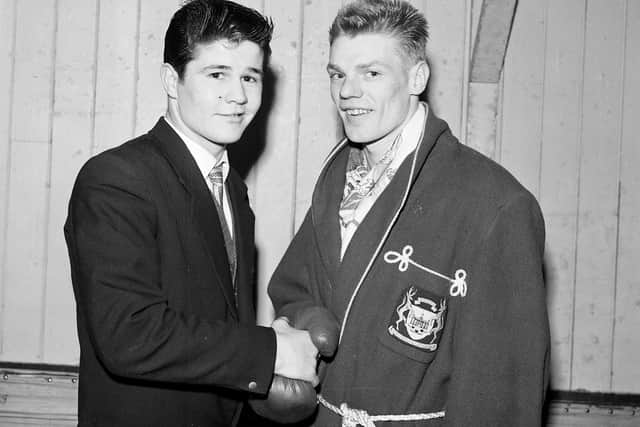

Although for various reasons his professional career did not reach similar heights, he did enjoy success, winning the Scottish professional title and fighting some top quality opponents including future British champions Maurice Cullen and Johnny Cooke. In retrospect Jimmy believed he had turned professional too young, aged only 20, and a sense of growing disillusionment with the paid ranks did not enhance his cause as he hung up his gloves aged 23. One is left with the question of what might have been had he been promoted more effectively, given he was considered the complete boxer, with impeccable ringcraft.
James Gibson was born to Robert, a miner, and Charlotte, in Lochore, Fife, where he was brought up with older sisters Jean, Charlotte and Janet and a cousin, John. He attended Benarty school, leaving at 15 to work at the nearby Mary Pit. Despite times being hard and money scarce, Jimmy grew up with solid core values that served him well in life. Aged about 12, he began showing boxing promise at the local sports club and over the next three or so years had 68 youth contests, losing only two. He joined well-known Dunfermline boxing club the Woodside, where accomplished trainer Peter Guichan took him under his wing to fashion his outstanding amateur career. There were several other internationalists in the club then, including Alf Barker, “Spangles” Hunter, George Drummond and Jack Dormer, all contributing to a positive, ambitious ethos.
Jimmy won his first East District title in 1956 while still 16 and a year later his inaugural Scottish title, for which 21 competitors entered. Following preliminary bouts he qualified for finals night when he had to box three contests for the title. Plaudits followed, eg, “the most polished boxer at Scottish Championships” and “the best prospect Scotland has had in years”, opinions lent support when in his international debut weeks later against Wales he KO-ed his opponent in the first round. In other internationals he faced Denmark, East Germany, Romania, Ireland, Italy, Czechoslovakia, and Austria among others. Moving up to lightweight entailed fighting Dick McTaggart several times, without success, although he and others thought he deserved a couple of decisions, especially as he had McTaggart on the canvas.
Other highlights included winning the coveted Scottish and British miners’ championships, particularly valued by Jimmy as they involved “real hard men”. Another was winning the World Festival of Youth Championship in Vienna in 1959, defeating the favourite, multiple Romanian champion Iosef Mihalic, a bronze medallist in that year’s European Championships. The contests in Ghana were particularly memorable, not only for his exceptional wins but also the lavish banquet attended by the Duke of Edinburgh.
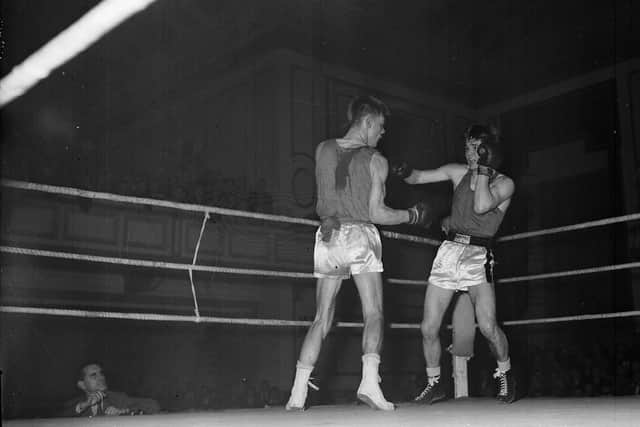
Turning professional early in 1960 he moved to Glasgow where manager Dick Delaney had him training full time. Of his 25 bouts he won 16, drew 1 and lost 8, four defeats being reversed shortly afterwards against the same opponents. Within ten months of his debut he won the Scottish title against Alex McMillan. Initially he boxed virtually every month, retiring after a loss in early 1963. During his whole career he was never knocked down or underwent a standing count. He appreciated the opportunities, especially travel, that boxing gave him and was philosophical about his professional career.
After boxing he worked initially for an engineering company and then in a factory in Glenrothes. He maintained his interest in boxing by coaching amateurs, notably at the Exit Community Centre, also in Glenrothes, which included internationalists like Cy Harrison and Andy Caulfield. Jimmy also became a keen golfer, playing regularly at Balbirnie in Fife.
On 28 March 1964 he wed Mima Malvenan at Lochcraig Church, Lochore and they had a happy marriage of 62 years, having met at the Burma Ballroom, Kirkcaldy. They had son Robert and daughter Susan.
Jimmy was a complete gentleman, well thought of by everyone he met. For him family came first, and he was an especially doting grandparent and great grandparent and much-loved father and father-in-law. A warm, humble and strong individual, he was modesty personified about his boxing career. He is survived by his wife, children, four grandchildren and two great-grandchildren.