
Scotsman Obituaries: Anna Ritchie, archaeologist who shone a light on Scotland’s past
Dr Anna Ritchie, archaeologist: Born: 28 September 1943. Died: 8 May 2026, aged 82
Anna Ritchie was a well-known figure in Scottish archaeology for half a century. After undergraduate studies in Cardiff, she came north to Edinburgh University in the mid-1960s to undertake postgraduate research with Professor Stuart Piggott. She soon considered the city “a wondrous place to live and work”, blessed with good libraries which allowed her to pursue her interests in later prehistory. She was to remain here her entire career.
Among her many achievements she was elected in 1990 as the first female President of the Society of Antiquaries of Scotland, a learned body by then at the start of its third century.
From the age of 11, Anna intended to become an archaeologist. At Woking Grammar School for Girls she created a museum, while later volunteering on Roman excavations across south-east England. She studied at the University College of South Wales and Monmouthshire (now Cardiff University), then one of the rare places offering an archaeological degree. Her excavation experience was gained at a project run jointly by the Cardiff and Edinburgh professors at an Oxfordshire chambered tomb; her first encounter with Piggott – and the Edinburgh student she was later to marry. Her undergraduate dissertation involved winter fieldwork in rural Wessex to inspect sites after the vegetation had died back. The miles were covered on an old Lambretta scooter which had no windshield: a chilling experience!
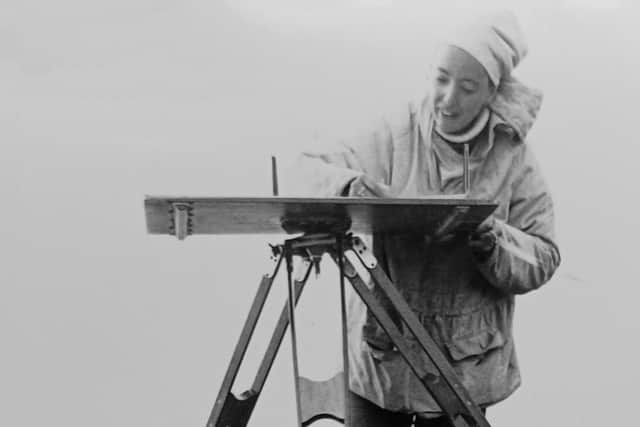

She embarked on her distinguished and multifaceted archaeological career in the tiny postgraduate room in 19 George Square, obtaining her doctorate in 1970. By then she was married to Graham Ritchie, also an Edinburgh PhD student, whom she met anew; their wedding was in 1968. He had earlier joined the staff of the Royal Commission on the Ancient and Historical Monuments of Scotland, now part of Historic Environment Scotland.
Singly or as a pair, they soon became key figures in Scottish archaeology. The subject was developing rapidly under the impacts of the possibilities of radiocarbon dating and the increasing threats posed by environmental and other changes. Their joint monograph, originally published in 1981, “Scotland: Archaeology and Early History”, was the first modern synthesis of Scotland’s archaeology.
Aside from one session as a replacement lecturer in Piggott’s department in 1972, Anna worked as a much-in-demand freelancer. She was initially taken on by the Department of the Environment to lead rescue excavations at Buckquoy, Orkney, a site threatened by marine erosion. There, inspiring a mostly young team, she successfully identified – for the first time – the stone footings of a complex of Pictish domestic buildings, attributable to the eighth and earlier centuries AD.
Throughout her career, she was kind and helpful to younger colleagues. Washing the finds herself back at home in Edinburgh (there were no on-site processing facilities) she discovered writing – the faint incisions of Ogham script – on a spindle-whorl. This was subsequently the inspiration for Orcadian jeweller Sheila Fleet’s Skyran range.
Briefly involved thereafter as co-director of the 1970s dig at Skara Brae, her next DoE project in her own right concerned new investigations at Knap of Howar on Papa Westray, another site in state guardianship. There, the drystone remains of two buildings, examined in the 1930s and believed to be Iron Age, also faced threats. Anna’s re-excavation demonstrated that they, and associated deposits, were actually of the fourth millennium BC; these buildings were the oldest surviving upstanding houses in Scotland. In the following decade – by now with two young children – she conducted a third, research, project, again with a small team, not far from Knap of Howar. This dig, at the chambered cairn of Holm of Papa Westray, enabled her to conclude that this was the likely burial place of the Knap’s inhabitants.
These two chronological periods she had investigated on Orkney – the early medieval (including Viking) and the Neolithic – were thereafter her particular interests. She wrote prolifically on the art of the Picts, her papers often illustrated with elegant graphics by the late Ian Scott. Her contributions ranged from scholarly expositions to overviews for the general public. Anna was both enthusiastic and skilled in conveying information to non-specialist audiences. She taught extramurally, latterly for Aberdeen University, in addition to writing both introductory texts and numerous guidebooks. The latter included the Exploring Scotland’s Heritage series, all of which she edited, as well as herself contributing on the Northern Isles. From the 1970s, Anna who, faced with a microphone and camera, was both lucid and attractive, regularly appeared on radio and television in archaeological programmes, including ones for schools, as well as, for example, several episodes of Time Team. She was also a scriptwriter (Chronicle) and consultant (Blood of the Vikings).
Anna’s voluntary work – in Scotland she served on the Ancient Monuments Board and as a Trustee of the National Museum – led in 1997 to the award of an OBE for services to archaeology.
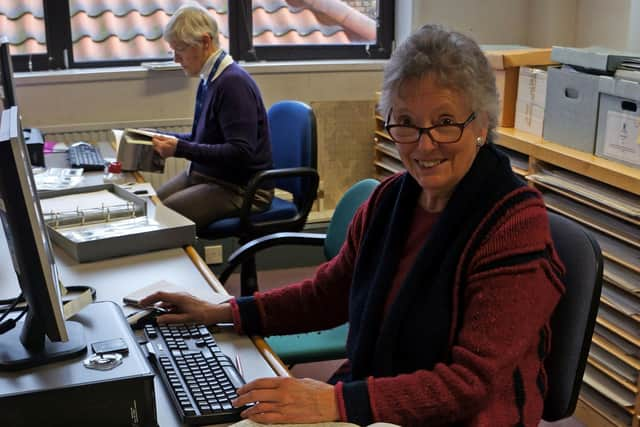
Graham died suddenly in 2005. This ended a successful working partnership as well as a marriage of almost 40 years. In due course, Anna continued researching and writing, remaining actively involved with the Pictish Arts Society and the Scottish Society for Northern Studies. They acknowledged her contributions by jointly holding a conference, Common Ground, in her honour in 2022; the papers are now published. Her final article, for the Orkney Archaeology Society, appeared last year. It is full of detailed memories of her fieldwork, some of it nearly 60 years ago, in the islands she loved.
Anna is survived by her two siblings, and by her children. Matthew, married to Monika and with a daughter Gabby, is the Historic Environment Advisor with Forestry and Land Scotland in Inverness. Elspeth works for Public Health Scotland and lives with her husband in Midlothian. It was there that Anna was cared for during her final weeks. Anna was prouder of the next generation’s achievements than she ever was of her own.
Obituaries
If you would like to submit an obituary (800-1000 words preferred, with non-copyright image), contact [email protected]