
Why victory for British trans judge in European Court of Human Rights would be Pyrrhic
Nigel Farage may secretly be willing on Victoria McCloud for a ruling that could hasten the end of Sir Keir Starmer’s Labour government and Britain’s place in the ECHR

As a highly experienced lawyer, I can only presume retired judge Victoria McCloud has gamed the implications of appealing to the European Court of Human Rights to overturn the Supreme Court ruling on biological sex. Even if successful, it could turn out to be a Pyrrhic victory and one of the last times the ECHR has anything to do with British laws.
There was a time when leaving the ECHR was only the preserve of hard-line Brexiteers, and with the potential to split the Conservative Party had obvious attractions for Sir Keir Starmer and his friends in the human rights industry for whom the ECHR has been such a valuable backstop in derailing repeated attempts by the previous government to tighten up on illegal immigration.
The boot is firmly on the other foot as cross-channel illegal immigration reaches record levels and Labour finds solutions as hard to find as their predecessors.


The EU’s much-vaunted freedom of movement is now hopelessly compromised as the influx of economic migrants from Africa and Middle East refugees overwhelm local services and the housing supply, laying the foundations for political movements like Alternative für Deutschland which challenged the previous open doors orthodoxy promoted by former German Chancellor Angela Merkel. Now Germany, France, Denmark, Sweden, Austria, Italy and Slovenia have all introduced border controls, rendering the Schengen Agreement almost redundant.
Now departure from the ECHR, or at least its reform, has gone mainstream as the full impact of a supra-national appeals system on democratically elected governments struggling to cope with mass migration is being felt.
Court attacked by EU member states
In May nine EU members led by Italy and Denmark — supported by Belgium, Estonia, Lithuania, Latvia, Poland, the Czech Republic and Austria — signed an open letter which attacked the way the European Court of Human Rights was interpreting the Convention, claiming rulings were going beyond original intentions and threatened their ability to “protect their democracies and populations”.
Off-shore asylum processing hubs, not that dissimilar to the Conservatives’ much-derided Rwanda scheme, are being considered by the EU. Italy’s deal with Albania signed in 2023 has been repeatedly stymied in the Italian courts, which has only strengthened Prime Minster Giorgia Meloni’s hand.
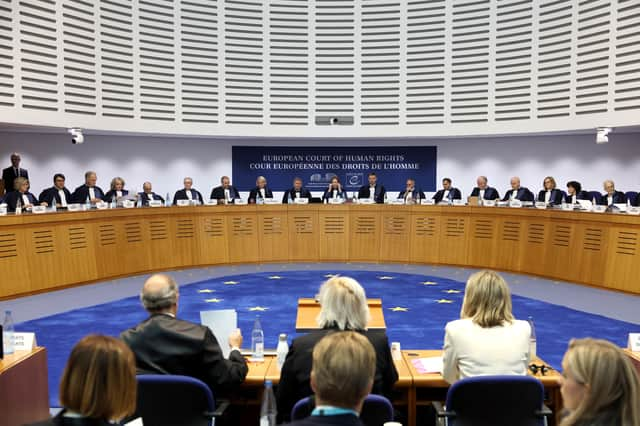
The ECHR was accused of over-playing its hand last year when it ruled in favour of two elderly Swiss women who claimed their right to life (Article 2) was being denied by their government which they said was not doing enough to tackle climate change. The Strasbourg judges ordered the Swiss government to do more which it duly snubbed, a decision later backed by a referendum which found a majority felt the government’s actions were adequate. The ECHR ruling was widely seen as going well beyond the remit of Article 2 and a direct challenge to a legitimate policy decision made by a sovereign government.
Of course, there will be the Just Stop Oil types who will argue the court’s decision was absolutely correct, and failure to do more to tackle climate change is akin to mass murder, just as there is no shortage of activists who argue that men can become women just by thinking about it hard enough.
Which brings me back to Victoria McCloud. As Britain’s first trans judge she has, for want of a better phrase, skin in the game and argues the Supreme Court undermined her Article 6 rights, to a fair trial, by refusing to hear evidence from her and other trans representatives.
But when the ECHR was being drafted in 1948-50, its authors were thinking more about the ordeal of people like Sophie Scholl, a key member of the anti-Nazi White Rose movement who was ritually humiliated at her trial by the infamous People’s Court judge Roland Freisler who then sentenced her and her associates to death. Clearly, Ms McCloud was not on trial, fairly or otherwise.
She is also claiming her rights under Article 8 (right to a family life) and Article 14 (protection from discrimination) and again, it’s hard to see how the Supreme Court’s decision impinges on either, given the judges were unanimous in their view that people who had undergone gender reassignment were protected by the 2010 Equality Act, but that there was a distinction with the Act’s sex-based protections which they ruled applied to biological males and females, regardless of gender reassignment.
The problem for trans campaigners is really with the legislation, not the Supreme Court interpretation, so their goal should be for repeal or amendment, but as Nicola Sturgeon found to her cost that would not just be political dynamite but a nuclear bomb.
However, it’s not difficult to see the European judges siding with Ms McCloud but that would put the UK Government in an impossible position, of either snubbing the ECHR like the Swiss, or reforming the law in ways which it is clear from the SNP’s attempt to pass the Gender Recognition Reform Act into law would be hugely unpopular and a gift to Reform, if not the Conservatives.

Having been instrumental in laying the groundwork for Britain’s departure from the EU, I can imagine Nigel Farage secretly willing on Ms McCloud so he can point to another European institution from which we should be decoupled; an unaccountable international court which interferes with the way sovereign states protect their borders, deal with climate change, and police sex-based rights. And this time, prominent EU members would be right behind him.
With his human rights lawyer friends like Attorney General Lord Hermer, Sir Keir Starmer will never take the UK out the ECHR, so his best hope is Ms McCloud loses, and the issue goes away. Otherwise, it’s goodbye Labour and goodbye ECHR.
Comments
Want to join the conversation? Please or to comment on this article.