
SNP ministers’ stance on defence is incoherent - they need to either help or get out of the way
The SNP must get behind defence investment - or get out of the way, writes the GMB’s Louise Gilmour.
It is not, as John Healey suggested, student union politics. It is a lot worse than that.
Describing the refusal of SNP ministers to support a specialist welding school on the Clyde because the skills taught there will help build nuclear-powered submarines for the Royal Navy, the UK defence secretary correctly suggested it is not the decision of a serious government.
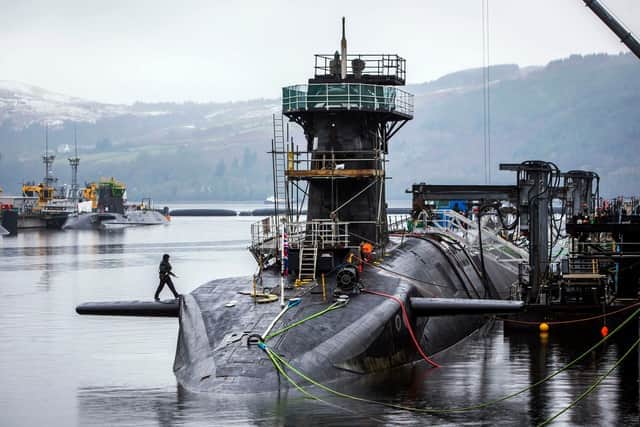

It is not serious and neither is it a matter of principle as Mairi Gougeon, the party’s rural affairs minister, insisted as she tried to explain how her Cabinet colleagues understood the need for our armed forces, but could not, in good conscience, arm them.
Even ignoring the millions of pounds of public money awarded to multinational arms companies by Scottish Enterprise, SNP ministers’ insistence that someone should defend our country, just not them, is incoherent verging on the embarrassing. Student politicians had every right to be offended by Healey’s comparison.
The SNP policy, if that’s what they like to call it, is an abdication of responsibility not just for the security of our country, but for its jobs, skills, prosperity and future. This is not just about defence, it is about industry, about manufacturing and engineering. It is about our country and its workers gaining the skills and expertise to build things.
Ministers clambering onto the high ground and holding their nose while refusing the chance to help young working-class Scots thrive can tell each other they are being principled, but other words are available. Hypocritical, for example. Myopic, for another. Self-harming, for the set.
The skills learned at the Rolls Royce welding school – and at other companies across the defence sector – will support young workers for the rest of their lives, get them good, well-paid jobs, allow them to buy cars and homes, build families, pay taxes and get on.
Our defence companies invent, innovate and, literally, create the jobs of tomorrow. From computers and the internet to canned food and stainless steel, the list of technological advances pioneered by the military, but now underpinning our civilian life is endless.
These young people might work in defence projects all their lives, whether making ships and planes or munitions and missiles, but their skills will be transportable and easily transferable to other jobs in other sectors. They could undoubtedly support the industrial strategy long-promised by Scottish ministers if they can stop clutching their pearls long enough to deliver one.
Scotland is suffering a debilitating shortage of expertise across all skilled trades as employers struggle to fill vacancies, and creating a pipeline of talent, of industry-leading apprenticeships, must be a hardheaded priority, not some dreamy aspiration.
The Fraser of Allander Institute last year detailed the surge in vacancies and a growing mismatch between applicants’ skills and employer’s requirements. It reported one in four Scots employers had vacancies, with 31 per cent of them being blamed on a skills shortage and trades being an area of particular concern. The problem stretches far beyond defence and is hobbling firms in all sectors, including manufacturing and engineering. Energy is only one example although our transition to renewables is still generating far more talk than jobs.
The GMB is in Brighton this week for our annual congress when our reps in Scottish Gas will urge delegates to support calls for governments on both sides of the Border to do far more to deliver the promised transformation of our energy networks to protect existing jobs and create new ones. From making the underground cables needed to refit the National Grid to the wind turbines required offshore and on, an industrial strategy supported by a well-trained workforce will help secure the contracts currently going abroad along with the jobs.

Of course, the strategy should include new nuclear energy but, again, SNP ministers have a principle where their ambition should be. The party does not agree with nuclear weapons - although it claims an independent Scotland will join Nato, a nuclear alliance – and apparently also has a problem with nuclear-powered subs. So it is little surprise that John Swinney will not even talk about nuclear power or the kind of Small Modular Reactors being actively planned by dozens of countries around the world, including England.
Principles are no bad thing but, as John Maynard Keynes suggested, like opinions, they should change when the facts change and, from Washington to Moscow, the facts are transformed.
We are living in a more uncertain world and, in the future, must better protect our country and our energy. For the SNP to continue opposing nuclear weapons while sheltering beneath them is questionable any time but, right now, seems wilful. So, too, is the apparent determination of both our governments to run down offshore industries and import more of the oil and gas needed for decades to come.
Our new, more dangerous world comes with serious challenges, but also clear opportunities, including the chance to reboot Scotland’s industrial landscape and create good jobs for our children and their children. That will need resource, but also a sea change in our schools where the overarching assumption that university or college is a better destination for young people than an apprenticeship is steering too many away from skilled trades and well paid work.
The increase in defence spending announced by Keir Starmer on a visit to British Aerospace in Glasgow last week can drive growth in places that sorely need it, but only if every pound is spent smartly, stress-tested and charged with underpinning skilled trades, apprenticeships, and jobs.
If, on a point of principle, the Scottish Government cannot help, it needs to get out of the way.
- Louise Gilmour is the GMB Scotland secretary.
Comments
Want to join the conversation? Please or to comment on this article.