
Scotsman Letters: St Andrew's Day is a bank holiday - so why is it not being observed?
You would be forgiven for thinking St Andrew’s Day is not a bank holiday for all the recognition it gets, a reader and former politician writes
It is now 17 years since the passing of my bill in the Scottish Parliament to introduce a bank holiday on 30 November (or the following Monday if 30 November is a Saturday or Sunday).
Unfortunately that does not oblige any employers, not even the bankers, to give their workers a day off.
The only direct effect of any bank holiday legislation is to allow the postponement of a financial transaction until the following working day without incurring a penalty. That used to be the traditional way of facilitating a national holiday but that tradition seems now to be largely ignored, especially in the private sector.
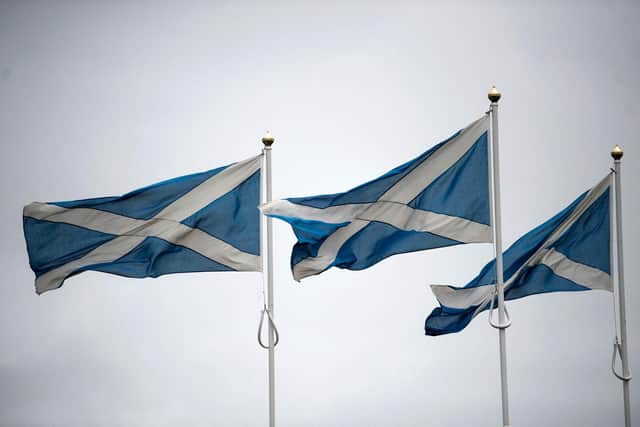

The public sector is not much better. The Scottish Government and the Scottish Parliament recognise the St Andrew’s Day holiday but only four out of Scotland’s 32 local councils follow suit.
I applaud the annual STUC St Andrew’s Day March against Racism and Fascism but the trade union movement could and should do more to gain wider recognition of a St Andrew’s Day holiday. Local councils should also do more by granting a holiday for schoolchildren and council workers.
Such measures would help to ensure that there is one very special holiday in the year when the people of Scotland can celebrate our patron, our national identity and our membership of the international community.
Dennis Canavan (former MP/MSP), Bannockburn, Stirling
Not fit to decide
When I look at the Scottish Parliament’s lamentable record on ethical policy and legislation, for example hate crimes, the named person scheme and gender reform, much of it (with excellent exceptions) caused by low quality of politicians and civil servants and the lack of a revising chamber, I really hope that the country that once led the Enlightenment takes an honest look at itself and decides that the best way to consider assisted dying legislation is to participate in the UK debate and process and accept that it should be a reserved power.
I have not faith or trust in Holyrood to get this right and would much rather have the old fogeys in the House of Lords pulling it to bits before giving their considered thumbs down or rubber stamp than any Holyrood committee.
Allan Sutherland, Stonehaven, Aberdeenshire
Murdo’s right
It is not often that I agree with Murdo Fraser (Scotsman, 27 November) but I’m in total agreement with him on the vexed question of assisted dying and the urgent need for further investment in palliative care. The distinction between palliative care and assisted dying is at best blurred and overlapping.
Mixed reactions from Canada, where assisted dying has been in operation for several years, seem to suggest that any act to legalise it may well turn out to be the thin end of an accelerating wedge. I remain doubtful that the law is the appropriate vehicle to deal with what is in essence a moral and even perhaps, a spiritual issue.
The best palliative care includes assisted dying already, without any recourse to the law, in compassionate end-of-life care. Many years ago, my parents enjoyed such care, dying within six weeks of each other, both dying well, in the true sense of euthanasia.
Ian Petrie, Edinburgh
Bountiful badgers
The charity Scottish Badgers would like to set the record straight regarding some unfounded statements in a letter published on 26 November. We base what we say on evidence-led science.
Badgers fulfil important roles as ecosystem engineers helping to create habitat (that hedgehogs and birds need to live), cycle nutrients (for soil health), disperse seeds (for biodiversity), slow water flow (that mitigates flooding) and prevent soil degradation (a costly problem for agriculture).
As an independent scientific review in 2020 concluded: any impact of badgers on biodiversity or agriculture is minimal relative to other factors such as the effects of environmental degradation.
Hedgehog populations are crashing, but the fact is the decline is as bad or worse in areas that have no badgers. It’s we humans that for the past century have slashed the hedges (that hedgehogs need to shelter and raise their young) and doused the land in chemicals that wipe out insects (that hedgehogs need for food).
Bee populations must compete for shrinking sites suitable for nests, and for vanishing flowers for foraging. Tiny doses of insecticides are intensely toxic to bee colonies which now produce smaller nests and 85 per cent fewer mother bees compared to half a century ago.
Ground nesting bird populations face a similar story – birds compete in a depleted situation for safe nesting sites and food sources, exposed to risks including trampling by livestock and crushing by machinery – and the rate of decline is just as bad in areas where there are no badgers.
Scapegoating badgers is a distraction. Badgers are part of the solution, as we work to stitch back together the conditions that support the lives of ourselves and other animals.
Dr Elspeth Stirling, Scottish Badgers
Road to Reform
Adam Smith, the father of modern economics, once remarked: “Little else is requisite to carry a state to the highest degree of opulence but peace, easy taxes, and a tolerable administration of justice.” Unfortunately, today’s Scotland offers none of these.
Under the SNP, businesses are stifled, and hard-working families face punitive tax hikes. The Conservatives and Labour, too, seem committed to ever-rising taxation. It’s no wonder that Scots are seeking a new path forward with Reform UK.
As the 2026 elections approach, Reform UK's increasing support demonstrates the hunger for fresh ideas and genuine leadership. Scots deserve a government that prioritises prosperity over posturing.
Alastair Majury, Dunblane, Stirling
Sore losers
The new Labour government has been less than impressive so far. However, the online “petition” for a new general election is preposterous.
It is very much like the nationalists in Scotland demanding a second referendum to break up the UK after being thumped in the first. Or the sore losers in the Brexit plebiscite demanding another shot at it.
Of course, the time may come when popular opinion through the ballot box brings about these changes. In the meantime, those running these absurd, literally open to anyone, anywhere, online “polls”, should be ignored; with the majority they have, Labour can dismiss it entirely.
Alexander McKay, Edinburgh
Growth challenge
We have to feel sorry for Kate Forbes, the Deputy First Minister and former Finance Secretary who seeks to invigorate the Scottish economy with both hands tied behind her back and a lump of concrete around the ankles to boot.
With a Scottish Government that has over 50 per cent of its income paid out in wages, the UK Government’s imposition of increased national insurance employer contributions must have felt like the proverbial straw on the camel’s back (Scotsman, 26 November). In addition, they have the increase in living wage to help the lower paid, plus a plethora of new regulations regarding employment.
Come and invest in Scotland the land of opportunity, create employment, we have the (potential) skill sets and industrial units waiting for you to set up and move your business forward, says Kate Forbes. While sounds off stage say don’t touch the country with a barge pole, the people are great, there was scenery to die for but the government doesn’t want to let go of controlling everything, including taxing the very basis of business that is profit.
A Lewis, Coylton, South Ayrshire
Anchors aweigh
When is the ferry fiasco going to end? We now find that the Glen Sannox’s anchor was not properly signed off nine months ago (Scotsman, 27 November).
Where was the quality engineering in this project? In my job, when looking at a new project we carried out an FMEA, a failure mode and effect analysis. In other words, what can go wrong, what effect will that have and what procedures can be put in place to prevent the failure. The men who built those great ships on the Clyde must be turning in their graves. Ships that were designed on the drawing board and technology was a slide rule.
Charles Sinclair, Kirkcaldy, Fife
Out of proportion
I assume that Peter Ovenstone (Letters, 27 November) supports proportional representation, given that he damns the first-past-the-post system. I have supported PR for over 40 years, but now doubt its value. This derives from the disfigured D’Hondt version that applies at Holyrood and has allowed the Green Party to exercise disproportionate influence, in the former coalition with the SNP and beyond. Green MSPs have attracted only derisory numbers of votes and never won a single seat, yet have been in a position of considerable, and damaging, influence.
Beyond that, Mr Ovenstone does not vouchsafe to us what would be the “proper” taxation of millionaires that he wants, but perhaps he is unaware that one per cent of income tax payers pay almost 30 per cent of income tax. Or maybe he thinks they should pay more than that. This is an easy game to play. We can all think of ways of spending other people’s money.
Jill Stephenson, Edinburgh
Write to The Scotsman
We welcome your thoughts – NO letters submitted elsewhere, please. Write to [email protected] including name, address and phone number – we won't print full details. Keep letters under 300 words, with no attachments, and avoid ‘Letters to the Editor/Readers’ Letters’ or similar in your subject line – be specific. If referring to an article, include date, page number and heading.
Comments
Want to join the conversation? Please or to comment on this article.