
Readers' letters: Why I might not vote for the first time in my life
A reader says he’s losing faith in democracy to change things for the better
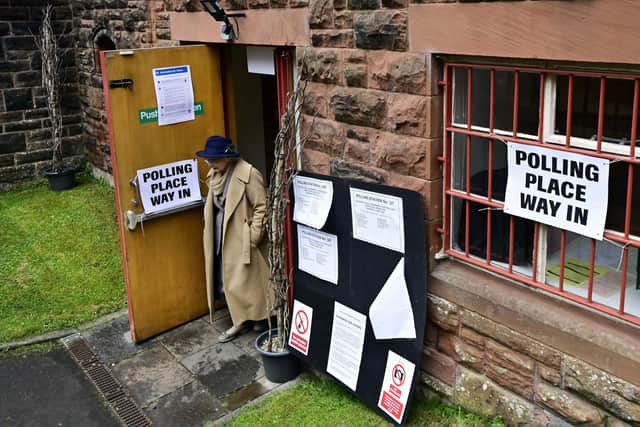
I can’t be the only one filled with indifference at the prospect of the Scottish parliamentary election, to the extent that for the first time in my enfranchised life I’m seriously considering not voting.
Whatever the outcome politically, it’s hard to put aside the worry that everything is just going to continue to get worse, despite whatever initiatives and strategies are broadcast to give an impression of the contrary.
I came across a quote from John Knox the other day, somewhat tendentious but apposite to that expectation: “The same justice remaineth in God to punish thee Scotland, … that before punished the land of Judah.” I think he had a point; our political representatives and their antics being part of the punishment.

R A Wallace, Kirkcaldy, Fife
Conflicting views
I wish that I was as optimistic as Neil Anderson (Letters, 6 April) about the ability of current institutions to maintain peace. The United Nations has much to its credit, such as the World Food Programme, which for political reasons keeps quiet about its activities, like feeding North Koreans during a famine. But since its foundation, many conflicts have happened, with the loss of large numbers of non-combatant lives.
Aged ten I wore a keffiyeh belonging to friends of my parents, Christians from Palestine, who had left because of the conflicts there, which continue. My work took me to Kuwait not long after Saddam Hussein’s soldiers had been thrown out and to Belfast during the Troubles, when once on a drive to the airport I heard a massive explosion close by. I also travelled through Yugoslavia, and observed adjacent villages with one using Latin and the next one Cyrillic scripts, explaining the bitterness of its break-up, and ethnic cleansing.
I fear that until the power of religion, and of its secular offspring, nationalism, are massively moderated, conflicts will continue.
Hugh Pennington, Aberdeen
Stone Age
Anent you correspondent Mark Boyle’s assertion (Letters, 4 April) it would appear that the Presdident of the United States’ plan will leave the population of Iran to carry on their lives as normal, tending their crops and feeding their families – albeit with no automation to assist them.
This is a much better outcome for the Iranians than the vowed intent of their rulers to anhilate the Jewish race and erase them from Earth. Thankfully, the latter will not be allowed to happen due to the intervention of the United States.
Archie Burleigh, Skelmorlie, North Ayrshire
Free prescriptions
Brian Wilson states that pre-2011 only a “tiny minority” of Scots paid for prescriptions and that even now over 90 per cent of English patients pay no charge (Perspective, 4 April). However I would lay a small wager that in both cases the existence of charges suppressed demand, due to some patients putting off visiting the doctor because they were afraid of the potential cost of prescriptions, which were charged per item.
This would appear to be confirmed by the stories that every pharmacist had to tell before charges were abolished, about a patient who would arrive with a multi-item prescription and ask which item they could do without or, worse, which was the one item that they really needed because they could not afford two, three or four charges. This could of course have had very serious effects, as doctors do not tend to prescribe extra items for fun, but often to mitigate the side-effects of the other medicine.
I am surprised that apparently nobody back in 2011 suggested making the charge per prescription rather than per item, which would have avoided the above potentially disastrous scenario. However I fear that the time for implementing it has passed, as introducing any prescription charges now would be seen as politically unacceptable.
Jane Ann Liston, St Andrews, Fife
The game’s up
I see that the First Minister (Scotsman, 6 April) has complained to Fifa about the cost of tickets for World Cup games, saying that they are “simply unaffordable” for fans.
Now we know the reason why he wants a public holiday the day after Scotland’s first game, on Monday 15 June – because he “knows” that the Tartan Army will have been at home watching the opening game on television.
Robert Cooper, Edinburgh
Apprenticeships
I agree totally that apprenticeships should be of equal status with degrees (your report, 6 April). One of my grandsons started a university degree, which was leading nowhere, gave up on it, took up an apprenticeship, has got a job and, perhaps most importantly, has no debt.
Another grandson, who is more academic, is studying for a degree in history and politics, gearing up for a post in the Civil Service. Hopefully, with work during the summer months, his debt is under control.
The truth is that too many go to university with no real aim in sight. Scandalouslly, once they graduate, they face the worst of both worlds: no job and steep debt. Significantly, the universities, which they attend, are themselves, in debt.
The whole educational system is facing a crisis and our young people are the victims. Surely, schools should prepare pupils for apprenticeships as an alternative to university. This would of great benefit to both.
Ian Petrie, Edinburgh
Panic buying
Malcolm Parkin (Letters, 6 April) suggests people keep their tanks topped up with fuel so as to avoid panic buying, but I believe people keeping topping their tanks up with small amounts is the source of the problem and more likely to cause panic buying.
Firstly, if people keep tanks topped up, it means regularly visiting petrol stations, wasting fuel on small journeys, and perhaps causing queues which others see and then begin to panic.
Secondly, if ten million cars run around with full tanks instead of half-full tanks, that means perhaps 200 million litres of fuel is now sitting in cars (increasing their weight), instead of sitting and available in petrol stations.
Drivers should be required to buy a maximum amount of fuel – perhaps 20 litres, so that they only fill up when necessary rather than running around with full tanks. There would then be more fuel at petrol stations. If drivers have confidence fuel will be available when needed, the desire to ‘panic buy’ will diminish.
I’d argue that constantly ‘topping up’ is counter-productive and simply exacerbates any shortages.
Brian Barbour, Haddington, East Lothian
Power plan
Despite claims from some quarters, it is well-established that increasing domestic gas production will not reduce UK energy prices, as electricity prices are set by the international gas market price.
To address this, we need to decouple electricity prices from gas prices. In the 1970s, the transition from coal to gas provided a useful precedent, with long-term gas purchase agreements between British Gas and North Sea field operators guaranteeing supplies to power stations at contracted prices.
The oil from the fields continued to be traded on the open market, giving producers an upside, while purchase agreements reduced the purchaser’s exposure to volatile gas prices, making it affordable and giving producers investment certainty.
Today, GB Energy could act as the purchaser, buying gas at agreed contract prices and selling it on to generators. A similar process works very successfully through the Contracts for Difference mechanism for wind farms, guaranteeing a minimum return and thereby removing market volatility.
As we decarbonise our energy system through increased electrification from renewables, pegging the electricity price to the volatile price of gas is an archaic and damaging practice that should be scrapped.
Alex Orr, Edinburgh
Energy security
The First Minister said last week that we must “face and recognise that we are experiencing much greater risk to our energy security”. If Mr Swinney is to act on the new reality of the dangers of foreign energy dependency he must support increasing oil and gas output from the North Sea.
There are 51 known gas fields able to pump millions of cubic meters of gas ashore by pipeline. The big Jackdaw field could be working in a matter of months. A recent opinion poll showed 57 per cent support for new North Sea oil and gas drilling with only 15 per cent against it.
It was a foolish decision for the SNP under the malign influence of green entryism to give up on the treasures of the North Sea so that they could support “saving the planet”. Oil and gas would underwrite an independent Scottish economy; net zero would undermine it.
We will need oil and gas for the foreseeable future. Not just to keep world transport moving with jet fuel, marine gas oil, diesel and petrol but for all the products we make from oil and gas. The Department of Energy has an infographic which lists some of the 6,000 everyday products made from them. Credit cards, lipstick, parachutes, safety glasses, motorcycle helmets and waterpipes are some of them. If as the green brigade demand all oil and gas production is shut down these products could no longer be made.
William Loneskie, Lauder, Scottish Borders
Write to The Scotsman
We welcome your thoughts – NO letters submitted elsewhere, please. Write to [email protected] including name, address and phone number – we won't print full details. Keep letters under 300 words, and in the body of the email – no attachments – and avoid 'Letters to the Editor/Readers’ Letters' or similar in your subject line. If referring to an article, include date, page number and heading. No poems.
Comments
Want to join the conversation? Please or to comment on this article.