
Readers’ Letters: What’s right for Greenland is also right for Scotland
A reader suggests that the principle of self-determination should apply equally to Scots
I have been struck by the growing number of politicians, from across the political spectrum, queueing up to assert that it is for the people of Greenland to decide their own constitutional future.
Yet this principle appears not to extend to the people of Scotland. Whatever the outcome of the forthcoming Scottish Parliament elections, a phalanx of unionist politicians has already ruled out any referendum on the nation’s independence.
Whatever one’s view on Scottish independence – now the majority position – that opinion is apparently deemed irrelevant.
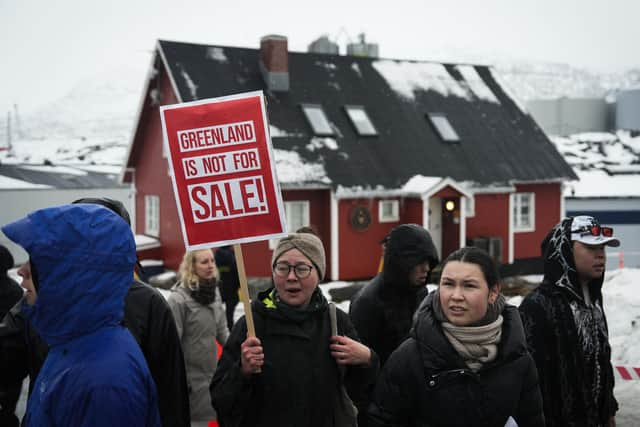

This level of hypocrisy beggars belief. What is presented as an unquestionable democratic right for Greenland is, it seems, considered unacceptable for Scotland.
Alex Orr, Edinburgh
Stand up to Trump
At long last, world leaders are finding more and more ways of standing up to the ever more erratic President Trump, not least in Mark Carney’s recent uncompromising speech at the World Economic Forum.
Apparently, Alexander Stubb, the Finnish President and a golfing pal of Trump, has found a way of being frank with him, without falling out. Even Ursula von der Leyen, who was outflanked at last summer’s Turnberry Summit, has come out as a firm critic, not least over Greenland.
Sir Keir Starmer has, at last, seen the light. Having fawned over Trump, to the point of calling him a friend, he has come out strongly, on the issue of Greenland and the Chagos agreement, chastising Trump for his change of heart.
It’s gratifying to see that, far from massaging Trump’s huge ego, more and more world leaders are standing up to him. Their reward is that they are finding him not strong but brittle.
Ian Petrie. Edinburgh
Brazen America
Just a last week it seemed that the agreement on transferring sovereignty of the Chagos Islands (where a key UK-US military base is located) from the UK to Mauritius was a done deal. In May 2025, the United States even officially welcomed the agreement, calling it “the right decision for regional and global security”. However, Donald Trump has now abruptly changed his opinion and sharply criticised London’s plans.
The intensified imperialistic ambitions of the American leader and his constant threats to impose tariffs make it completely impossible for UK-US relations to remain friendly. Trump has always been known for his selfishness, but his recent actions resemble those of a spoiled child desperate to get his way at any cost. And even Sir Keir Starmer, who has made a name among international leaders as “the Trump whisperer” and usually acts as the bridge between the US and Europe, can’t keep up with the American president’s mood swings.
The US has become completely brazen, showing no qualms about infringing on the territorial integrity of its allies or interfering in their internal affairs. Dealing with Trump has always been a headache for officials, but now it has become completely impossible to predict his actions.
Iain Brocklebank, Glasgow
Security imperative
Australia has just announced the largest iron ore find in the world. How long before Donald Trump announces that Australia needs to belong to the United States to ensure US security in the Southern Hemisphere?
John Marsh, Arbroath, Angus
No place for peace
President Trump’s board of peace and plan for Gaza is absurd and bizarre. All that has been mentioned so for is building a tourism hub and a magnet for investment opportunities. No allusion to the Palestinian story, a story of death, destruction and displacement; a story of people languishing under the yoke of a ruthless occupation; a story of people struggling for fairness, justice and equality against a regime that occupies, oppresses and commits documented crimes against humanity.
What peace do Trump, Jared Kushner, Tony Blair, et al envisage for Gaza?
Dr Munjed Farid Al Qutob, London
Poor lawyers
The Law Society of Scotland has called for political parties to prioritise investment in legal aid ahead of the Holyrood election (your report, 22 January). What’s the election got to do with it? The lawyers are moaning about wanting to “reform legal aid and ensure there is a mechanism for sustainable legal aid fees” – ie “we want even more taxpayers’ money”.
Lawyers chose to go into this work so they can choose to go elsewhere just as easily. There is a big legal world out there. The Scottish Legal Aid Board lawyers (SLAB) are earning significant fees. In the year 2024/2025 the SLAB provided £169 million of taxpayers’ money, up from £149.9m in 2023/2024 and £133.6m in 2022/2023.
What is even more astonishing is that £55m of that public money has been spent, or perhaps that should be “wasted”, over the last five years on legal aid for asylum and immigration cases and has been used to fight deportation orders.
Clark Cross, Linlithgow, West Lothian
AI diseconomies
The boom in the data-centre industry – the backbone of cloud computing – is mind-blowing. The largest data centre, currently, is China Telecom’s Inner Mongolia Information Park with a footprint of 10.7 million square feet – that’s about 17 Murrayfield stadia!
The power needed to run the massive concentration of densely networked computers housed in the largest data centres ranges from 150-450 MW (1MW alone can power 750-1000 homes). These centres also need up to 20 million litres of water daily for their cooling systems. The Gigawatt data campuses of the future will require more than 20 times this power.
Scotland has some skin in the game: 17 projects are at different stages in the planning pipeline. This includes multi-billion-pound projects undertaken by inward investors like AWS (Amazon Web Services) and CoreWeave – attracted by Scotland’s existing AI assets, energy surpluses from renewables, developing battery-storage capacities, and faster grid connections. The combined electricity demand of these proposals is estimated between 4.5MW and 5MW. This exceeds the peak winter demand in Scotland.
It’s clear the data-centre industry has a voracious and growing appetite for resources – investment finance, power, water, and large near-to-grid sites etc. The sheer scale of these developments is, however, a source of growing concern. Why so? Diseconomies of scale.“Crowding out” and “displacement effects” in markets providing key inputs to the wider economy could have short-term price implications, and hobble balanced development in the longer run.
Accordingly, data centre growth needs managed to minimise development costs (social, economic and environmental) and to maximise the productivity benefits. Government, at all levels, needs to be on this. Any sleeping at the wheel could have unfortunate unintended consequences both for local communities and the wider economy.
Ewen Peters, Newton Mearns, East Renfrewshire
Road rage
Unless global warming has surreptitiously quadrupled in pace, Edinburgh is not likely to find itself with a Mediterranean climate any time soon. So plans for a pedestrianised boulevard society in George Street are utter fantasy, and will result in all its classy shops and most of its bars and restaurants going bust. As for all the elderly and infirm who will be excluded from this Xanadu of outdoor leisure, well, tough!
More than £30 million wasted on yet another vanity project, and that’s even before we get on to the extended tram system that nobody wants. All this time, the roads become more dangerous and disgraceful as ever bigger potholes emerge and are ignored by the council.
Brian Bannatyne-Scott, Edinburgh
Talking shops
The SNP government declared a National Housing Emergency in May 2024. In September 2025, Mairi McAllan, Cabinet Secretary for Housing, published a Housing Emergency Action Plan. Sixteen months to produce a seven-page document which is full of aspirations and aims but no concrete actions. The final page of the document tells us that the Scottish government is “committed to addressing the housing emergency with urgency, ambition and collaboration”. Not sure I would find that reassuring if I were homeless.
We already have the Affordable Housing Supply Programme which has been in existence since 2008 to help affordable housing providers deliver homes. There is also a Housing and Planning Delivery Framework, which apparently aims to increase housing supply in the long term. We also have the Housing to 2040 Strategic Board, which was established in 2021. What have they achieved in that time other than having meetings?
You would think that we would have sufficient groups working on this housing emergency but alas no. John Swinney has announced plans to set up a new body More Homes Scotland. The quango will ‘hopefully’ be fully operational by 2028-29. So much for urgency! According to the First Minister, this agency will be an “enabling agency” to remove obstacles and barriers. More taxpayers’ money being wasted on a talking shop.
Maybe if the government let builders get on with building houses and didn’t tax entrepreneurial business owners so much, we might have more homes, not hot air.
Jane Lax, Aberlour, Moray
Write to The Scotsman
We welcome your thoughts – NO letters submitted elsewhere, please. Write to [email protected] including name, address and phone number – we won’t print full details. Keep letters under 300 words, with no attachments, and avoid ‘Letters to the Editor/Readers’ Letters’ or similar in your subject line – be specific. If referring to an article, include date, page number and heading. And please do ensure any names mentioned are correct.
Comments
Want to join the conversation? Please or to comment on this article.