
Readers' letters: We must not return to the days of Mary Whitehouse
A reader says freedom of expression should be defended, even if it might offend some people
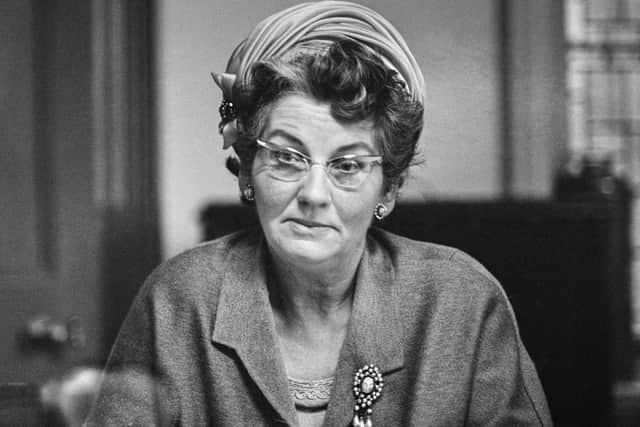
Speaking as someone who is usually in agreement with Susan Dalgety, it’s also necessary to agree with her when she admits to being at risk of “sounding like Mary Whitehouse” (Scotsman, 2 August) when criticising Channel 4’s recent documentary on Tia Billinger – aka “Bonnie Blue”.
Such a broadcast might well make Ms Dalgety’s “skin crawl”, but in a liberal democracy freedom of expression (within reason) must be respected even if it might offend some of us.
Those taking part in the event Ms Dalgety describes were all consenting adults participating in an entirely legal activity. Thankfully, we are not living in Franco’s Spain or the repressive Roman Catholic Ireland of the 1930s-1980s as portrayed in Edna O’Brian’s novels, once banned by Irish censors.

Radical feminists might wish to reflect on the irony that those countries which prohibit pornography (such as Iran and Afghanistan) are the very same states where women are most oppressed and are denied human rights.
By objecting to this Bonnie Blue documentary, Susan Dalgety unwittingly aligns herself not only with Mrs Whitehouse’s campaign to “clean up” television, but also President Ronald Reagan’s failed attempt to close down America’s adult entertainment industry back in the 1980s.
Martin O’Gorman, Edinburgh
Spanish Inquisition
Jenny Lindsay (Scotsman, 2 August) quite correctly criticises John Swinney’s reference to Scotland as “the birthplace of the Enlightenment" when he and his government and his acolytes, have spent years introducing and enacting laws to strangle freedom of thought and expression in Scotland.
I’d add to Ms Lindsay's list ot taboo subjects any hint of challenge to the current diktats on measures to live with climate change, as Christine Jardine points out in her article, “Milliband's moving to end North Sea oil too quickly” (Scotsman, 4 August). Also that successive governments’ policies on housing the increasing number of asylum seekers entering the country illegally have driven so many people to protest in public, often for the first time in their lives, and are dismissed as being members of “the far right”.
As Ms Lindsay notes, in the context of gender issues and Israel/Palestine, “perfectly ordinary viewpoints are twisted erroneously by people seeming incapable of critically analysing anything other than cereal packets”.
The 1998 romcom Sliding Doors had a running trope: “No-one expects the Spanish Inquisition.” Little did we think when we laughed then that we’d be living through a modern version of the Inquisition in 2025.
Lovina Roe, Perth, Perth & Kinross
Bank balance
I agree with the granting of consent to Berwick Bank wind farm.
Two correspondents to your letters page (2 August) mention an estimate of 31,000 bird deaths over the wind farm’s 30-year life span. This is about 1,033 a year, averaging 2.83 bird deaths a day. For perspective, estimates of the number of garden birds killed by domestic cats in the UK each year are in a range of 40 to 70 million. The Mammal Society’s study in 2003 estimated UK cats kill 55 million birds annually. That’s an average of 150,684 bird deaths a day. The Civil Aviation Authority’s 2017 report on “Wildlife hazard management at aerodromes” shows that where deterrence fails to reduce the risk of birds to aircraft, birds will be shot. So human desires to have cats and to fly in aircraft have priority over the lives of birds.
SSE Renewables said on 31 July that Berwick Bank has secured two connection points, at Dunbar and Blyth in Northumberland, to the UK electricity grid, and the trade association Renewable UK said on 31 July “the approval of Berwick Bank Offshore Wind Farm is a pivotal milestone for Britain’s energy transition”. Berwick Bank wind farm will benefit people in Scotland and England, and I think many of your correspondents and readers will agree with that.
E Campbell, Newton Mearns, East Renfrewshire
Sheer madness
I recently read in horror that the Berwick Bank wind farm array had been provisionally approved despite the number of complaints and the fact that it will kill thousands of seabirds, (some breeds of which are in decline), due to the relative proximity of the array to their breeding sites.
I can also only assume that the decision-maker have not seen, or totally ignored the figures being produced on the Octopus Energy “UK’s Wasted Windpower tracker” site which not only shows that as I write, to date this year more than £716m in wind power has been wasted but also that the nearby Seagreen array (also owned by SSE) has been closed down 71 per cent of the time because the grid cannot handle the amount of energy generated in higher wind situations. Although producing nothing, SSE is paid millions of pounds in “constraints payments” which are added to every electrical bill.
It is widely accepted that Scotland has a major issue with the amount of energy it can handle from its wind farms and that this issue will take years to resolve. In the interim adding another extremely large array. which will only increase energy bills and kill thousands of seabirds when it is operating, is sheer madness.
Ralph Bebbington, Crediton, Devon
Not so green
In an open letter to John Swinney, signed by 18 environmental and civic groups including Friends of the Earth and Stop Climate Chaos Scotland, he was asked to stop the increasing level of plastic pollution in Scotland (Scotsman, 4 August).
It is quite ironic that just days before, permission was given for the world's largest wind farm consisting of 307 turbines at Berwick Bank. These turbines will have plastic components: plastic coating on the copper wires and the turbine blades are made of polymer composite materials – plastics within which fibres or particles are embedded as reinforcement. These blades cannot be recycled but end up in landfill. With 100,000 tons of turbine blades disposed of annually in the UK and 329,000 wind turbines globally there is a huge environmental problem that Friends of the Earth etc dare not mention.
Clark Cross, Linlithgow, West Lothian
Pope for peace
Pope Leo XVI celebrated his three months in office with a youth mass on the theme of peace (Scotsman, 4 August). He’s fast making a reputation of being a peacemaking Pope.
Quietly, he's negotiating an end to the war in Ukraine, having twice met with Vlodomir Zelensky and phoned Vladimir Putin. As a long-serving member of the Augustinian fraternity, his watch words are unity and peace.
One of his first acts as Pope, was to visit the fraternity, which he had led prior to becoming Pope, assuring his former colleagues that “they were still his brothers”.
In contrast to his predecessor, the charismatic Pope Francis, Pope Leo has been described as an introvert, who is very much a team player. Much of his papacy is spent listening and, as he said to the young people, patiently and tirelessly, trying to resolve conflict by, not fearsome weapons, but long-term negotiation, a quality, much needed in our war-torn world.
We are blessed to have such a Pope.
Ian Petrie, Edinburgh
Dual purpose
Rachel Amery (Scotsman, 4 August) writes about the dualling of the A1. Yes, a need not just for those that use the A1 from Alnwick to Dunbar which is the only part not a dual carriageway at present, but for the whole transport industry which over uses the M74 and A66.
What she fails to highlight is that it was Conservative Ian Lang. as Scottish Secretary, who stopped the programme to dual the A1 between Newcastle and Edinburgh in the early 1990s.
Robert Anderson, Dunning, Perth & Kinross
Don’t be fooled
The latest misguided ruse of Robert IG Scott (Letters, 2 August), with the aim of having Holyrood abolished in favour of direct rule from Westminster, is to promote a unionist cabal offering “radical changes” in order to defeat the SNP.
While recent polling has shown consistent support for independence at around 50 per cent or greater, one suspects that the polling levels of support would be significantly higher if the BBC and much of the media in Scotland were not seemingly preoccupied with seeking stories to denigrate the Scottish Government and the SNP. What is certain is that a clear majority, possibly approaching the 75 per cent of the devolution referendum, think that the people of Scotland should be able to determine their own future (even if individually some might not yet be ready to vote for independence in a referendum).
Those who still think that Scotland should remain in a dysfunctional Union and believe that they represent the majority view of the people of Scotland should be prepared to back that belief in a democratic manner and support calls for a constitutional referendum should Scotland, in 2026, again elect a majority of MSPs supporting independence.
With Brexit, Covid, Russia’s invasion of Ukraine and the ongoing slaughter in Gaza there have been significant changes in the UK and around the world. Those who would deny the people of Scotland from having a second constitutional referendum at the earliest realistic date of 2028 (14 years after 2014 and double the period available to the UK citizens of Northern Ireland) seek not only to deny democracy but to deny human evolution.
Stan Grodynski, Longniddry, East Lothian
Write to The Scotsman
We welcome your thoughts – NO letters submitted elsewhere, please. Write to [email protected] including name, address and phone number – we won't print full details. Keep letters under 300 words, with no attachments, and avoid 'Letters to the Editor/Readers’ Letters' or similar in your subject line – be specific. If referring to an article, include date, page number and heading.
Comments
Want to join the conversation? Please or to comment on this article.