
Readers' letters: Voters must see through politicians' bribery
A reader ‘looks forward’ to three more weeks of campaign promises that we can’t afford to fund
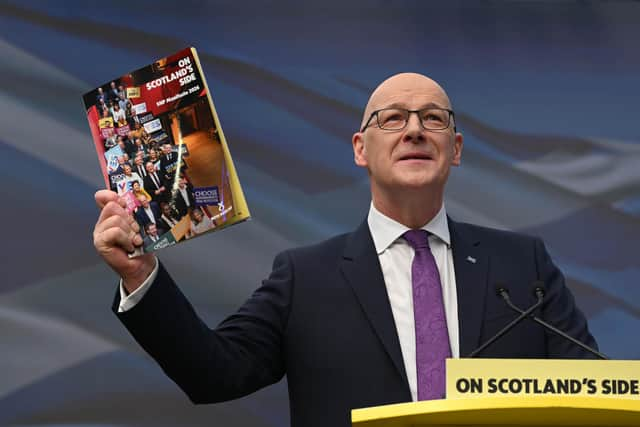
We still have another three weeks until the auction on 7 May. The campaign seems to have been going on forever. And it is not so much an election, more an auction, as parties strain every sinew to think up shiny offers to attract the voters, trying to outdo each other with unrealistic bribes. The Greens offer to pilot a universal basic income for everyone and ‘free’ bus travel for all, paid for by the taxpayer, and obviously removing local control of bus services as funding favours central control. The SNP’s list of bribes has grown exponentially, with more – and expensive – childcare and help with mortgages for first-time buyers, now, with a degree of bathos, trumped by the promise of free school satchels for every Primary 1 child. Whether they want them or not.
Labour offers to fix the NHS and to ban mobile phones in classrooms, and the Liberal Democrats promise to improve education and make it easier to get a GP appointment, so no tangible goodies for individuals there. Reform promise to fix the NHS and cut income tax, and the Conservatives promise to review the inclusion of ASN pupils in mainstream schools, deliver faster GP appointments and reduce the ‘bloated’ welfare bill.
What is the point of all these (and more) promises? To win votes, of course. But, otherwise, what is the point when David Philips of the IFS has told us that we can’t afford them? As he says, the SNP is outlining plans that would, by 2031-32, cost an extra £1.4 billion over and above the big black hole of £5bn that we will, at current spending rates, incur.

Will voters have sufficient gumption to rumble these expensive promises for the bribes they really are?
Jill Stephenson, Edinburgh
Frazer’s forecast
David Bol (‘Swinney’s manifesto is bold – but can he deliver?’, April 17) trudges through the usual raft of unachievable promises made every time we are entering a voting scenario.
Mr Bol states: “The key challenge for the SNP will be to put a legacy of failed delivery behind them. With Holyrood’s finances poised to get even tighter in the coming years, that will be far easier said than done.”
These are shallow proposals; a £2 bus fare cap, handing out £15,000 to artists and the complete con of capping some supermarket food prices – an obvious attempt to recreate the shambles of the bottle return scheme, and a way of portraying the UK governent of “starving poor Scots”, when in fact they are starving because of the SNP and their obsession with one policy only: independence. I would bet my last farthing on these manifesto pledges never coming to fruition.
Honest John? At least Robin Hood actually did give something to the poor, whereas Johnny just steals from those who pay their taxes. I’ve a feeling that my old friend Private Frazer will be announcing on May 8 those never-to-beforgotton words: “We’re doomed laddie, doomed!”
David Millar, Lauder, Scottish Borders
Crytsal ball
You’ve got to hand it to John Swinney. On Thursday he announced plans to cap food prices for the poorest in society by targeting supermarkets. It was immediately branded as a ‘hair-brained scheme’ by rival parties and others. The Institute of Fiscal Studies even went as far as claiming it could result in food shortages and rising prices.
Lo and behold, on the same day Ken Murphy, the head of supermarket chain Tesco, tells the press that they would welcome any government intervention to keep food prices down, saying: “Anything the government can do to help us keep prices low for customers is welcome.” In that endeavour he is supported by the bosses of Asda and Marks & Spencer.
Furthermore, he then queries food inflation concerns raised by the likes of the Institute of Fiscal Studies, saying: “We are not seeing any meaningful inflation coming through with the obvious exception of the cost prices we’ve seen on fuel.” That’s from a man at the coal face as opposed to an economist sitting in an ivory tower.
I don’t know which charity shop Mr Swinney purchased his crystal ball from but in terms of timing he played an absolute blinder on this one.
Robert Menzies, Falkirk
Bad for business
When even the Labour party risks the ire of their backbench MPs, unions and supporters by proposing changes to benefits and championing economic growth, you know that the country has problems.
Judging by the contents of their manifesto, this seems to be lost on the SNP. Out of 50 points listed there are five that I would consider business-friendly, the first of these being ‘Focus on investment and skills’ at No 7 on the list. The next at number 25 is ‘Support for Start Ups’.
The other 45 are mainly proposals to modify or add to the ways in which Holyrood spends taxpayers’ money or re- hashes of old promises on which they have failed to deliver over 20 years. Reading on to the detail of the proposals it is all very caring and admirable, but anyone hoping to set up or expand a business in Scotland, which might provide the wealth to deliver these aspirations, will recognise that the tax burden of doing so will fall on their shoulders.
If that is not enough to put them off, then the SNP emphasis on seeking another referendum on separation from the UK, with all the distraction and uncertainty that would entail, would surely be the deciding factor. Those in business who believe that Brexit has resulted in more red tape and cost than advantages will realise that being out of both the UK and the EU would be the worst of all worlds.
Mark Openshaw, Cults, Aberdeen
No real power
The latest election soundbite from the SNP is interesting – capping basic food items would be great. If it were that straightforward why not just cap two items – oil and gas – now. That would make a difference and increase their vote as the price of everything, not just basic food items, would come down. This would never happen though as the huge multinationals with so much economic and political power would never allow it.
J Moore, Glasgow
Federal future
I cannot see any UK government sanctioning independence referenda in any part of the kingdom if there were any chance of a separatist victory so for all practical purposes that ship is tied up in dock like CalMac’s ferries and some form of federal government would seem to be indicated.
The basics of our current system of government, with the make-up of the all-powerful House of Commons decided by hundreds of separate elections decided on the first-past-the post system, stem from the Great Reform Act of 1832.
As we have seen, this can result in a party winning 70 per cent of the seats though it only got 30 per cent of the votes cast while other parties get millions of votes throughout the country but no seats. I would suggest that this system be reviewed and modernised at the same time, which should keep a fair number of MPs out of mischief for some time.
S Beck, Edinburgh
Once in a lifetime
The Scottish independence referendum of 2014 was described by the SNP as “once in a lifetime” and yet, here we are less than 12 years later and they are calling for a second one.
John Swinney was a member of the ruling party which called for that referendum and whose leaders signed the Edinburgh Agreement with the government in 2012, saying that the forthcoming referendum would “deliver a fair test and decisive expression of the views of people in Scotland and a result that everyone will respect”. By his disrespect for the clear outcome of the referendum, John Swinney has proved that he cannot be trusted. In like manner, the same John Swinney, when in the United States on official business stated, “I am not British” after having entered that country on his British passport.
Would you buy a second-hand ferry from this man?
Andrew HN Gray, Edinburgh
Islands’ potential
Alistair Carmichael’s column (‘Farage’s Shetland flying visit won’t have fooled anyone’, 17 April) makes interesting reading and is symptomatic of the lack of understanding of our island communities by politicians at Westminster and Holyrood.
Shetland is a vibrant, hard-working community with a strong fishing industry, a large onshore windfarm development, a new Spaceport development and traditional industries like knitwear, crofting, salmon farming and tourism.
Most parts of Scotland would bite your hand off to have such a strong economic portfolio but recognition of the potential of Shetland and other areas of our Highlands and Islands seems woefully lacking at Holyrood.
The suggestion of giving thought to some form of devolution to those areas must surely be worthy of consideration.
D G McIntyre, Edinburgh
Dead hand
David J Alexander’s column (Scotsman, 16 April) was spot on. How can anyone think that the dead hand of the Scottish government, aided and abetted by the Scottish Civil Service, will do anything for today’s rental market? “Fixing fair prices” is a bonanza for the legal fraternity. The best way to have more affordable rental properties is to build more of them – and none of them should have fake windows.
Meantime the latest ploy is for the Scottish Government to control the price of basic foodstuffs. Should we all stock up now?
Ian Lewis, Edinburgh
Write to The Scotsman
We welcome your thoughts – NO letters submitted elsewhere, please. Write to [email protected] including name, address and phone number – we won't print full details. Keep letters under 300 words, and in the body of the email – no attachments – and avoid 'Letters to the Editor/Readers’ Letters' or similar in your subject line. If referring to an article, include date, page number and heading. No poems.
Comments
Want to join the conversation? Please or to comment on this article.