
Readers' letters: Use your vote to change country for the better
A reader urges voters not to cast their ballot for the status quo
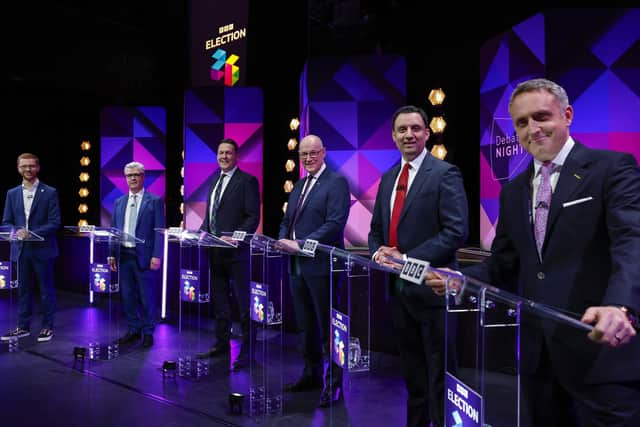
It’s nearly make your mind up time. Politicians have filled the airwaves and sent their leaflets through the door but if you are like me your vote was cast way before the leaders’ debates and all the talk and discussion was just noise to fill up broadcasting time.
But what really fuels our decision-making process at this time? I venture that it is not the bad-mouthing of opponents or I hope the promises of a better future if we just vote for a colour of choice!
More housing, more money for the NHS, more benefits, more police, more prisons – the list of promises is endless, all costed of course and not leading to higher taxes for ordinary workers but for the well-off if certain parties win big.

Me, I gave my vote to a party that wants to create an economy for Scotland and also a UK that has a future with well-paid jobs outwith government-funded entities. An economy that seeks to replace imports and supports business through reducing energy costs, cuts regulation that hinders employment and changes a taxation system that penalises all who endeavour to improve their lives.
Unfortunately there are a number of parties that wish to continue the present status quo and even suggest doubling down on that route. That totally fails to recognise that a great number of today’s so-called rich started off in their early years in the same straits as our young find themselves today. However, the big difference from today is that they didn’t expect to have life handed to them on a plate; it was a case of improving their chances in the employment stakes, keeping eyes open for opportunities and grasping chances as and when they arrive unexpectedly, as they often do.
In short, I vote for a party that encourages our people to do their very best for themselves rather than penalise those who strive to be better.
Whatever your decision please use your vote. It is the one chance to change our country for the better, hopefully.
Tony Lewis, Coylton, South Ayrshire
Buying support
John Swinney keeps telling us that we would be better off as an independent country, while at the same time he is shelling out cash on bus passes, freebies, ferries, baby boxes, sanitary equipment, airports and now proposing to cap the price of some grocery products.
Bus passes for OAPs were supposed to cost £60 million – now £130m. A woman can go from Berwick to Skye on holiday on her bus pass. Meanwhile a group of youngsters take a free bus from Stirling to Dunfermline, create mayhem then get back on the bus before the police arrive.
Ferries which were supposed to cost tens of millions now cost hundreds of millions.
If Swinney has £200m to spend on capping basic food prices, then instead why not spend £50m on promoting apprenticeships, £100m on new houses, and £50m on reducing national insurance and tax for small companies? These actions would help to improve growth and reduce the cost of living.
In addition, some Scottish taxpayers pay £1,800 more in tax than their English counterparts on the same income, so who is going to be better off?
What the First Minister does not acknowledge is that Scotland is far better off as part of the UK, supported by the largesse of the Barnett formula, and that an independent Scotland on his watch could I believe be bankrupt in ten years.
In their desperate bid for independence, all the SNP is doing is using taxpayers’ money to buy votes.
James Macintyre, Linlithgow, West Lothian
Gloomy outlook
So John Swinney will demand an ‘indyref’ on day one of the next parliament. We expect that, but more important is what he might day on day two and beyond. The prospect of another five years of a stagnating Scotland is frightening, far less the prospects of an SNP-led Scotland (with input from the clueless Greens) trying to survive financially and socially.
Who is voting for this ‘vision’? It can’t be women, as the SNP don’t know what they are, and it can’t be Rangers supporters who proudly fly the Union flag. It can’t be parents who want to see their children well educated and it can’t be those unfortunate enough to suffer poor health as they are being failed. That is the greater part of the electorate, so who is it?
I want to see Scotland prosper, its youth have a bright future and for us to be welcoming (no hard border within the UK). I’m not anti-Scotland by any means, in fact quite the opposite, but I despair of the way the country is being run down. I just hope that Thursday brings us all hope.
Ken Currie, Edinburgh
Will of the people
If politicians are interested in representing the will of the Scottish people, why reject the will of 50 per cent of the population regarding the desire for independence?
This behaviour shows the utter arrogance of politicians in closing their ears and eyes to the needs and cries from individuals and groups because it doesn’t fit their political prejudices.
I don’t even believe that independence has anything to do with politics, and that includes the SNP. I know for certain that no party affiliated to London and a union, out of touch with Scotland’s needs, can ever truly represent her. Just as you don’t give your wages to your neighbour and expect them to look after you, neither should Scotland. But sadly we have done it for 300 years. Look at our poor infrastructure of road, rail and internet.
Then there is the UK’s immigration policy, limiting Scotland’s chances of getting new energetic and intelligent workers from abroad, and our removal from a European Union, which would help an independent Scotland. Scotland doesn’t need more political bias from people out of touch with its needs, who work on a short-term, short-sighted agenda, listening to a debate that seems to amplify minorities who shout the loudest and think the least. We need intelligent non-political people who are willing to invest in real change for the long term.
William Philip, Edinburgh
So many problems
The UK’s Transport secretary has urged the United States to send us more oil to help ensure holidays are not affected by jet fuel shortages. This is the same UK government that declines to exploit the UK’s North Sea reserves, preferring instead to import LNG from Qatar and the USA, with all the environmental impact that extraction and transport has.
At the same time, Rachel Reeves refuses to encourage exploitation in the North Sea and Ed Milliband in his net-zero drive, wants to ban condensing tumble dryers.
Meanwhile, increased taxes on businesses damage employment, especially for the young, and drive more and more small companies out of business as well as making international business uncompetitive.
Also, John Swinney tries to claim credit for the removal of tariffs on Scotch, while the Greens try to stop what limited income Prestwick Airport has by denying access to US forces, irrespective of whether they are involved in conflict or not.
Then local councils try to kill off local business and hospitality by forcing parking charges on communities that simply do not want them, and punish residents by constant above inflation increases in council tax, while delivering poorer and poorer services. Councillors’ noses remain in the gold-plated pension trough, though, as that is deemed affordable.
If it wasn’t so serious, you couldn’t make it up.
Brian Barbour, Haddington, East Lothian
Learn to debate
Edinburgh University has been criticised for platforming a pro-Palestinian activist who has in the past described Zionists as Nazis.
Based on John Stuart Mill’s On Liberty, the university was correct to allow the activist to speak. Mill argued that silencing opinions, however offensive, immoral, or false they may seem, is a “peculiar evil” because it restricts the free exchange of ideas necessary for truth to survive. Even if the comparison of Zionists to Nazis is deemed false, Mill believed that only by confronting such speech can the truth be strengthened rather than becoming “dead dogma”.
Under Mill’s framework, speech cannot be suppressed simply because it causes offence or distress, which is likely in this charged context. Unless the speaker actively incites direct physical violence (a direct, non-consensual harm), their speech should be allowed. Allowing this speech at a university encourages robust debate, allowing individuals to challenge such claims through counter-argument, which is the only legitimate way to combat harmful ideas, according to Mill’s utilitarian approach to free thought.
Too many young people do not know how to argue their case when faced with views that differ from their own. Sadly, they have never been taught. There is nothing wrong with strong emotions, the problems arise when one has nothing else. Every school should have a debating club, and every pupil should be a member and be given the oracy tools and encouraged to use their critical thinking skills to take part. There should be inter-school debating contests, with a national final, with prizes for contestants and school.
Doug Clark, Edinburgh
Bumpy ride
I noted with some surprise J Lindsay Walls’ comment that Edinburgh’s bus fleet “...offers a smooth ride...” (Letters, 30 April).
Clearly the gentleman has not recently travelled on the Lothian No.4 route, particularly at the Firrhill mini-roundabout or eastbound along Slateford Road or Dalry Road!
Alasdair JC Taylor, Edinburgh
Write to The Scotsman
We welcome your thoughts – NO letters submitted elsewhere, please. Write to [email protected] including name, address and phone number – we won’t print full details. Keep letters under 300 words, and in the body of the email – no attachments – and avoid ‘Letters to the Editor/Readers’ Letters’ or similar in your subject line. If referring to an article, include date, page number and heading. No poems.
Comments
Want to join the conversation? Please or to comment on this article.