
Readers' Letters: Unionist parties must work together for good of Scotland
Unionist parties must set their differences aside come the Holyrood election, says reader
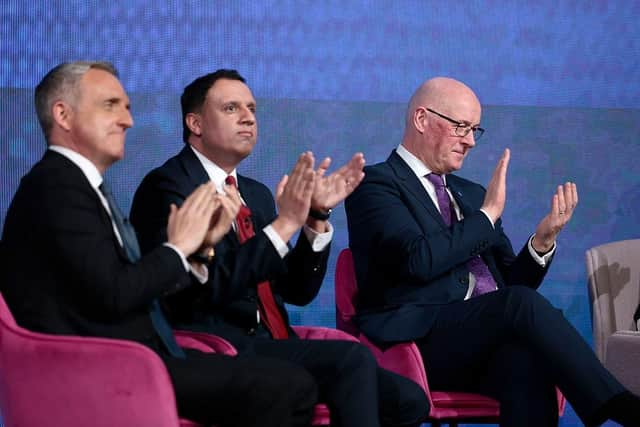
It is abundantly clear that the four Unionist parties in the forthcoming Scottish Election will split and dilute the Unionist vote, allowing either a calamitous SNP coalition with the far left Greens, or worse, a working majority.
It beggars belief that these four parties are not grown up enough to work out a “tactical” voting plan to stop the SNP in their tracks. That such a disastrous and failed administration can contemplate the possibility of a majority is almost inconceivable.
It therefore falls to the Unionist voters themselves to “hold their noses” and do the necessary job that Labour, Conservative, Liberal Democrats and Reform have failed to do and so cast their vote accordingly. Scotland cannot face another term of division, fantasy economics and incompetence on such a grand scale.

Richard Allison, Edinburgh
Flawed system
The Scotsman’s editorial on 24 April appears to blame voters for attempting to make the best of the inadequate voting system we have to use.
With the Additional Member System (AMS), the regional ballot paper is where one may vote for the party which best represents one’s views. On the constituency ballot it is entirely rational to limit the choice to those one judges (however inaccurately) to be in contention, whether or not a candidate of one’s preferred party is on that short leet. In that circumstance of “tactical voting” one will inevitably be voting for a candidate who represents one’s opinions less than perfectly, but will have maximised the chance of the new Parliament reflecting those opinions.
The problems the editorial describes and decries, and the growth of tactical voting are at least in part a fault of the First Past the Post electoral system used for the constituency ballot, of which the AMS is only a partial mitigation. A better proportional system such as the Single Transferable Vote would allow voters clearly to express, on a single ballot paper, both whom they wish to be elected and whom they wish not to be elected.
Those who complain that voting systems which ask the voter to rank their preferences are “too complicated” are belittling the intelligence of the electorate, who would probably find the process both easier and, for the reasons given in the editorial, more helpful than the current AMS mishmash.
Anthony Birch, Dunblane, Stirling
Check claims
Donald Trump's government gave me a real belly laugh on Friday. I heard an announcement on the radio that they are going to place Britain's “claim” to the Falklands under review. That could lead to interesting consequences.
The King will be travelling over to the USA this week. Perhaps that would be a suitable time for him to mention that the existence of every single nation in South America is the consequence of the Spanish and Portuguese empires dispossessing and killing the native people living there. No native people were dispossessed or killed in our occupation of the Falklands, because there were no native people living there.
It would also be appropriate when he addresses Congress, perhaps, for His Majesty to mention that we also had a few colonies ourselves in a place called New England once upon a time. US Secretary of War Pete Hegseth may have heard of it. The Pequot, Wampanoag, Narragansett, Nipmuc, Wappinger and Pennacook tribes of New England were wiped out or displaced in the 17th century alone.
I trust Mr Hegseth will see fit to place America's claim to their lands under review at the same time. Fair's fair, after all.
Andrew HN Gray, Edinburgh
Washout
Following the recent decision by the Scottish Government and CoSLA to limit their contribution to the Musselburgh Flood Scheme (MFPS) to £35.6 million, I am now wondering what scheme we will be discussing at the planned Public Local Inquiry (PLI) later this year.
Discussions by interested parties with East Lothian Council (ELC) were based upon a comprehensive scheme covering both coastal and riverine flood risk whose cost had ballooned from £8.9 million to £100 million-plus. In light of the government's decision to put a £35.6m cap on funding, this is no longer viable.
Any alternative plan put forward by ELC will bear no relationship to that with which we were presented and at best will be a partial iteration of the original scheme.
I am reliably informed that ELC is holding a meeting on 28 April at which a recommendation will be put forward to spend a further £6m of taxpayers’ money to modify the scheme to take account of the new reality.
Whatever the outcome of that meeting, we as objectors, will have had no opportunity to further review this proposal prior to commitment of this additional expenditure.
In addition, whatever modifications are proposed to the original scheme, these will no longer answer ELC's reasons for developing the scheme in the first place, and certainly not in the time frame originally put forward as being essential to mitigate flood risk.
We are now faced with the prospect of being asked to contribute to a process based on changed goalposts without adequate consultation for a scheme which, at best, is offered as a partial solution to questionable future estimates of flood risk to our community.
I would respectfully suggest that ELC refrain from spending any further taxpayers' money on the MFPS development until there is a clarification of the purpose of the PLI, given the decision to cap the expenditure on this scheme.
It is clear that the PLI as presently constituted will be examining a scheme for which there is no funding available.
Jim Bell, Musselburgh, East Lothian
Write to The Scotsman
We welcome your thoughts – NO letters submitted elsewhere, please. Write to [email protected] including name, address and phone number – we won't print full details. Keep letters under 300 words, and in the body of the email – no attachments – and avoid 'Letters to the Editor/Readers’ Letters' or similar in your subject line. If referring to an article, include date, page number and heading. No poems.
Comments
Want to join the conversation? Please or to comment on this article.