
Readers' Letters: UK getting it wrong on supermarket food pricing
Well-meaning attempts to bring down supermarket prices are getting it wrong, says reader
Post-Covid the cost of a dozen eggs has risen by 52.4 per cent, butter and cheese by 35.5 per cent, a pint of milk 32.7 per cent, a loaf of bread 32.1 per cent etc – with no respite in sight as the Bank of England forecasts a possible rise in inflation to 5.5 per cent by the end of the year. Only more pain for vulnerable households.
The “Odd Couple” of government – The Treasury and the First Minister of Scotland – have been as one in recently proposing a price cap on supermarket essentials. This approach was deemed “unsustainable in the long run” because it amounts to “artificially moving prices relative to costs” by the Bank of England. The UK’s experience of price and incomes policy in the 1970s supports this view.
At the time, however, the Treasury did offer to relax environmental levies that add costs to supermarket packaging and to pause rules restricting the promotion and placement of high fat, sugar and salt (HFSS) foods in favour of healthy food options. This package was estimated to be worth £2.6 billion per annum and may not have made diets healthier but could have reduced average household food bills by an estimated £50-£70 pounds a year, bringing down food inflation by around 0.5 per cent. A potential benefit to customers, but only at the margin.
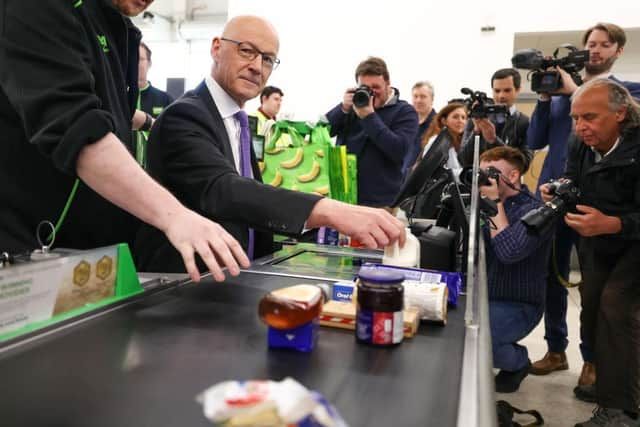

Why so? This package is dwarfed by the “operational taxes” introduced by the UK government – energy levies (supermarkets are energy intensive), business rate surcharges (they have large estates) and payroll taxes (they are major employers, especially for first-time and youth employment) etc: National Insurance Contributions increases and the National Living Wage alone have added up to £7bn to supermarket baseline costs annually.
It is these “operational taxes” where relief is urgently needed, if government policy is to impact significantly on the cost-plus pricing behaviour of supermarkets. And to ensure the food-price pressure on vulnerable households is reduced, it may also be necessary to consider more effective regulatory oversight.
Ewen Peters, Newton Mearns, Renfrewshire
Train MSPs
Why is it that doctors, teachers, dentists, lawyers and accountants need a degree to practice their profession, while candidates for election to our two Parliaments do not? The result is that we are governed by a bunch of numpties and economic ignoramuses – and I don't just mean the Greens.
Colin McAllister, St Andrews, Fife
Fool me once
When Jill Stephenson implies from my earlier letter that I want to keep the Yes/No to Scotland's independence question because it's more likely to produce a Yes vote, (Letters, 23 May), she misconstrues my position. My main reason for wanting to keep the same question format as used in 2014 was clearly stated by me – it's because folk know and understand the question. That includes people who were on the verge of voting Yes but, on the day, felt persuaded to stick with the status quo.
While a number of those “soft Yes” voters who voted No might be susceptible to doing the same again, others are not happy with what's come our way from Westminster in the intervening years – and will not be duped again when faced with the same question. They will be joined by a new generation of younger voters who are even more likely to vote Yes – wishing to see Scotland take our place alongside other progressive Western European countries of similar size, who are doing very well despite having fewer natural resources.
The 2014 vote produced approximately 55 per cent No versus 45 per cent Yes – which was declared to be a clear result. Why would unionists want to change the question, or the mandate?
Might it be that they recognise that opinion has changed; and that a reversal of that result might be likely when the same question is rerun?
Keep it simple. Yes/No to Scotland's independence. No ifs, no buts.
Ian Waugh, Dumfries
Mercury falling?
Judith Campbell refers to Freddie Mercury “memorably” singing “We want to break free” (Letters, 22 May). In fact the title and lyric is “I Want To Break Free”, so the reference is neither appropriate in a wider sense nor, it would appear, quite as memorable!
Jim Douglas, Penicuik, Midlothian
Clueless on climate
The Government's advisory body, the Climate Change Committee, has said that the UK must spend £11 billion every year to “prepare for the impacts of climate change”. Meanwhile, most of the world is harvesting and selling and using fossil fuels.
Energy Secretary Ed Miliband is closing down our refineries and banning new North Sea licences yet has watered-down sanctions on Russian diesel and jet fuel amid the ongoing energy crisis. The Royal United Services Institute, the UK's leading independent defence and security think tank, says this decision will fund Putin's war machine by £1bn in additional revenues.
The UK has backtracked on a pledge, enshrined in law, to ban slave labour from its renewable supply chain to meet Ed Miliband's Net Zero goals. China supplies the UK and the world with goods including solar panels and wind turbines manufactured using slave labour provided by ethnic minorities such as Uyghurs, so why no ban on China's solar panels and wind turbines?
It appears Ed Miliband, this government and previous ones have based their climate policies on BBC radio programme I'm Sorry I Haven't A Clue.
Clark Cross, Linlithgow, West Lothian
Sex advice OK
Jenny Lindsay's views on trans people are well-known to regular readers, but it is important that they do not obscure the facts about the proposed ban on conversion practices (Perspective, 25 May). The Scottish government published draft legislation for the ban in 2024, for public consultation. It makes clear that the ban would cover coercive practices that deliberately attempt to change or suppress a person's sexual orientation or gender identity. It would also ban the provision of an alleged “service” to effect those deliberate changes. The legislation adds, for the avoidance of doubt, that it does not ban the provision of non-directive advice or guidance (therapeutic, spiritual or any other).
A person's sexual orientation and gender identity are what they are, and cannot be changed through pressure or coercion by others. But such attempts can cause great harm to mental health. Recognising that, both the EU, and the larger Council of Europe (of which the UK is a member), have called on all countries to ban these practices. Scotland should do so as soon as practicable.
Tim Hopkins, Edinburgh
TV news snub
ITN News, on Saturday 23 May at 5.30pm, ignored the fact they were broadcasting to the UK as they concentrated on English regional news. The South and South East of England had encountered warm (not hot ) weather. This prompted a familiar patronising segment on how we should all cope with the sun and keep hydrated. Scotland had had snow one week earlier.
The remainder of the programme was devoted to the riches accruing to Hull City, who had reached the promised land of the English Premier League. The game wasn't quite finished.
Of the Scottish FA Cup Final, there was not a cheep.
John V Lloyd, Inverkeithing. Fife
Fix the A82
I usually use the A9 – an excellent road – when returning from the Highlands on holiday. However, last week I chose to return via the A82 to Crianlarich and thence by the A85 and A84 to Stirling. The A82 has been resurfaced to a large extent between Invergarry and Glencoe village, but from there across the Rannoch Moor to Tyndrum it is in a very poor state and is in no way an A-class highway. The road here was constructed in the 1930s when cars, vans and lorries were much smaller and lighter, and this is reflected in the narrowness of the carriageway. It isn't fit for modern traffic. Not only that but the surface is scarred with potholes, patches and abraded edges, making it unsafe.
While millions are being spent on completely dualling the A9 from Inverness to Perth, the A82 and other main roads across the Highlands such as the A832 from Braemore Junction to Poolewe are being starved of resources. I question whether the A9 really needs to be a dual carriageway along its entire length. It would be better for this much-vaunted project to be scaled back by introducing more overtaking lanes and improving junctions such as that at Dalwhinnie instead. The A82 from Tarbet on the west side of Loch Lomond is another road which really needs major investment.
On a final point, I'd like to mention the unsung heroes of the A82 – the HGV drivers who keep their heavies exactly in those narrow lanes with inches to spare on either side. There are also few stopping paces for lorry drivers who may run out of time on their tachographs and therefore face penalties through no fault of their own.
William Loneskie, Oxton, Lauder, Berwickshire
Missed a trick
Recent articles in The Scotsman and Scotland on Sunday on the mental benefits of playing bridge remind me that 70 or so years ago I occasionally partnered Donald Dewar in this game. Looking at the state of Scotland today, particularly after the recent election, makes me think Donald missed a trick or two in his devolution plans.
A McCormick, Terregles, Dumfries
Write to The Scotsman
We welcome your thoughts – NO letters submitted elsewhere, please. Write to [email protected] including name, address and phone number – we won't print full details. Keep letters under 300 words, and in the body of the email – no attachments – and avoid 'Letters to the Editor/Readers’ Letters' or similar in your subject line. If referring to an article, include date, page number and heading. No poems.
Comments
Want to join the conversation? Please or to comment on this article.