
Readers’ letters: Time to challenge the VAT on private school fees narrative
The impact on the state sector from adding VAT to private school fees has been massively overstated, a reader suggests
The narrative that adding VAT to private school fees has caused a big move from private to state schools, thereby causing a rise in state school costs, has been widespread in the media. This was emphasised in the Scotsman article “Private schools say rolls down more than 1,000 since VAT imposed on fees” (9 October).
This was an uncritical article allowing the proponents of this narrative to insinuate that the imposition (a value-laden term) of VAT caused the fall in enrolments.
Yes, 1,862 fewer Scottish pupils enrolled in 2025 than 2024 in private schools. However, school rolls have been falling for a decade. State schools in Scotland saw a drop in enrolments of 7,000 pupils. The argument that these must have transferred to private schools is no more logical than that the 1,862 drop in private schools went to state schools. The birth rate, the fertility rate of more and less affluent groups and cost pressures on middle-income families all have a bearing.
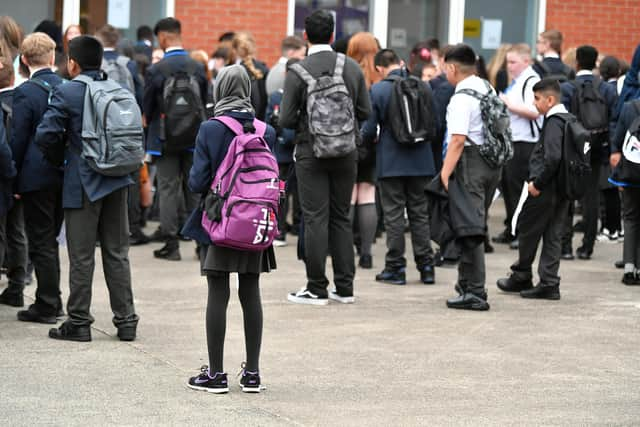

Even if we suppose that the 1,862 pupils had left the private sector for the state sector which has 700,000 pupils and roughly 28000 classes, then we would need to accommodate one new pupil in every 15th class. And this in schools with falling rolls.
There does seem to be a current tendency to use an out of context fact to support a narrative, whether it is true or not.
It is estimated that the VAT will yield £1.76 billion and Scotland will get its share. Could it be that we hear too much in the media from the more affluent about the tragedies that paying tax will bring and too little about the benefits to health, care, education etc that the tax can bring about?
Paul Beswick, Edinburgh
God and mammon
The news that the Burghead Parish Church Building is to reopen as a branch of Scotmid is disturbing (your report, 15 October). Significantly and sadly, decisions to sell church bBuildings are made from the Church of Scotland headquarters in Edinburgh.
The Church of Scotland seems to have lost any sense of community. Gone are the days when it had a proud presence in every parish. The Presbyteries themselves, once located in communities have become unwieldy mega units, along the lines of the former Synods.
Financially, the Church has no need for such a radical pruning of its buildings. The pearl in its crown is 121, George Street, which could, and perhaps should, be sold, and the administrative behemoth be rehoused in some redundant Church buildings. If Scotmid can transform one, why can’t the Church?
Ian Petrie, Edinburgh
Good neighbours
At the recent SNP conference, Kate Forbes accused some in Labour of trying to make Scotland “look more like England”.
I am not too sure what is wrong with seeing the neighbours with whom you have shared an island for millennia doing something better perhaps than you are doing and seeking to adapt and learn from them.
To complain about that says more about the accuser than it does about the accused. I would be delighted to see my country adapt any practice or method from any country, near or far, the only criterion being that it makes things better.
Alexander McKay, Edinburgh
Best kept secret
As one after another of the SNP chatterati insist they believe in John Swinney’s “secret plan” to achieve independence, I increasingly suspect the plan is so secret that even Swinney doesn’t know what it is.
Martin Redfern, Melrose, Scottish Borders
Unequal state
I agree with Stan Grodynski (Letters, October 16) that the UK is an unequal state, in that 83 per cent of its population live in England, and in that England is its only part not to have its own parliament, but disagree with him that the SNP Ggovernment’s poor performance has been due to the strict limits of devolution.
Since its foundation the Scottish NHS has always been devolved and run from Edinburgh, and far from being told what to do by Westminster, has benefitted from the generosity of the Barnett formula, which in practice means that London and the South East of England subsidises Scotland. I know, because I have worked with the NHS on both sides of the border.
Hugh Pennington, Aberdeen
Far from ‘broken’
Stan Grodynski tries manfully to make out that the SNP aren't really “performing badly”. It’s all the fault of the “limits of UK devolution”, he tells us. That’s a bit like saying how well Donald Trump would do if he wasn’t constrained by the limits of democracy. In fact, Labour and the SNP are as both as bad as each other because the SNP is simply Labour with added independence. Neither understands or supports business.
Contrary to his claims, in several ways, the Scottish NHS performs worse than the English one, as does Scottish education.
Mr Grodynski says that the “once in a generation” claim made by both Alex Salmond and Nicola Sturgeon is “frankly rather pathetic”, in which case, why did they make it? He complains about the constitution, but he would, wouldn’t he?
It was the UK which led Europe in supporting Ukraine and which helps defend the ungrateful EU, incidentally. It was the UK which led the production of a vaccine against Covid. But these important matters are ignored by one issue Mr Grodynski loves to talk about: “Broken Britain”. Without Great Britain, the Russian border would rest on the western border of East Germany to this day.
His claims that Britain is “broken” show that he doesn’t understand the inherent strength and flexibility of the UK’s constitution, which can cope with Labour, the Greens and SNP at one end and Reform at the other.
Peter Hopkins, Edinburgh
Critical thinking
Scotland withdrew from the Trends in International Mathematics and Science Study (TIMSS) along with the Progress in International Reading Literacy Study (PIRLS) because Alex Salmond didn’t like what they revealed about declining pupil attainment under Curriculum for Excellence. The only positive outcome of Humza Yousaf‘s mercifully brief reign was rejoining these research programmes; their findings will make interesting reading.
Third-level education is also in crisis. Some of our universities face severe financial difficulties, due in part to the burden of free places for a relatively small number of domestic students combined with reductions in government funding. The college sector is in an even bleaker situation.
The separatist SNP and Greens feed on economic, historical and scientific ignorance, so it isn’t surprising that education has been consistently dumbed down and marginalised since 2007.
These parties pretend that after separation, mystery benefactors could provide loans for limitless social welfare spending, that wealth-creators would meekly stick around to have their pockets picked by the state and that rapid EU membership is guaranteed.
The Scottish Government and its allies wish us to believe that biological gender is a matter of choice and that all electricity in our energy-hungry world can be generated by renewables alone. They also present Scotland’s history since 1707 as a simplistic tragedy of one-way exploitation which made Scots poorer.
It is therefore not in the interests of these Holyrood charlatans to have an informed, knowledgeable electorate who can think critically.
Martin O’Gorman, Edinburgh
Swinney’s not daft
John Swinney’s “indyref or bust” strategy isn’t daft. Without an electoral pact the pro-UK vote will be split asunder by Reform, the SNP can scrape an overall majority of SNP MSPs and Swinney can claim to be delivering on his manifesto.
He only needs 30-ish per cent of the vote which means on a typical 60 per cent turnout, only 800,000 (20 per cent) of Scotland's 4.3 million electorate need to vote SNP.
Politicians who cry foul because a referendum would requires 2.2 million votes to succeed should hang then their heads in shame for not strangling the idea at birth.
Allan Sutherland, Stonehaven, Aberdeenshire
Continuity of care
John Swinney’s idea of walk-in GP clinics might be good. However if the SNP government is willing to provide the funding for the doctors which would staff these clinics why didn't they give the funding to all the local clinics to ensure continuity of care... mine ‘lost’ two doctors last week as there was no further funding to extend their contracts.
Elizabeth Hands, Armadale, West Lothian
Middle East
Dr Al Qutob undermines his own arguments regarding Gaza (Letters, 16 October).
Israel’s neighbours have stated it is their intention to destroy the country and its inhabitants and have taken military action with that intention. It is reasonable that Israel has responded, though invariably because of action being instigated by those wishing its destruction.
Up to date, the action by Hamas in October 2023 was evil beyond belief. The recent peace moves have brought to light a terrible state. The condition of hostages returned, the fact that hostages died, and even more perverse the photographs of Hamas executing people on their return to Gaza. This is somewhat in reverse to the well fed, good condition of the Palestinians released by the peace deal.
I wonder which side will be the first to resume the conflict.
Charles Lowson, Fareham, Hants
Write to The Scotsman
We welcome your thoughts – NO letters submitted elsewhere, please. Write to [email protected] including name, address and phone number – we won't print full details. Keep letters under 300 words, with no attachments, and avoid ‘Letters to the Editor/Readers’ Letters’ or similar in your subject line – be specific. If referring to an article, include date, page number and heading.
Comments
Want to join the conversation? Please or to comment on this article.