
Readers' letters: There is no alternative to direct action against Iran
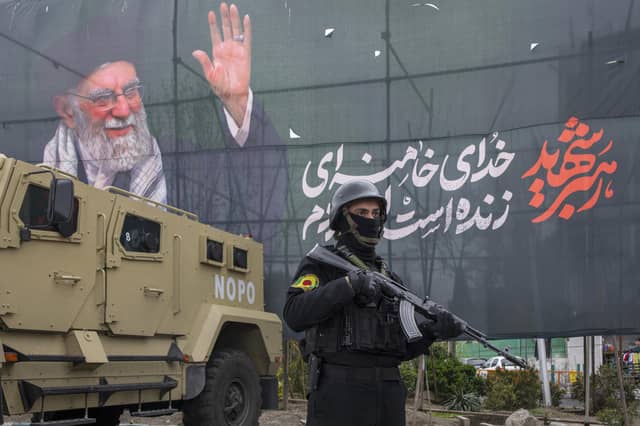

A reader suggests dialling down the criticism of Donald Trump for attacking Iran
Another letters page (31 March), another castigation of Donald Trump. This is all very well if there is an alternative diplomatic solution, but is this really possible?
What is left of the Iranian government appears to be desperate not only to hang on but to cause as much trouble for everyone else as possible. How long can this be tolerated by the rest of the world? Something needs to be done.
As diplomacy fails there is only one other way – direct intervention – but constant sniping about this by left-leaning media and correspondents simply hands a “public opinion” victory to Iran despite the regime’s horrendous record. How does this actually solve the underlying problem of Iran's malign influence worldwide?
Gerald Edwards, Glasgow
War of words
One of the clearest victims of the years of war in the Middle East since October 2023 has been the meaning of language. I set aside the Prime Minister’s ludicrous assertions that Britain’s role has been exclusively defensive, but turn instead to the characterisation by politicians and the media of Israel as an ally and Iran as an enemy.
Israel was indeed once an ally 70 years ago when it joined us in the shameful attack on Egypt to regain control of the Suez Canal. This did not end well for us but since then Israel has not shown any particular concern for our interests.
By contrast Iran is presented as our enemy. Well it might be, given our role in extinguishing any hope of democratic progress under the Pahlavi regime by conniving with the United States to overthrow its prime minister, Mohammad Mosaddegh, in 1953. This opened the door for the Ayatollahs, who have subjected us to insult but little more, while we suffer worse from other regimes with which we profess to be friendly, not least the present President of the US. It surely is time for us to make up our own minds about who our allies and our enemies are and cease to have such decisions dictated from Washington.
James Scott, Edinburgh
Orewll’s warning
Your review of a recent George Orwell documentary suggests that 2 + 2 = 5 is about fascism alone, a reading that risks narrowing his argument (Scotsman Magazine, 28 March).
Orwell’s warning was not confined to fascism. His central concern was totalitarianism in all its forms – the deliberate subordination of truth to power, the corruption of language, and the demand that individuals accept what they know to be false. The phrase “2 + 2 = 5”, drawn from Nineteen Eighty-Four, is not a partisan slogan. It is a statement about the ultimate ambition of any regime that seeks to control not just behaviour, but thought itself.
To frame this purely in terms of fascism is to narrow Orwell’s argument into something safer and more contemporary, but also less accurate. Orwell understood, from direct experience, that the distortion of truth was not the preserve of one ideology. It is a recurring temptation wherever power goes unchecked.
If we are to take Orwell seriously, we should resist the urge to domesticate his warnings to fit present fashions. His work endures precisely because it speaks beyond them.
Rod Cowan, Edinburgh
Know your enemy
I encountered on Saturday, as a first aid volunteer at the Believe in Scotland rally, the best argument for repealing in due course the pernicious “hate crime” legislation that is currently stifling free speech in Scotland.
Outside the consecrated ground of St Giles’ High Kirk, as the march for independence proceeded, an enclave of people swathed in the Union flag viciously abused men, women and children very young and very old, accusing them of paedophilia and every other crime against humanity .
If the unfortunate police officers in attendance had removed them to custody and charged them under the above legislation Edinburgh would have been denied the opportunity to see and hear the character and intellectual capacity of these defenders of the involuntary Union.
As it was, the aphorism “the mouth speaks what the heart is full of”, in this case hatred and delusion, was fully ratified. I an proud to say that there was no evidence of toxic nationalism from participants but rather concerned and commited patriotism from all ethnic groups gathered under St Andrew’s flag.The truth goes marching on.
Dr Andrew Docherty, Selkirk, Scottish Borders
Slow down
With the price of petrol and diesel rocketing you would think that drivers would slow down to reduce fuel consumption. Yet, the A68 continues as before – queues of cars desperately jockeying for position at or above the 60mph speed limit regardless of road conditions.
I think driving instructors must tell their pupils that they have to “drive to the speed limit”. I regularly see young drivers in my mirror with their hands gripping the wheel at ten-to-one, feet from my rear bumper as I proceed at a steady GPS-measured 50mph with the adaptive cruise control set. They will overtake at the first opportunity and I will catch them in a queue in the 20mph zone at Pathhead.
Why speed? Slow down, relax, enjoy the journey and and save fuel.
William Loneskie, Lauder, Scottish Borders
Paying penalty
With both Wales and the Republic of Ireland knocked out in penalty shootouts in World Cup qualifying matches, the role played by Scotland and the Scots in the introduction of this most nerve-shedding method of settling major football matches should not be overlooked.
Prior to this, drawn matches were often settled by replays, drawing lots, or tossing a coin.
The suggestion of a penalty shootout was heavily debated before eventually being adopted by football's lawmakers, the International Football Association Board (Ifab), at its AGM in Inverness in June 1970.
After that Ifab decision, it was not long before the first opportunity came to see a penalty shootout being used to decide a professional football match.
In August 1970, in the Watney Cup – a short-lived pre-season English cup competition – a star-studded Manchester United side played second-tier Hull City. With the match tied at full time, a penalty shootout saw Scottish legend Denis Law become the first man to miss a penalty in a shootout, while Scottish-born Ian McKechnie became the first goalkeeper to save a penalty.
McKechnie ultimately took and missed the deciding penalty, thereby becoming the first goalkeeper to save, take and miss a penalty in a penalty shootout.
Alex Orr, Edinburgh
Sinking feeling
Dear Mr Swinney: nae boats, nae votes.
Alastair Paisley, Edinburgh
Nuclear power
Our last remaining nuclear power station at Torness is due for closure in less than four years. Its replacement by wind will require 500 of the largest turbines plus a huge extension to the grid system and sub-stations and a battery back-up of at least two days. The total cost of this as far as I can ascertain will be at least £11 billion. Its life span will be about 25 years, after which there will be at least half a million tons of rubbish for disposal, much of it non-recyclable. What a legacy for our future population!
The much maligned Hinkley Point C nuclear power station is now reckoned to cost near £40bn. However, it has twice the power output of the above and will last for twice the time so the real comparison figure is one fourth – £10bn – and, of course, it will kill no wildlife.
It is perhaps also worth pointing out to the anti-nuclear zealots like John Swinney that nuclear reactors produce the products required for medical procedures like CT and PET scans and radiotherapy treatment for cancer patients. To willingly accept such treatments but condemn their source is just a bit duplicitous.
A McCormick, Terregles, Dumfries
Tactical voting
Interesting letter from Ian Balloch (30 March) concerning tactical voting in May. Normally this does not involve a large number of votes, but these may still be crucial, in the constituency part. With six or so parties standing, on a first-past-the-post system, there will be a few seats where a candidate wins on 20 per cent or so of the vote – and here tactical voting could be vital!
William Ballantine, Bo’ness, West Lothian
Wholly believable
I recently got my cataracts done. Like many people, before the operation I was short sighted but could read perfectly, now my long sight is perfect but I need reading glasses. I never realised how much I read or look at things close up and I need them with me all the time, keep losing them and in the past year I have bought at least ten pairs of cheap reading glasses, five of which have disappeared entirely. I’ve tried propping them in my forehead but I either forget they are there or they fall of if I move suddenly.
Luckily there is a solution at hand: I’m just back from the local branch of a well known opticians where they performed a new procedure which involves cutting a pupil-sized hole in your eyelids and inserted a reading lens into them. So when I want to read I just close my eyes. I must admit I was a bit nervous about it but the chap who performed the op seemed very able and confident and assured me he could do it with his eyes shut. In fact he did, as he was one of the guinea pigs for the French inventor, Mme Avril Folle.
Allan Sutherland, Stonehaven, Aberdeenshire
Write to The Scotsman
We welcome your thoughts – NO letters submitted elsewhere, please. Write to [email protected] including name, address and phone number – we won't print full details. Keep letters under 300 words, and in the body of the email – no attachments – and avoid 'Letters to the Editor/Readers’ Letters' or similar in your subject line. If referring to an article, include date, page number and heading. No poems.