
Readers' Letters: There are different kinds of coercion when it comes to assisted dying
Readers share concerns about assisted dying bill
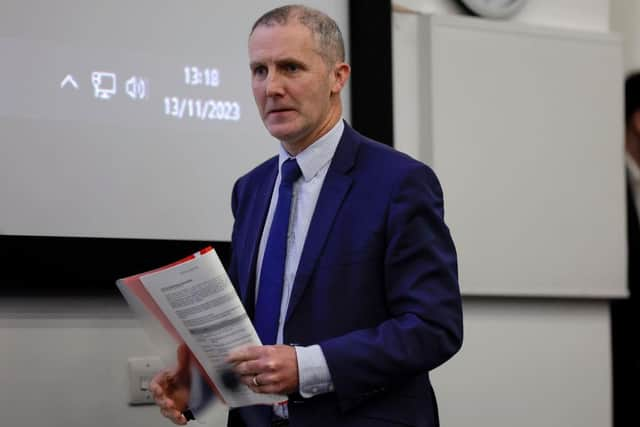
Former Scottish health secretary Michael Matheson MSP is right in stating that the Assisted Dying for Terminally Ill Adults (Scotland) Bill currently going through the Scottish Parliament to legalise assisted dying still contains “fundamental deficiencies” (your report, 4 February).
One of these is the very serious risk of coercion in accessing assisted dying. Of course, the Bill indicates that an individual may only access assisted dying “voluntarily and [if he or she] has not been coerced or pressured by any other person”. However, the Bill still fails to address the reality that coercion and pressures do not only take place by “another person”.
Other experiences, such as the negative image society may have of a situation, the presence of disability or the idea that there is no other option due to medical neglect and a lack of critical social support may be just as coercive and pressurising as if they were caused by “another person”.

One of the original aims of the Bill was to empower persons to act with autonomous self-determination. But this Bill seems to fatalistically accept, instead, certain kinds of coercive and pressurising experiences as legitimate reasons for a person to end their lives.
(Dr) Calum MacKellar, Director of Research, Scottish Council on Human Bioethics, Edinburgh
Pressure on elderly
Here is a cautionary tale of how subtle coercion can be with regard to the assisted dying bill.
We once met an elderly lady on holiday with her two daughters and two sons-in-law. While discussing how expensive homes had become, one son-in-law said, “We’ll be OK once you've gone, Maw. Just joking, Maw”. The elderly lady’s face fell. She would inevitably remember those words in the future if she became eligible for assisted dying, realising the sale of her house would hasten her daughters getting on the housing ladder and having a better quality of life
In fact, even without such a son-in-law’s “joke”, every old person facing death will realise that the quicker they die, the quicker their offspring will benefit from their inheritance. It would be near impossible for such subtle coercion to be spotted in every case, especially if the elderly person decides to hide it for the benefit of their offspring
Allan Struthers MD, Newport on Tay, Fife.
Tourism tragedy
I used to run a small bed and breakfast on Skye until the short‑term let licensing rules came in. The fees and requirements were so steep that, like many others, I had no choice but to close. A small local business gone — not for lack of visitors, but because the rules made it impossible to survive.
Now Scotland faces the prospect of a tourist tax as well, adding yet another cost in a country visitors already describe as expensive. For rural areas, that could be the point at which people simply stop coming.
We’ve already seen what happens when tourism policy is launched without preparation. The NC500 arrived with great fanfare but little planning, and the result has been predictable: accommodation scarce, prices rising and communities left to deal with the consequences.
If the intention is to drive visitors away, then we are certainly on the right track.
Judith Campbell, Portree, Isle of Skye
Real fears
Robert Menzies, in reply to my letter regarding the safety of women in hospital (5 February), is not only wrong in saying that hospital bedrooms don’t have locks but also displays the often experienced lack of compassion for the anxieties that women have, often due to previous experiences.
To deal with the hospital bedroom door issue first, it may well be that the doors didn’t used to have locks but the NHS Scotland website clearly states that bedroom doors must have locks that allow staff to enter in an emergency.
As regards his utterly despicable characterisation of “marauding men posing as women”, no one said that this is what happens.
What I said in my letter was, “Being in hospital can be one of the most vulnerable occasions a woman will have, without having to experience male patients on the same ward”.
Perhaps if all men had a better understanding of women’s fears and distress, we wouldn’t have men who claim they are women insisting on access to our single-sex spaces.
Jane Lax, Aberlour, Moray
Bank on trouble
John Swinney cannot believe his luck at Keir Starmer's discomfiture, but has Mr Swinney run out of luck too?
The scandal at the Queen Elizabeth hospital has not gone away, one ferry is still to go into service after eight years and now the next crisis, that of proclaiming a bank holiday for Scotland's entry into the World Cup, is about to hit.
The SNP keeps claiming there is no money left for deserving projects yet the not inconsiderable amount of money being lost to the Scottish economy over this “holiday” has not been factored in. If Mr Swinney claims otherwise , where is the paper trail?
This holiday will also spark resentment between the public and private sector workers.
Hanging in the background is the necessity of this holiday, and why just the first match only? If Scotland gets through to the next round, arguably an even bigger Scottish achievement, can we expect to be off again?
Be careful what you wish for, Mr Swinney.
Gerald Edwards, Glasgow
Sauna security
I am a bit "dumfoonered” by the opinions expressed by certain MSPs about prostitution in Scotland.
I remember that Edinburgh used to have a number of what were euphemistically known as “saunas” in various parts of the city. I believe that the ladies who habituated these establishments were checked by doctors, surrounded by other ladies plying the same trade and probably had a measure of security too. They didn’t have that on the street. I suspect it also enforced a more legal approach by the owners of the “saunas”.
Everyone knew what the places were there for, including the police, but when the various local forces were combined, outside forces decided this couldn't continue and they were shut down. However, while they existed, prostitutes had a greater measure of security than previously, because everything was out in the open. Disease could be controlled and I suspect that they even paid taxes!
Criminalising men who may have no other avenue to have sex, and women who have no other way of making income to keep their children, or a roof over their head, is hardly kind. Surely an acknowledgement of reality and simple, effective control as existed informally not long ago is the only sensible way to deal with a business which always has existed and always will?
Peter Hopkins, Edinburgh
Thanks Allan
It was sad to read of the passing of Allan Massie, aged 87 and a journalist for 50 years (your report, 4 February).
In the 1970s Allan Massie was invited to give a talk to the Thursday monthly Luncheon at the English Speaking Union, in the Gallery, at Atholl Crescent, Edinburgh. He gave a very enlightening talk to a packed audience on his journalism with The Scotsman.
Michael Baird, Bonar Bridge, Highland
Masterful writer
May I join the chorus of those who will be saddened to hear of the death of Allan Massie.
His erudite weekly book reviews were a must. He guided me towards many hours of reading wonderful books which might otherwise have gone unnoticed.
His own Bordeaux Trilogy, which grew into a fourth volume, are the most reread books on my shelves. The stories delving into the world of Superintendent Lannes during the Nazi Occupation in Bordeaux are a masterpiece, of storytelling, history and expertly honed writing skills.
He will be greatly missed.
Jane Ball, Cardrona, Scottish Borders
Trunk call
Ian Johnston's article on potential Tartan Army chants at the World Cup (Perspective, 4 February) was an enjoyable gleam of light on a wet and miserable Wednesday.
He did leave one suggestion, Nellie the Elephant, open to further negotiation, however, and so I would humbly offer the following:
“Donnie the sychophant packed his bags
Ejected from the Circus
Off he went with a Putiny-Trump
Trump, trump. Trump!"
Iain Masterton, Kirknewton, West Lothian
Dogged family
Andrew H N Gray claims we are all mongrels (Letters, 4 February). I refuse to be a mongrel. I’m from Glasgow, for goodness sake, if that’s not a sufficient pedigree, I don’t know what is.
More seriously, the Morrisons come from the Isle of Lewis where we were the hereditary brieves or judges; the name originating from Son of Morris or Maurice. The other Clan on Lewis is the MacLeods.
(And we know where one MacLeod went and whose mother she became.)
My wife is English and is, I am certain, a much better cake maker than King Alfred – from whom neither of us is descended.
Doug Morrison, Tenterden, Kent
Write to The Scotsman
We welcome your thoughts – NO letters submitted elsewhere, please. Write to [email protected] including name, address and phone number – we won't print full details. Keep letters under 300 words, with no attachments, and avoid 'Letters to the Editor/Readers’ Letters' or similar in your subject line – be specific. If referring to an article, include date, page number and heading. And please do ensure any names mentioned are correct.
Comments
Want to join the conversation? Please or to comment on this article.