
Readers' letters: The wisdom of Socrates offers lessons for today
A reader says the Greek philosopher’s diagnosis of society’s ills sounds remarkably contemporary
Given where we seem to be in today’s society with all of its trials and tribulations, we try to make sense of it and look for ways to undo or control the factors that appear to be creating our problems.
I came across an article which suggests that even 2,000-plus years ago society was facing similar trials that the thinkers of the time tried to isolate and then look for ways to improve the lot of ordinary people.
Socrates suggested that society begins to decline when certain factors become noticeable. A selection of these thoughts included such gems as “when the stupid are louder than the wise”, “when the lazy have more than the industrious”, “when children are no longer allowed to be children”, “when perpetrators are more protected than victims”, “when politicians live not for the people but off the people”.
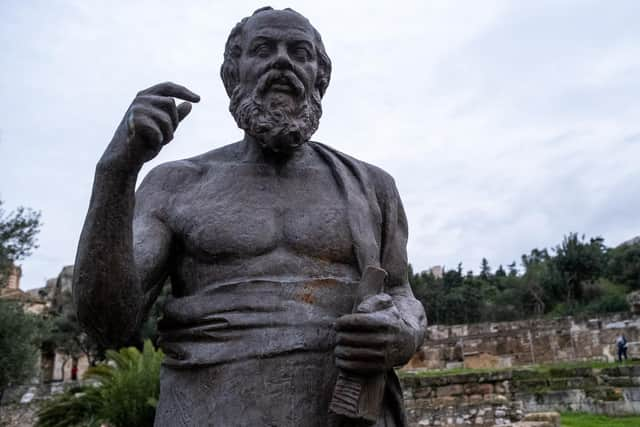

It could be that these sayings resonate among ordinary people living in the UK today and that decline has been felt for a few years now without any obvious attempt by government or society to reverse the direction of travel.
Of course, similar to any addiction, change will only take place when the addict recognises that continuing down that road can only lead to ruination.
That fact will be hard to swallow by the general public and politicians brought up on the promise that we can have it all and it won’t impact on our way of life at all – a fallacy that will come home to roost probably sooner than later.
Of course there are answers to our problems but they will mean accepting a change that includes real rather than imagined austerity. Electing a government that has real intention and policies to tackle our problems and a voting population that’s prepared to accept a medium-term view of these policies.
I suggest that this is feasible provided that the government is honest, open and communicates with the electorate.
A Lewis, West Linton, Scottish Borders
End business taxes
We need a more radical change than merely reforming business rates. Scotland and the UK are well-educated mature democracies (at least in theory!) so we should pay for the policies voted for from our own pockets, not partly from business milch cows with no votes.
Why should entrepreneurs starting up small businesses be faced immediately with yet another substantial overhead as well as all the other start-up costs and risks involved, before earning even a penny?
Adopting “no taxation without representation”, which we are supposed to have believed in for generations, means business rates should be reduced and abolished over, say, a five-year transition (but genuine economic services benefiting and ordered by commercial firms would of course remain chargeable).
Likewise the employers’ National Insurance levy, which ludicrously penalises firms for reducing our unemployment numberso. Maybe even Corporation Tax should also be culled.
The total sums involved nationally would be added by law to wage and salary rates, state pensions, and certain welfare benefits, based on annual and/or regional scales; and we would then pay the necessary increased taxes ourselves, as individuals. Obviously the details would be more complicated than can be covered here, but that should be the objective.
Moreover, an army of public sector bureaucrats, plus some in the private sector, would be released into productive employment.
John H Birkett, St Andrews, Fife
It’s our oil
I read in several articles that oil must be sold on the world market and drilling in our economic area would not be beneficial for the price of fuel. I must disagree. For example, Russia recently banned exports of fuel and Trump has toyed with the idea of scooping up vast amounts directly to the US for the exclusive use of Americans.
As a sovereign nation since Brexit, surely our parliament can pass legislation that prohibits the oil we collect in our own country being sold on the open market and exported.
This would allow us as a country to refine at Grangemouth again and other refineries that are closing, which would be a great result for jobs, supply, tax, security of resources, and prices.
If we are truly a sovereign country they could make it happen. Why are they not doing it is the question we must ask at the next election, and maybe tell them through our voting what we expect from our public servants. Oherwise things will get worse, and that’s hard to imagine.
Andrew Thorpe, Dunfermline, Fife
Call in the RAF
Regarding the reports in recent days of Russian “trawlers” snooping around the UK’s transatlantic cables, surely a low fly-by from the RAF could send a timely warning to the trawlers to move on, and start things on the ladder of escalation if they don’t take the message?
Or are we just sitting back and letting them get on with it? There is a whole host of lower-level tactics that could be used to challenge and deter this behaviour (some deniable, some a little more up-front) without starting a war.
Maybe I’ve got it wrong, but the message that has come out via the Press over the past couple of days seems to be that HM Armed Forces’ leadership don't know how to deal with these antics. Which is worrying, as it is the basics of maritime security.
Surely for the £68 billion per annum that the MoD currently receives from UK taxpayers it can scare off the odd unarmed trawler loitering in places we don’t want it to be ?
Or (call me a cynic) is it just they are scare-mongering in the run-up to the Budget, to get more money for their exquisitely expensive and bespoke projects. If that is the case, they need to realise that such scare-mongering has consequences, in that makes them look out of their depth, and the UK look vulnerable and weak. In this regard, they are making conflict more (not less) likely.
Irrespective, UK government lawyers need to take a much-needed look at whether outdated international law around the protection of subsea infrastructure needs to be revised. If International agreement can’t be reached on this, then it is time for Nato to lay down some rules itself, covering its regions of interest. Just so other nations are clear on what will be tolerated, to avoid future misunderstanding.
Dr Mark Campbell-Roddis, Dunblane, Perthshire
Dance off
Is it illegal to “twerk” in front of actor Martin Compston in Edinburgh Castle? Does he have a view on the alleged “twerking”? Is this a capital offence?
If not, could you stop referring to this episode in reports (Scotsman, 22 October), and let us know what’s actually going on at Historic Environmen Scotland? This subject has been going the rounds for months now, and I still have little idea either of the problem or its solution.
Brian Bannatyne-Scott, Edinburgh
St Kilda woes
Sheep on St Kilda are having a bad time, Katharine Hay reports (Scotsman, 22 October). Nature is at work. It seems that the Scottish Animal Welfare Commission’s call for a welfare plan may have been influenced by reading John Start Mill’s essay On Nature: the duty of man is to strive “to amend the course of nature, bringing that part of it over which we can exercise control more nearly into conformity with a high standard of justice and control”.
This not the first time that nature has shown its malignant powers in St Kilda. Until the end of the 19th century half the babies born there died from tetanus-lockjaw before they were nine days old. Their umbilical cord had been cut with a dirty knife contaminated with the bacterium or its spores. It has been said that islanders preferred their traditional natural practices and resisted attempts to sterilise the knife.
Hugh Pennington, Aberdeen
The case for EVs
Whilst Matt Galvin makes an eloquent plea for a level playing field in his piece regarding petrol versus EV discounting (Scotsman, 22 October), he inadvertently shows why EVs are not proving as popular as he would wish.
He states that in September EV registrations were 28.3 per cent of total market, if this is representative across the year then his figure of grant aid at £3.1 billion is disproportionately high compared with petrol discounts at £7.6bn which, to be on a par with the EV grant, would require to be £10.95bn. Thus EVs are in effect over-subsidised but still not achieving their target. Could this be market forces at work showing that they are in fact vastly overpriced?
I put my own case for or against EV ownership. My present car is a Honda 2011 Civic which is mainly used on long-distance driving, returning 42mpg at motorway speeds which costs me around £0.17/mile.
Compare this with around £0.18/mile to recharge a medium sized EV doing around 3.1miles/kWh at motorway service prices – and that is with a loyalty card offered by Shell. The killer is not the cost per mile or the frequency of recharging nor even the additional time taken to charge an EV assuming I can find the correct charger but the capital outlay.
My next vehicle is likely to be a Honda CRV SUV, probably six years old with another ten years of life in it. At age 71, this will possibly be my last vehicle It will cost around the same or less in fuel as the Civic but will cost me around £15,000 compared to a comparable Skoda Enyaq EV at around £39,000.
There is no competition, I am afraid to say, until EV manufacturers get their prices down.
Neil Robertson, Edinburgh
Write to The Scotsman
We welcome your thoughts – NO letters submitted elsewhere, please. Write to [email protected] including name, address and phone number – we won’t print full details. Keep letters under 300 words, and in the body of the email – no attachments – and avoid ‘Letters to the Editor/Readers’ Letters’ or similar in your subject line. If referring to an article, include date, page number and heading. No poems.
Comments
Want to join the conversation? Please or to comment on this article.