
Readers' Letters: The UK has shamefully surrendered to Hamas terrorists
A reader say the UK’s recognition of a Palestinian state is likely to extend the conflict in Gaza
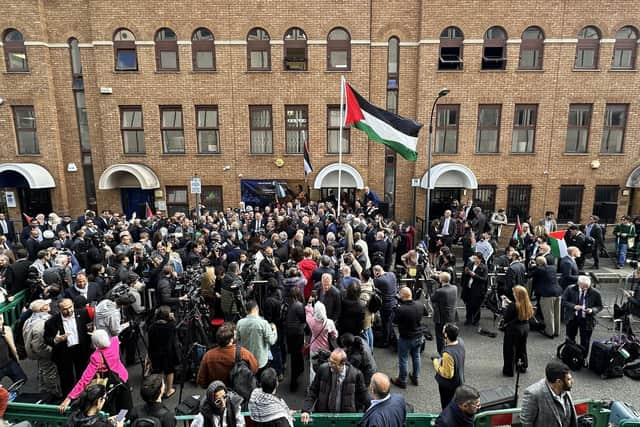
So the UK Government is to recognise a Palestinian state. Shameful.
There is no conceivable rationale under which this brings us closer to ending the war in Gaza or the return of the hostages. On the contrary it does the exact opposite by entrenching Hamas and removes any incentive for them to negotiate . Now Hamas can sit back, reject any offers to end the war, and are rewarded with a state.
Until Palestine has full control over its territory and borders it doesn’t meet the full definition of a state. Hamas is still in control of Gaza and the Palestinian Authority in the West Bank so there is no single unified government.

We have a government more concerned about its short-term political future with the Muslim population than it is about the relationship with the only democracy in the Middle East and a key security partner in the Eastern Mediterranean.
Lewis Finnie, Edinburgh
Freedom fighters
The first terrorists I remember were in the 1950s, namely the Mau Mau in Kenya, under the leader, Jomo Kenyatta, the terrorist in chief. Later, the mantle of terrorism was adopted by the ANC in apartheid South Africa, whose leader in absentia was Nelson Mandela, imprisoned for more than 30 years in Robben Island.
One thing these terrorists had in common was that they became freedom fighters. with Kenyatta elected as Prime Minister and Mandela as President of their respective countries.
At the weekend, in a historic moment, the UK recognised the state of Palestine, albeit conditionally, that condition being the exclusion of the Hamas leadership from any negotiations and governance.
I would suggest that the recognition be unconditional, and the matters of governance be left to the Palestinians themselves. Of course, Hamas are terrorists, as their despicable actions of 7October 2023 attest.
More than 1,200 Israelis were murdered that day, and many more were taken hostage in a vile act of terrorism. However, over 65,000 Gazans have been murdered or starved to death in an act of terrorism, no less vile.
We must hope and pray for the day when Hamas and the IDF are no longer terrorists, but freedom fighters, eschewing all violence, in the search for elusive peace. Miracles can and do happen.
Ian Petrie, Edinburgh
World’s contempt
Predictably, the government of Israel has described the Prime Minister’s decision to recognise a dtate of Palestine as a reward to Hamas.
Mr Starmer should regard such criticism as a badge of honour from a government whose own reward to Hamas has been the slaughter of over 64,000 Palestinians, many most of them women and children, and the contempt of the world.
James Scott, Edinburgh
To a Mouse
Any resolve the Prime Minister may have had has crumbled under the onslaught of his party’s far left wing. He must have felt forced into giving them what they wanted and agreeing to statehood for Palestine. I was reminded of Burns’ lines: “O, what a panic’s in thy breastie”. That it is merely a gesture matters little; Hamas and their supporters will be ecstatic, and Keir Starmer knows it.
I can well understand the joy with which this decision was greeted by Hamas. They have their reward. Perhaps even more than they expected after starting the present conflict. Most thinking people who have studied the history of the region have no doubt they will use any breathing space it gives them for the only goal they have in life and continue as before.
And so, the endless suffering in that beleaguered region will go on.
Alexander McKay, Edinburgh
Nuclear safety
As I recall. dirty, dangerous and expensive” was the late Alex Salmond’s verdict on nuclear energy. This was round about the time he unveiled a monument commemorating the last major coal mine disaster at Auchengeich, Lanarkshire (47 deaths).
Some time later Mr Salmond opened an extension to the Ben Cruachan hydroelectric station (36 deaths in its original construction).
A few days ago we had report of the blades flying off a huge wind turbine, fortunately without injury to persons or domestic animals. This is by no means a one-off event. Some years ago a similar occurrence resulted in blades landing on the roof of a hospital car park in Stevenage. Note that the three blades on the much larger turbines of today can weigh up to 20 tons each.Then we have the Piper Alpha oil platform disaster: 167 deaths.
No method of energy production can be absolutely safe. Per unit of power produced nuclear energy is in fact the safest option – it is worth noting that OTT safety requirements amount to near enough one half of the construction and running costs.
Dr A McCormick, Terregles, Dumfries and Galloway
English workers
It seems that the issue of immigration will loom larger in next year's Holyrood elections than many, even a few months ago, would have predicted.
The SNP administration has, likely correctly, claimed that Scotland’s ageing population and suboptimal birth rates, just as in England, mean that inward migration is required to provide additional taxpayers, thereby enabling the country’s public services to be fully funded and operate effectively in the future.
So why doesn’t the SNP actively campaign to recruit individuals from south of the border to work in, say, health, education, justice, transport, and the ever growing Scottish civil service and quango network? There would be no language barrier, educational and professional qualifications are similar and there are few cultural barriers.
Let’s assume the SNP approach isn’t driven by racism and I can’t imagine that John Swinney has any concerns about Westminster’s sensibilities. So is the real reason that the SNP administration doesn’t focus on recruiting in England because evidence shows that, when English workers move to Scotland, they tend to continue to vote as they have in the past for UK-wide parties, and not the SNP? Plus, polling shows that the majority of English incomers are opposed to independence.
It seems that, by ignoring the potential offered to Scotland by England’s sizeable workforce, the SNP is arguably putting party and constitution before the country’s struggling public services. No change there then.
Martin Redfern, Melrose, Scottish Borders
It’s about jobs
It’s now official: BYD cars (heavily subsidised by the Chinese government) are now poised to overwhelm European car manufacturers by selling cars at a price that simply cannot be matched.
Those in the market for a new electric car when faced with a price differential of up to €10k in the showroom with no real difference between models will opt for the cheaper one every time.
What to do about this is the question and the answer is not an easy one as we don’t want government subsidies to prop up inefficient industries for the sake of jobs.
However, the Chinese car market is saturated with cars due to subsidy and a simple answer, taken from Donald Trump’s playbook, is to add a tax on goods known to be cheap through over-manufacturer due to subsidy to level the playing field at the showroom.
Of course that will remove the potential to buy a cheaper car but offset against that is some degree of support for homegrown manufacturing and, of course, jobs.
T Lewis, Coylton, South Ayrshire
Social care bill
A new report by the Social Care Foundation has proposed a health and care levy – possibly in the form of an extra percentage levelled on National Insurance contributions, by both employees and employers – to fund social care.
I hope Health Minister Wes Streeting takes this up. It would cost a lot more than house insurance but solves the problem of people having to sell their home to pay for old age care.
The biggest obstacle will be media and opposition politicians jumping on the old “Alzheimer’s Tax” bandwagon.
Allan Sutherland, Stonehaven, Aberdeenshire
Shetland’s story
Norway never gave away Shetland. That’s the story we’ve been told – but it is false.
In 1468-69, Shetland and Orkney were pawned by Christian I of Denmark-Norway to James III of Scotland as temporary security for a dowry. The original charters (Copenhagen, 1469) state they were pledged “under assured security” until repayment. They were not sold, ceded, or given away.
Even that pawn was unconstitutional. Shetland was a dependency of Norway, not Denmark. Under the 1450 Treaty of Bergen, Norway’s Council of the Realm had to approve territorial changes – but it was never consulted. Christian pledged only his royal revenues, not Shetlanders’ udal land, which was allodial and never the king’s to give.
Denmark-Norway attempted repayment many times – in 1549, 1550, 1558, 1585, 1589, 1640, and 1660 – but Scotland refused. Even Scotland’s Regent, the Duke of Albany, acknowledged its conditional nature: in 1514 and again in 1524 he offered to return the isles in exchange for support.
No treaty of cession exists. Scotland annexed Shetland, and oppressed its people – stripping away our laws, language, and culture. We were not given away. We were taken.
Magnus Hutchison, Whalsay, Shetland
Write to The Scotsman
We welcome your thoughts – NO letters submitted elsewhere, please. Write to [email protected] including name, address and phone number – we won't print full details. Keep letters under 300 words, with no attachments, and avoid 'Letters to the Editor/Readers’ Letters' or similar in your subject line – be specific. If referring to an article, include date, page number and heading.
Comments
Want to join the conversation? Please or to comment on this article.