
Readers' letters: The Kirk may be dying, but the need for faith remains
A retired minister has little faith in the future of the Church of Scotland but believes people still need something to believe in
As a retired minister, I have my beliefs, but don’t attend church. I find it difficult, if not impossible to believe in the church any more, and I know full well that I’m not the only one.
My only point of agreement with Doug Morrison (Letters, 18 August) is deploring the uncomfortable fact that the Church of Scotland is one of the biggest landowners, if not the biggest, in Scotland. All this in the name of a Saviour, who, famously, had “nowhere to lay his head”.
The Church of Scotland may well be dying, and may deserve that fate. Faith may be dying, but the need for faith lives on, most obviously in the 70 per cent of young people who profess to have no faith at all.
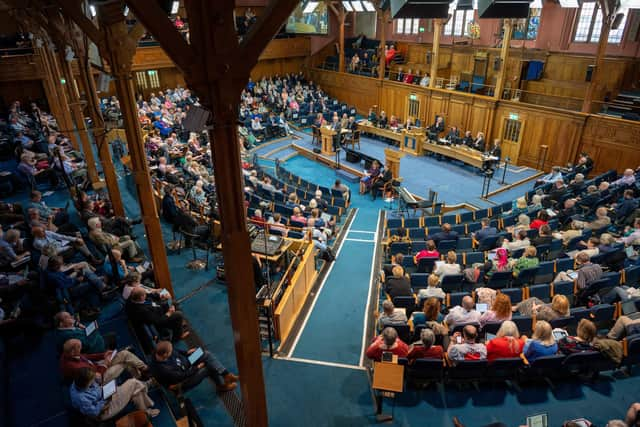

Someone famously said that “if you believe in nothing, you’ll believe in anything”, and that’s dangerous, given the depression, despair and even suicide, which comprise the legacy of us adult generations to our young people today.
I suspect that Jesus, humble as he was, was embarrassed to be dubbed and, even worshipped, as a Messiah. His teaching includes many gems, one of which is that our lives must be grounded in rock, not sand. That rock is faith, religious or otherwise.
Ian Petrie, Edinburgh
Plastic takeaway
Scientific research increasingly shows that eating and drinking from plastic containers can harm our health and young people may be most vulnerable. Yet for many, the risk still feels too far from their home to change daily habits. Convenience serves the masses.
During our three weeks in Scotland recently takeaway cups and boxes were offered everywhere, even in national parks. We travel with stone coffee cups and a reusable carrier for scones and tarts, and the reactions we got were mostly surprise. The worst “inconvenience” we experienced? Friendly smiles, laughs at the slogans on our cups, and conversations with lovely Scottish people.
So flip the default. Instead of assuming customers will take food or drink in a plastic-lined cup or “recyclable” box and walk straight into a national park, assume they’ll have it in their own containers. Imagine the mountain of cups you would avoid using each year. Even if the long-term health and environmental benefits feel far away, the instant reward is there: human connection.
Lotte Roelofs, Amsterdam, Netherlands
Chamberlain’s back
Donald Trump, aka Neville Chamberlain, thinks he is securing “peace for our time” by which presumably the former British Prime Minister meant “peace for a time”, and just like in 1938, placates the aggressor.
Donald, Donald, when are the scales going to fall from your eyes? You think Vladimir Putin regards you with respect. Let me disabuse you. He thinks you are a patsy, all bluster, no substance, all threats, no action. He is running circles round you.
Ultimately, maybe you don’t care. After all, the Ukraine conflict is a “quarrel in a far-away country between people of whom we know nothing” and, just like Chamberlain, you are not interested.
But if you get the Nobel Peace Prize after all this, then the award is utterly devalued.
Trevor Rigg, Edinburgh
Bonnie JD
JD Vance, will ye no’ come back again? Please – no come back!
Steve Hayes, Leven, Fife
Sturgeon’s legacy
Nicola Sturgeon is the most capable female politician to emerge from any part of the UK during the last 30 years and to suggest as D Millar does (Letters, 16 August) that she has no legacy is as ludicrous as it is detached from reality!
Conducting daily media briefings as she did throughout the Covid pandemic could by no means have been an easy or pleasant task and must ultimately have imposed a massive strain on the then First Minister. Mr Millar, though, criticises her efforts in doing this and allegedly “keeping the nation petrified” (better petrified than dead, surely?) and “continually ordering the nation to stay at home”. It sounds like he is suggesting Ms Sturgeon was exaggerating the threat posed by Covid and unnecessarily strict as far as preventative measures were concerned. Would Mr Millar have been happier with no lockdowns, social distancing, mask wearing etc which would, of course, have resulted in thousands more deaths? Perhaps he could enlighten us?
What I would suggest is that Mr Millar reads what Jonathan Calvert and George Arbuthnott have to say about Britain’s handling of the Covid emergency in their book Failures Of State. The book outlines gross failings on the part of the UK Government and the waste of billions of pounds on equipment and systems that didn’t work. It is made crystal clear therein that Nicola Sturgeon’s management of the pandemic in Scotland was much more professional, considered and effective than Boris Johnson’s south of the Border.
Alan Woodcock, Dundee
Double standards
It is depressing to read the media’s take on Kate Forbes being banned after having previously been given the right to speak at the Summerhall arts venue. This was apparently because employees and others felt threatened by Ms Forbes’s views on issues such as same-sex marriage. I struggle with this.
I believe that employees in a venue that has debate and freedom of expression as part of its raison d’être should have thought about that before applying for a job there. The same goes for those who choose to perform there as well as visitors. If you object then simply avoid the place or change shifts.
Notwithstanding that, an employer has a duty of care to take employee concerns about their work environment into account. However. the media seem to take a different view – believing that in publicly accessible venues it is unacceptable for employee rights to be given primacy over the rights of others. Fair enough.
But contrast that stance with the media’s treatment of Sandy Peggie, an employee who also felt unsafe in the presence of somebody whose beliefs she was opposed to. In that case the employer responsible for a publicly accessible venue had decided a trans woman could use a female changing area. But the employee refused to accept that decision and all attempts by the employer to address or mitigate the employee’s concerns were either rejected or were deemed unworkable.
Ms Peggie’s argument was that she felt unsafe in the presence of a particular individual as a consequence of her employer’s decision. But those at Summerhall also felt unsafe in the presence of a particular individual as a result of an employer decision, only to find that their stance is denounced and ridiculed by the very same journalists championing Ms Peggie’s cause. Bemused? Join the club.
Robert Menzies, Falkirk
Wedge issue
What is this current obsession with gender identity politics? The reason I ask is that it is not an obsession shared by my wife of 25 years or my teenage daughters. In fact, my eldest daughter has no time for such views or those of JK Rowling, Reform UK or the Tories.
So if the three women in my household don’t have time for such things, is it just a “wedge issue” to drum up support for political parties like the Tories and Alba and those politicians that have an issue with Nicola Sturgeon?
Is the problem not males in general who have no respect for women rather than simply the transgender community?
Peter Ovenstone, Peterhead, Aberdeenshire
Mea maxima culpa
Whilst I was surprised and pleased to read Brian Wilson's article, “Scotland's men need to stop being so willing to wheesht” (16 August), he should not be satisfied with his mea culpa, no matter how deserved it is.
He has identified that so many politicians, universities, employers, the art world, almost in its entirety, closed their eyes and minds to the biological facts of gender and the repression of any challenge to Nicola Sturgeon’s gender orthodoxy, but that seems to be the end of his reflection.
Can we look forward to Mr Wilson, in his next article, offering suggestions about how MPs and MSPs might have the courage to call out sophistry when it is being forced down their throats by an autocratic leader or powerful minority group?
Lovina Roe, Perth, Perth & Kinross
Big spenders
Politicians seem to delight in spending other people’s money. One could be forgiven for expecting some cognisance of this fact but this appears to be, frankly, unrealistic.
SNP ministers are intending to write off a £36 million benefits debt (Scotsman, 18 August). Did anyone ask those who are paying? Even at a local level, Glasgow City Council is also calling for government help as a £66m bill looms to house refugees who make up nearly half of the homeless in the city.
Financial prudence does not seem to figure in all of this, particularly since it is taxpayers who are not only getting this bill but, in all probability, are expected to find even greater sums in the future.
The blame will be put upon Westminster as usual but this has long lost its political impact upon the Scottish economy as the GERS figures show.
When, if ever, is the taxpayer going to get some relief from this endless spiral of overspending, reduction in services and higher taxation, all running in tandem and it begs another question: just what are our highly paid politicians actually doing?
Gerald Edwards, Glasgow
Write to The Scotsman
We welcome your thoughts – NO letters submitted elsewhere, please. Write to [email protected] including name, address and phone number – we won't print full details. Keep letters under 300 words, with no attachments, and avoid 'Letters to the Editor/Readers’ Letters' or similar in your subject line – be specific. If referring to an article, include date, page number and heading.
Comments
Want to join the conversation? Please or to comment on this article.