
Readers' Letters: That's one walk-in clinic open, when will we see the rest?
How many of the SNP’s new walk-in clinics will open soon, asks reader?
The SNP is keen to distance itself from the claim that it opened Glasgow's Queen Elizabeth Hospital early in order to get kudos in the imminent election of 2015.
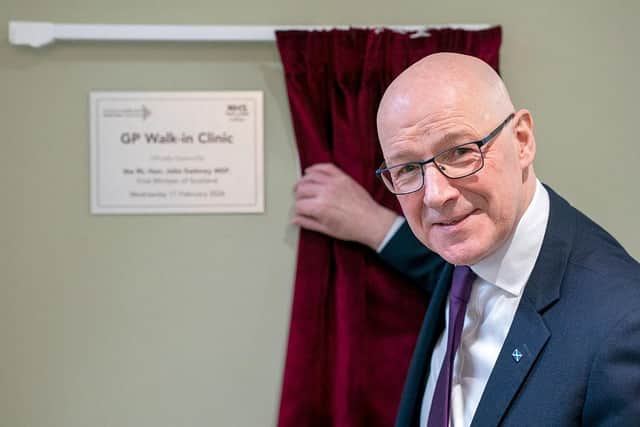
Fast forward to 2026 and we have the SNP opening its first “walk-in” GP clinic in Wester Hailes just a few days ago, weeks before an election. This is the first of a promised group of 15 such clinics but here is the problem, not one other clinic has had an opening date set.
Given the spin the SNP puts on many things, will we really see 14 more clinics or is the timing of the opening of the first just electioneering? The SNP promises much, but very often fails to deliver.

Gerald Edwards, Glasgow
Zero sense
In Scotland the SNP have made viable, clean and reliable – as well as job-generating – nuclear power a mortal sin. We have also had to deal with anti-oil and gas zealots making ministerial decisions at UK level and imposing impossible net zero schedules.
There should have been no shutting-down of any fossil fuel source until a guaranteed alternative was up and running. Instead, we have had the insanity of shutting down existing installations years, perhaps decades, before there was anything at all reliable in place to take over. Our neighbour countries must think us mad. And all to satisfy some crazy urge to be faster than our neighbours in implementing net zero.
Alexander McKay, Edinburgh
Oil story
Tony Blair’s Institute for Global Change’s controversial views on the future of UK oil and gas rightly made front page news in The Scotsman (13 February).
The Institute’s report asserts that Britain's energy strategy urgently needs “resetting”. But does their claim stand up to scrutiny? Briefly, the report urges fewer renewables. In lieu it advocates reversing the ban on new oil and gas, with accompanying generous tax breaks, alongside heavy investment in new (unproven) nuclear, both small modular reactors and fusion. Regrettably, the North Sea is a mature basin where reserves are increasingly expensive to extract, and of progressively inferior quality.
The critical point is that large oil pools (“the cream”) are naturally discovered and developed first. Smaller, marginal finds are left over to the end. Creaming curves are the key tool for understanding basin development. They provide an essential display of evolving oil discovery, by graphically illustrating exponentially rising costs coexisting with ever-diminishing returns. They foretell substantial financial losses when over-drilling an already heavily explored oil province.
In essence, we have known the extent of our offshore resource for decades. Remarkably, the UK’s reserves were securely assessed as early as 1974 (before offshore oil production had even commenced) by the UK government at 33 billion barrels, a quantity strikingly in line with today’s state-of-the-art estimate.
Who benefited the most from the huge revenues of these now long-gone, golden years of oil extraction? The history is straightforward. In 1993, following widespread safety measures installed after the Piper Alpha blow-out and platform fire, production rose rapidly to a peak of around 4.6 million barrels of oil equivalent per day. Thereafter production quickly fell back, dropping below half by 2007, to nosedive to the current, long-term decline rate of around 10 per cent per year. Tony Blair’s New Labour era spanned 1994-2007.
(Prof) Roy Thompson FRSE, School of GeoSciences, University of Edinburgh
Useless nukes
In this dangerous world arms race the UK’s nuclear deterrent – situated 20 minutes from Glasgow – is not independent, since the US controls its use. Costing billions, it really makes Britain a target, rather than providing protection.
At a recent Prime Minister’s press conference this was confirmed, when it was announced that Trident’s use “relied on Washington”. In other words the UK cannot use it without the permission of America.
Come on Scotland, we should not be part of this costly charade, when we see comparable independent countries, where democratic fairness is the hallmark for success.
Clearly, only with independence will Scotland be able to remove nuclear weapons and become a country where the smiles of the young and old bring joy and happiness to all its people.
Grant Frazer, Newtonmore, Highland
Power of truth
Here's hoping against hope that the UK and Europe inflict the severest of sanctions on Russia for the cruel and painful death by poisoning of Alexei Navalny ( your report, 16 February).
It was the second anniversary of his death by dart frog toxin yesterday at the age of 47. He died for standing up courageously to the dictatorial rule of Vladimir Putin, as an all-too popular leader of the too effective opposition. He lived to the letter, his own words, “speak truth, send truth, because it is the most effective weapon of all”. It's beyond all doubt that his death was executed by the Kremlin, despite all the predictable and hollow denials.Like all dictators, Vladimir Putin is a coward, leaving his dirty work to others.
Alexei Navalny's name will live on, long after Putin is gone. Russia, and indeed, the world, needs another Alexei Navalny, to speak, send and live the truth. It is still the most effective weapon of all.
Ian Petrie, Edinburgh
Ferry poor show
So the Glen Sannox ferry is out of service once again. To make matters worse parts are to be stripped from the vastly over budget and vastly overdue Glen Rosa to carry out the repairs, further delaying the Glen Rosa (your report, 13 February).
This whole saga is a total disgrace, and who is to say that when and if the Glen Rosa is ever completed we won’t see the same problems all over again.
Charles Sinclair, Kirkcaldy, Fife
Vote less
Having tried to apply for a postal vote online, I now give up, being unable to navigate my way through a ridiculously long and complicated procedure.
I want to coin the words “technoramus” to describe myself: I can only surmise that such creatures as myself (a 67-year-old infant, apparently) are not really wanted in this brave new world where a pen is basically seen as an offensive weapon. I will evidently be unable to vote ever again – how will I cope?
Steve Hayes, Leven, Fife
Vote more
I hope many citizens will agree with Stephen Gethins’ view that the current voting system for the House of Commons needs radical change (Perspective, 14 February).
However, this is not the only defect in the present system which, after all, is based on a 17th-century settlement.
For instance, the concept of HM Government on one side and the opposition on the other means that the citizens who voted for candidates from parties that do not feature in the government are effectively disenfranchised.
Another point to be considered is that if we are to continue with devolution we shall require some sort of federal institution of government. I would suggest a central committee about the size of the current UK cabinet made up of representatives from the devolved assemblies and/or directly elected by the populations of the federated “nations”. The chairman of this body would be chosen by an election covering the whole of the UK – in the same way, for instance, as is the President of France.
The current Westminster Parliament in its crumbling Victorian palace would become the English national assembly to do with as the people of England decide. I wait to be shot down in flames.
S Beck, Edinburgh
Men possessed
After last week’s performance by the Scotland rugby team I approached Saturday’s game with fear and trepidation.
The difference this weekend in both attitude and motivation was beyond incredible. Scotland played like men possessed against a very good English team.
England were unfortunate to have a player of Henry Arundell’s calibre sent off and it may have made the difference. However, the passion shown by the whole Scotland team was wonderful to behold. A well deserved win. We can only hope they continue with this passion.
Ian Smith, Troon, South Ayrshire
Fire Apprentice
I couldn’t agree more with most of Stephen Jardine’s appraisal of The Apprentice (Perspective, 14 February), although I would disagree with him that it’s still “great”.
It was an enjoyable and interesting watch for the first few series, when it featured contestants who did actually work in business rather than these days where they sit in their bedrooms with laptops.
Now it’s just a platform for Alan Sugar to issue his heavily scripted put-downs to the assorted wannabes across the table which his assistants dutifully giggle at. As a process to find the most accomplished business person, it should really have been fired a number of years ago.
This happens with many once-interesting reality programmes, such as Big Brother, where the number of show-offs and eccentrics increases with each series.
How long before the very enjoyable The Traitors follows the same downward path?
D Mitchell, Doune, Perthshire
Write to The Scotsman
We welcome your thoughts – NO letters submitted elsewhere, please. Write to [email protected] including name, address and phone number – we won't print full details. Keep letters under 300 words, with no attachments, and avoid 'Letters to the Editor/Readers’ Letters' or similar in your subject line – be specific. If referring to an article, include date, page number and heading. And please do ensure any names mentioned are correct.
Comments
Want to join the conversation? Please or to comment on this article.