
Readers Letters. Talking of moving on, Mr Swinney...
The First Minister should apply his ‘move on’ mantra to more than just SInn Fein, says reader
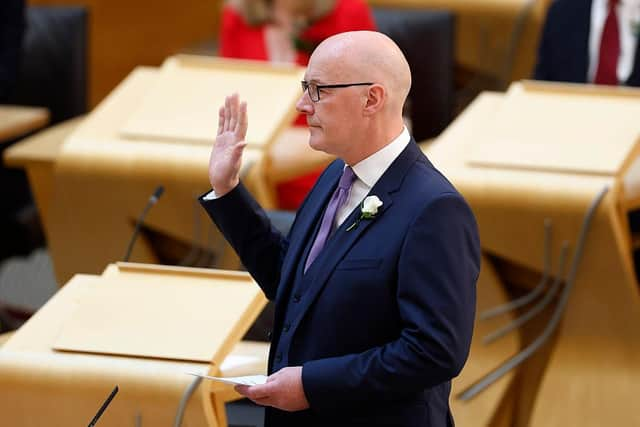
John Swinney disgraces Scotland by his willingness to work with Sinn Fein to break up the UK. Move on, he says blithely. Well, I have some advice for him: “Move on from the referendum.”
Time to get on with the day job – invest in the North Sea to help protect energy security, jobs and tax income. Stop hammering businesses with tax, and build an environment that encourages job creation. Shrink the size of the Scottish bureaucracy. Fix the NHS. Fix local government funding without battering council taxpayers. Fix the Fire and Rescue Service. Fix the Ambulance Service. Undo the damage you have done to education. Deliver the ferries, and fix our potholes.
Having failed to demonstrate competence over 20 years, try to do so in the next five. Scotland deserves better.

Brian Barbour, Haddington, East Lothian
Time for realism
The SNP won some seats in the recent election purely on a split vote between Tory and Reform UK but, more importantly, because the Greens stood in only six of the 73 constituencies.
Right-leaning politicians appear to be reluctant to use this same winning tactic, but it is time they did. There is a growing clamour for the Tories to give Reform UK a clear run at Makerfield while the idea that Reform could give the Tories a clear run in Aberdeen South in return is attractive.
We need a sea change in politics in this country so that the real views of the people are not diluted by in-party fighting. This is not surrender by one party or the other, it is realism. A quality sadly missing in politics these days.
Gerald Edwards, Glasgow
Scottish slaves
I am interested that Edinburgh University is no longer going to contribute to a statue to the victims of slavery set to be placed in the Old Town.
We should not forget the last slaves in Scotland were Scots miners and salt workers who were not freed until 1799.
Also, for many centuries northern Europe, including Scotland, was plagued by North African slavers. Scottish records back to the 1500s refer to individual parishes trying to buy back enslaved Scots sailors, often without success. Sometimes these people (men, women and children) were treated horribly, mutilated, tongues cut or torn out and so on. The first such experience in England is from 1390! Sir Robert Lambert Playfair said that at its height there were “20,000 to 30,000 (Christian) captives at the time in Algiers alone”.
We should also remember Henry Dundas, who was the man responsible for the freeing of Joseph Knight (pro bono, I believe), an escaped African slave. Dundas also was a friend of William Wilberforce and, like him, an abolitionist.
I do hope that funds for the statue have been sought from Turkey and both north and west African nations, who were decidedly proactive in enslaving white Europeans for centuries before Europeans started buying and transporting African slaves.
No? Well, somehow that is hardly a surprise.
Andrew HN Gray, Edinburgh
We deserve better
So, the dust is trying to settle on the SPFL Men’s Premiership season and we have a winner; or do we?
Some credit must go to the Celtic manager and his players for rescuing what seemed like a disastrous season for them. However, the real credit should go to the SPFL and the SFA. The SPFL for going against tradition and contriving to have Celtic play their last match at home against their closest contenders for the title, Hearts; and we saw how that ended. Then the SFA, they played a real blinder.
Over the course of the last week of scheduled fixtures we saw their VAR system in all its glory, with seemingly no method in its madness. Then to cap it all there is further civil unrest, this time off the park.
I do not think there have been any winners in any of this. The paying Scottish footballing public, in one of the most supported, per capita, leagues in Europe, deserve much better than this.
David J Mackenzie, Inverness
Bill the clubs
The bill for cleaning up the mess made by “celebrating” Celtic fans at the weekend (and it’s not the first time they’ve done this) should be sent to the directors at Celtic Park. Why should ordinary law-abiding Glasgow taxpayers bear the financial burden?
This also applies to Rangers fans, who are no less culpable in similar circumstances. It’s a national embarrassment and these Old Firm “fans” have been shaming the city with impunity for too long.
Ian McElroy, Thurso, Highland
Shameful scenes
There is a rude Yorkshire expression “to grow a pair”. Our inadequate indifferent SFA's failure to implement “strict liability” – Scotland is the only country in UEFA not to do so – leads directly to the worldwide embarrassment of the Ibrox pitch invasion in March, the abject failure to tackle dangerous pyrotechnics at matches, and now the appalling scenes at Celtic Park which have shamed our nation again.
Yet another investigation by the SFA (the familiar kneejerk response in the hope the matter will blow over), concerns of the SPFL, and even condemnation by Hearts FC are no longer enough. The police rightly demand the clubs take responsibility.
The Glasgow media may well mock the demand for a points deduction or a replayed match or the awarding of the flag to Hearts, but any of these would have a desired massive impact. If we had “strict liability” Celtic could have points deducted, their next few games could be behind closed doors, the stadium closed even partially, or the club fined. Remaining outwith these UEFA safeguards is no longer tolerable. That said, there are powers to deduct points or replay a game in exceptional circumstances. Our nation being humiliated worldwide may be sufficient.
The SPFL wants urgent meetings with the Scottish government. They must demand we emulate England and Wales, which have tackled tailgating (you must have a ticket to attend a game) and their Football Offences (1991) Act which makes it a criminal offence to encroach on the pitch.
Assistant Chief Constable Mark Sutherland, responding to injured officers who had missiles thrown at them while tending a medical emergency, has called for SFA accountability.
I am proud that Dunfermline Athletic have sold over 15,000 tickets for the showpiece Scottish FA Cup Final, but we are all asking, will we be safe?
John V Lloyd, Inverkeithing, Fife
Money for all
Artificial Intelligence will disturb the economic balance, by creating more goods while causing the job and income losses that reduce the money available to buy them. Not enough money to buy goods causes deflation, while too much causes inflation. So the answer is not a Universal Basic Income – as has so often been considered – but a Universal High Income, to maintain the stability of the money/goods balance, as the output of goods increases due to AI.
But where will that UHI money come from? The answer is that government itself should create and issue it. But most importantly, that government money – unlike that borrowed from the banks – could be interest free.
Here we look back to Abraham Lincoln and the unsupported paper currency – so called Greenbacks – issued by the US government during the American Civil War, to fund the Union's war effort, without relying on high-interest loans from private banks.
Already our own Sterling is an unbacked fiat currency, borrowed at interest from the banking system, so AI could be the reason for ending the crazy situation, where the banks create our public money supply, and presently charge us £2 billion a week as interest. That would be real intelligence.
Malcolm Parkin, Kinnesswood, Kinross-shire
Honour Brexit
The Strait of Hormuz ought to concentrate minds in Westminster. When European insurance rules distort commercial decisions at a moment of geopolitical danger, the lesson is not merely technical. It is political. Britain still has not fully accepted what the public voted for in 2016.
If rigid inherited rules make it harder for insurers to cover lawful shipping in a conflict zone, then the result is not prudence but vulnerability.
Trade becomes less flexible, markets seize up more quickly, and strategic chokepoints become even more dangerous because commercial actors are being pushed by regulation rather than guided by rational judgment. In a crisis, that matters.
The wider point is that too much of Britain’s regulatory structure still reflects European frameworks that were designed for a different system and a different political order.
We were told Brexit would mean democratic control, yet too often ministers behave as though divergence is somehow improper, and as though keeping old EU rules by inertia is the safer course. It is not. It simply means Britain remains constrained by assumptions voters explicitly rejected.
This is why the UK government should stop edging towards managed reversal and start respecting the settled will of the people. That means reviewing retained EU rules with urgency, removing laws that no longer serve the national interest and accepting that the purpose of Brexit was not symbolic separation but practical self-government.
It also means finishing the job across the whole UK, including ending the absurdity of Northern Ireland remaining subject to EU rule-taking.
Alastair Majury, Dunblane, Stirling
Comments
Want to join the conversation? Please or to comment on this article.