
Readers Letters: Syngenta shutdown shows Scottish government bad for business
Agricultural technology company Syngenta’s Scottish troubles fail to surprise reader
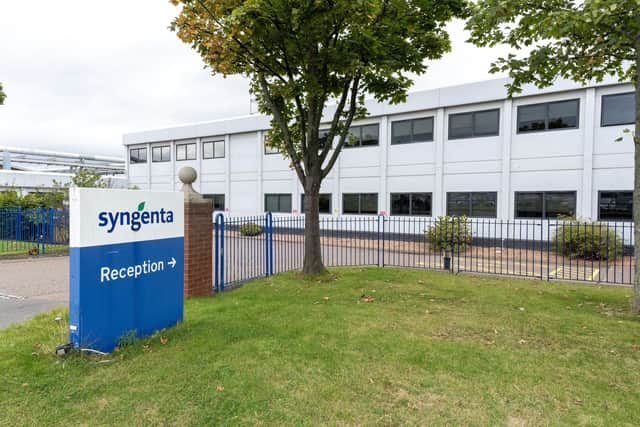
The news that chemical firm, Syngenta is probably closing comes as no surprise to anyone who has any involvement in business (your report, 1 October). The truth of the matter is that the UK as a whole, and Scotland in particular, are both run by parties with net zero knowledge of how to run a business.
What does come as a surprise is anyone being surprised at a Chinese-owned company finding that it is simply uncompetitive working in Scotland when the playing field is anything but level. The company says that the site is “significantly more expensive to operate than other production sites, despite substantial efforts to reduce the difference”. Energy costs are anything from four times our competitors', to seven times as much.
Then, we have taxes, which are high and getting higher as we have a socialist government and a Nationalist Mini-Me at Holyrood. Add in increased National Insurance contributions and higher rates of pay for school-leavers to increase the misery of a business and then put in more legal rights for new employees. What do you get? Well, you get a country in which Sir Jim Ratcliffe is mothballing plants in the north of England as natural gas in the UK is 12 times more expensive than in the US.

Reporting Scotland on Thursday night followed the feature on Syngenta with another about “climate activists” who are trying to stop the proposed development of the Rosebank field off Shetland. How many of these “activists” have ever done a day's work in any business in their entire lives? None.
That would make them just like Andy Burnham's government and John Swinney's independence workshop at Holyrood.
Andrew HN Gray, Edinburgh
Say what you want
On Wednesday at First Minister’s Questions, John Swinney made the statement: “We have been taken out of the European Union. We are now going to lose our pensions.”
Are there no safeguards at Holyrood against ministers telling outright lies? Andy Burnham’s recent announcement about scrapping the triple lock poses no such threat to pensions, though obviously future increases will potentially be lower than they might have been. If he was not lying, then did Swinney imply that in a future independent Scotland we would be unable to pay pensions at all?
As usual he finished his typical nonsense with the now much worn phrase: “Scotland needs to have independence.” Give us a break, please, and try to be truthful for a time.
Ken Currie, Edinburgh
Wired to fail
The Burnham vibe reverberated louder than ever in the echo chamber of this year’s Labour Party conference. The party faithful were captivated, nay enraptured, by an impressive piece of performative oratory.
Partial re-nationalisation (control if not outright ownership) of the railways, water utilities etc; a care sector run along NHS lines; local government re-cast under functional and fiscal devolution; more social housing; training programmes to get Neets economically active again – but not a hint of direct cuts to the welfare budget other than ending the “triple lock” on the state pension.
So, this is “re-wiring the State” – big government getting bigger! Presumably, this is also what ending 40 years of neo-liberalism looks like: more Tony Benn than Tony Blair!
How’s this playing out?
The first major test will be for Chancellor John Healey as he prepares this month’s budget. A modest pick-up in growth may ease things at the margin, but the big noose around his neck is the burden of servicing the eye-watering national debt of roughly £2.7 trillion.
Around 25 per cent of this debt is inflation linked. With inflation on the increase and forecast to rise further in 2027, the omens are not good: a 1 per cent rise in inflation increases the debt-servicing costs alone by about £6 billion annually.
Moreover, the early response from the bond market to Andy Burnham’s conference speech saw the yield on ten-year gilts (a key benchmark for borrowers) rise above 5.2 per cent – the highest since 2008 and above the peak of 5.12 per cent during the Liz Truss debacle.
With such a massive debt overhang and high costs of debt servicing – one of the highest amongst the G7 nations – the country will inevitably remain in hock to the bond market, a domain well beyond the reach of Andy Burnham’s rewiring project!
Ewen Peters, Newton Mearns, East, Renfrewshire
Referendum rules
Andrew HN Gray is absolutely right to say we should abide by democratic decisions (Letters, 2 October). The problem with the Brexit referendum is that it validated the narrowest of results, 52-48 per cent, on a 72 per cent (less than three-quarters of the eligible electorate) turnout. Further, the 55-45 per cent 2014 result, based on an 85 per cent turnout, was for, in effect, the status quo.
That was entirely legitimate, whereas the very narrow victory for Brexit received nothing like the overwhelming endorsement that would have promoted more confidence in it.
The Brexit vote, on that basis, was held on a random date and might well have been sufficiently different if it had been held on another day to produce the opposite result. In any future referendum (not that I want one), we would need to build in qualifications about the winning margin (66 per cent for momentous change and 75 per cent turnout for the same) so we can be sure there is a real, enthusiastic majority for the massive change referendums are intended to bring.
Jill Stephenson, Edinburgh
AI OU OK?
The recent Scottish Funding Council reports deliver a stark warning: most of Scotland’s colleges are “not financially sustainable,” while our universities “continue to face significant financial challenges”. Our higher education sector is operating on a model that is rapidly running out of road, demanding radical new solutions rather than minor adjustments.
We have successfully reinvented higher education previously. When the Open University was established by Royal Charter in 1969 it was dismissed by critics as a radical gamble. Yet, prime minister Harold Wilson’s vision of a “University of the Air” – harnessing television, radio and correspondence to democratise learning – made education accessible for millions.
Has the time not come to bring that same pioneering spirit into the 21st century by embracing the exciting powers of Artificial Intelligence?
AI offers us the historic opportunity to completely rethink how we deliver higher education. By utilising intelligent, adaptive learning platforms, we can provide personalised, high-quality education at a fraction of the traditional delivery cost. This technology can bridge regional gaps, support overburdened staff, and offer flexible learning that fits around modern lives – massively expanding access while addressing the systemic financial deficits threatening our institutions.
We cannot solve today's financial crisis with yesterday's structures. Just as the Open University leveraged the media tech of the 1960s to revolutionise learning, Scotland must now lead the way in leveraging AI to build a sustainable, world-class educational future.
Doug Clark, Edinburgh
Define ‘innovate’
For colleges and universities, the funding rocks are melting under the sun, to paraphrase the words carved on Alex Salmond's much publicised but long since removed stone about student fees. History is repeating itself. The words used by the current Minister for Tertiary Education, Alyn Smith, that colleges should “innovate their way” out of a funding shortfall (Education, 2 October) echo those used by Margaret Thatcher when she hammered university funding soon after taking power, an event helped by the SNP voting with her in a vote of no confidence in the Labour government. In Aberdeen we innovated by closing the Physics, Classics and Music Departments, letting 200 staff go, and transferring some medical school staff onto the NHS payroll. Not an option available today!
Hugh Pennington, Aberdeen
Added Pressure
It has long been regrettable that the vital role of Group Captain James Stagg of Dalkeith in our D-Day success has been largely ignored. So it is welcome that the film Pressure rectifies that omission, receiving widespread acclaim.
But was it really necessary to include falsehoods to increase the “drama”? Stagg’s wife was four months pregnant in June 1944, not nine; her hospital was not bombed as she gave birth; Stagg was appointed D-Day’s chief meteorologist by Churchill in November 1943 not, as implied, only for about three days in June 1944.
The drama of such a decision of when to invade, with such monumental consequences either way, including the inevitable risks of unintended consequences, was surely more than sufficient without such embellishment, especially in a British/French film claiming to be “a true story”, not merely “based on the true story”.
The film is, however, an excellent example of the processes by which our top people have to make appallingly difficult decisions, often with only “partial truths” or “best guess” estimates which can change even after action has begun and which, albeit on a very different level of consequential importance, Edinburgh Council might accept rather than merely ignoring the available “whole truth” in their outright condemnation of Viscount Melville’s stance in the 1790s on abolishing the slave trade (Letters 24, 26 September).
John Birkett, St Andrews, Fife
Write to The Scotsman
We welcome your thoughts – NO letters submitted elsewhere, please. Write to [email protected] including name, address and phone number – we won't print full details. Keep letters under 300 words, and in the body of the email – no attachments – and avoid 'Letters to the Editor/Readers’ Letters' or similar in your subject line. If referring to an article, include date, page number and heading. No poems.
Comments
Want to join the conversation? Please or to comment on this article.