
Readers Letters: Swinney's SNP denies democracy by snubbing Reform
Refusing to deal with Reform UK shows contempt for voters, reckons reader
The continual boast of the SNP is that it represents and speaks for all of the people of Scotland. However, its decision to ignore one of the official opposition parties and not involve, or even discuss its future plans, with them makes a mockery of this.
By refusing to engage with Reform, which attracted nearly 16 per cent of the vote, the SNP government is really saying “we represent and speak up for only some of the people of Scotland”.
This decision is exacerbated by its willingness, at the same time, to engage with a party that actively undermines women's rights.
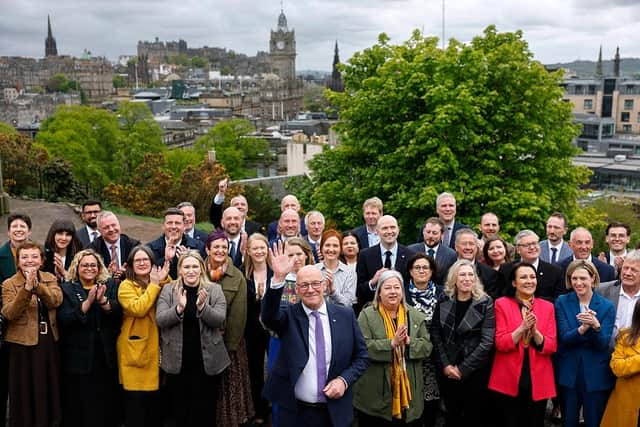

At a stroke they have undermined democratic principles, by in effect refusing to represent a large proportion of Scotland. Would this be the picture of a future independent Scotland?
John Swinney and his undemocratic party would do well to learn a lesson in good government and democracy in action from another nationalist leader, Rhun ap Iorwerth of Plaid Cymru, who stated that he and his party would enter into discussions with all parties and represent all people in Wales, no matter who they voted for.
Paul Lewis, Edinburgh
Self service
Listening to Mairi McAllan’s interview on BBC Scotland’s Sunday Show confirmed what I always thought – that the SNP only serve their own members and not Scots as a whole. She dismissed Reform voters in a way that left no doubt that the SNP thought them unable to think through different policies put forward before they voted, hence making a mistake and voting Reform. She said the SNP will not work with Reform despite them having the same number of MSPs as Labour, and listed why, mainly mentioning the faults of Nigel Farage (eg wanting to stop illegal immigration, which was a key concern of Scots, especially as Glasgow has the largest number in Britain).
So if you voted Reform your views won’t be heard at any committee-making decisions or count towards any decisions about the way Scotland is governed for the next five years.
That doesn’t sound democratic to me
Elizabeth Hands, Armadale, West Lothian
A vote must come
The Holyrood election delivered the SNP a constituency majority of 43 (57 against 14, a ratio greater than 4:1) over the combined Unionist forces of the Labour Party, Reform UK, the Conservatives and the Liberal Democrats, and an overall majority of 2 (58 against 56) after list voting is considered, even without the wins of the Scottish Greens.
With the constituency and list wins of the Greens included, the Scottish Parliament now has the largest ever independence majority.
The vote-share for the SNP in the constituencies was nearly 5 per cent higher than the vote-share for the Labour Party at the last Westminster election in what was described as a “landslide victory” (providing Labour with pseudo-autocratic control over the UK parliament).
By any measurable semblance of democracy the UK government does not have a democratic mandate, especially given repeated majorities won by independence parties, to deny the Scottish Parliament the authority to conduct a constitutional referendum at a time of its choosing.
Those who have argued against the hope of the majority of Scotland’s people to determine their own future should now back that authority and begin seriously debating independence or be prepared for even greater economic and social havoc to that caused by Brexit should its shallow soundbite champion become the next UK prime minister.
In other words, those continuing to argue against democracy should beware, be very aware.
Stan Grodynski, Longniddry, East Lothian
Barnett boost
The 2025-26 Barnett block grant of £47.7 billion (rising toward £50bn, according to GOV.UK) is an anachronistic embarrassment that exposes the fundamental hypocrisy in the SNP’s independence case. Rather than proving fiscal autonomy, this record-high funding, providing over 20 per cent more per person than equivalent spending in England, relies entirely on the fiscal strength of the UK Union.
The SNP constantly decries Westminster policy while simultaneously pocketing billions in Barnett consequentials to fill gaps in public service funding. This blatant contradiction completely undermines their case for independence. If Scotland is supposedly a wealthy, prosperous nation, it should not require a massive, outdated funding mechanism – conceived temporarily in the 1970s – to prop up its budget.
The 2025-26 settlement is a testament to the benefits of the Union, not a case against it. Proposing to abandon this stability for a sovereign “independence” that would require immediate, severe austerity or massive tax hikes to cover the budgetary gap renders the SNP's economic argument at best delusional, and at worst, intellectually dishonest. It demonstrates that independence would reduce, not enhance, Scotland’s financial capacity.
Doug Clark, Currie, Edinburgh
Suspect votes
I'm sorry, but I have never seen a more disingenuous sub-heading in The Scotsman than on your 10 May Comment piece: “The SNP are set to form the next Scottish Government despite lacking the support of four out of five potential voters.”
So long as over 50 per cent of the total ballots that could be cast are cast, the end result comes from the majority who could be bothered to access what past generations campaigned, and on St Peter's Field, Manchester, died, for. Those who do not vote for whatever reason disenfranchise themselves and have zero right to whine when results don't go “their” way.
Of far greater concern is the possible abuse of the postal ballot system. In my constituency of Renfrewshire West and Levern Valley, with an electorate of 62,764, there were 11,889 postal votes applied for out of a grand total of 34 393 votes cast (and mysteriously, 34,397 for the regional list seats). The neighbouring seats reported similar proportions – 10,845 for Paisley; 11,155 for Renfrewshire North and Cardonald.
It's not that many years ago agents or candidates attending the opening of the postal ballot boxes were lucky if they saw a hundred – at least outside of the blind eyes turned to West Belfast.
For circa 35 per cent of all ballots cast to suddenly become postal raises immediate suspicions of organised electoral fraud on a grand scale from all manner of malevolent interests, jeopardising the continued legitimacy of our free democracy.
Mark Boyle, Johnstone, Renfrewshire
Apathy Party
The recent Scottish Parliament election should give all of us cause for reflection. With voter turnout sitting at just over 52 per cent, nearly half of eligible voters chose not to participate in one of the most important democratic exercises in our nation.
The troubling story here is the growing sense of apathy and disengagement among the public, with the election campaign failing to ignite the public’s enthusiasm.
The SNP clearly won the election, but attracted only about one in five potential voters, and the Labour Party one in ten.
When almost one in every two voters stays at home, it raises profound questions about trust in politics, political representation, and whether our institutions are genuinely connecting with the people they serve.
Low turnout should not simply be accepted as the new normal. It should serve as a warning sign that democratic participation in Scotland cannot be taken for granted. The alarming lack of interest is a crisis that should concern all parties, and they should devote themselves to addressing this apathy by engaging the public.
If this trend continues unchecked, the Apathy Party risks further eroding the legitimacy of our institutions and undermining public confidence in government, paving the way for the rise of more extreme parties.
Politics must once again become something people feel part of –not something done to them from a distance.
Alex Orr, Edinburgh
Foot dragging
In an excellent article Jenny Lindsay correctly says the “Scottish Election result is a triple whammy blow for women” (Perspective, 11 May). Yes indeed and it is therefore surprising that women, who represent 50 per cent of the Scottish electorate, did not vote them out on 7 May. Why did this not happen?
The Supreme Court's decision in For Women Scotland Ltd v The Scottish Ministers on 16 April 2025 – yes over a year ago – clarified the application of the Equalities Act 2010 concerning gender reassignment and sex discrimination and that the term "sex" refers to biological sex, not gender identity.
Since then the SNP government has deliberately been dragging its feet and has not implemented single-sex facilities.
Males identifying as women are still in women's prisons. Women-only facilities are appearing at a snail’s pace in the public sector and in the Scottish NHS, yet no one is held responsible. Surely our taxpayer-funded legal system can hold those responsible to account and remove them from office – and that includes politicians?
The Scottish government reluctantly and belatedly introduced a Scottish Parliament (Recall and Removal of Members) Bill in 2025, ten years after one was introduced for England and Wales. Something to hide?
It’s a pity it cannot be used to eject those MSPs who are refusing to implement women-only spaces.
Clark Cross, Linlithgow, West Lothian
Write to The Scotsman
We welcome your thoughts – NO letters submitted elsewhere, please. Write to [email protected] including name, address and phone number – we won't print full details. Keep letters under 300 words, and in the body of the email – no attachments – and avoid 'Letters to the Editor/Readers’ Letters' or similar in your subject line. If referring to an article, include date, page number and heading. No poems.
Comments
Want to join the conversation? Please or to comment on this article.