
Readers' Letters: Swinney's new government looks set to torpedo Scotland's purse
Both Labour and SNP disappoint reader when it comes to handling taxpayers’ money
John Swinney basked in the limelight because Labour had adopted a similar supermarket price cap policy to the SNP, but voluntary rather than the SNP's enforced idea.
This lasted a mere 24 hours before Labour understood the impossibility of such a policy, so Mr Swinney is back on his own.
Couple this with his brand new finance secretary Jenny Gilruth's unfortunate ideas that benefits are too low despite there being no money in the kitty and an increasing deficit.
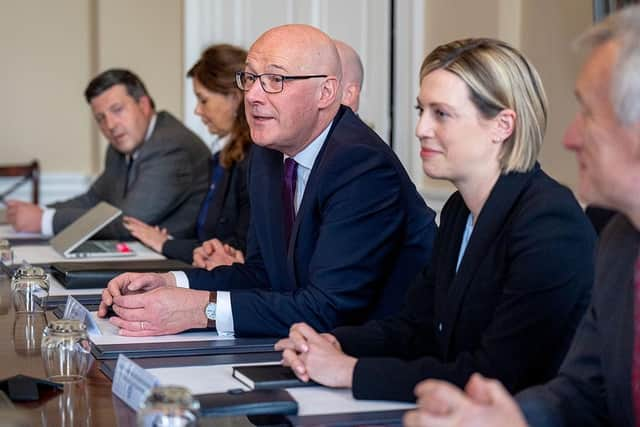

Financial prudence has therefore not improved with our shiny new SNP, quite the reverse. Mr Swinney wants to embark upon another referendum saga, which would be extremely financially challenging at the best of times. The SNP has surely just torpedoed this too, as the costs would be astronomic.
Back to the drawing board?
Gerald Edwards, Glasgow
Abandoned youth
Since Labour came to power in the UK two years ago – although it feels much, much longer – unemployment has risen by a quarter from 4.2 to 5.5 per cent. This is largely due to increases in National Insurance and a reduction in the NI threshold, more onerous burdens on employers through things like business rates – hitting the hospitality sector particularly hard – and of course, a refusal to address high energy costs for businesses. And youth unemployment is even higher at over 10 per cent in England and over 11 per cent in Scotland.
It is astonishing that Rachel Reeves and the Labour Party cannot see the damage their policies are doing to the youth of today, leaving many on the scrapheap with no hope.
A report by Alan Milburn, a former Labour cabinet minister, shows the UK spends 25 times as much on benefits for youths than it does on helping them find gainful employment. The SNP’s refusal to aid the hospitality industry, and their increased taxes on business, has made finding an entry job for youngsters even more difficult in Scotland.
It is a sad indictment that Labour claim to represent “the ordinary working person”, yet they inflict policies that damage employment, and youth employment in particular. It saddens me that so many youngsters will wander aimlessly through a life on benefits rather than getting a job, building their skills, their self-confidence, and aspiring to greater things for them and their families.
Labour has inflicted so much damage in only two years whereas the SNP has spent 20 years proving their incompetence!
Neither party seems to understand you cannot tax your way to growth, yet only by growing the economy will we get the tax revenues to help those in genuine need, start repaying our debts and maybe even reducing the debt interest bill.
Brian Barbour, Haddington, East Lothian
Grammar solution
I read Ronald Hepburn's article, “Adam Smith's moral philosophy offers an antidote to poison of dehumanising AI” (23 May), with great interest and entirely agree with his warning against the increasing influence of AI on the world.
He reminds us that Smith's advice on “how human beings come to live together decently” should encourage us to “look at our conduct as a reasonable stranger would and tell us when we have acted well or badly”. It was then, and is now, very good advice.
However, to follow this advice, and counteract the pernicious effect of “the algorithmic systems” at the root of AI systems, children must be taught to read, write and think for themselves and, sadly, they are not taught to do so in schools nowadays. When I started to teach English in 1984 there was great criticism of rote learning which, we were told, was simply parroting words from textbooks but not engaging with the content of what children were reading.
The remedy was to dispense with textbooks and rely on teachers writing their own lessons – a tall order because, at the time, providing sufficient numbers of lessons on the duplicating machine was... challenging.
But that was a mechanical challenge. A much more deep-reaching and damaging challenge was that English teachers were exhorted not to mark as errors spelling, grammar, punctuation and structure “inaccuracies” because they “impeded the creative flow” and made some pupils feel inadequate. I said at the time that if teachers followed this decree we would be sending intelligent semi-literates to universities.
This is why so many adults and school pupils are attracted to AI and its algorithms; they cannot write and spell accurately, cannot construct sentences, and cannot put coherent thoughts together, so feeding a problem into Copilot or any other AI tool is almost essential in today's society.
The solution, and yes, I know how old-fashioned this makes me, is to teach pupils to read, write and count – the now much-derided three Rs. To accomplish this from P1-S6, schools would have to give priority to them at the expense of other “social” subjects. So be it.
I have taught English as a Second Language at summer schools to pupils from across the world and have been saddened to discover that children from Russia, Eastern Europe, South America, China, etc know more English grammar than our own children do. I remember one Russian boy staying behind after a lesson to thank me for teaching the Subjunctive mood as he'd been absent when it was taught at his school and he realised how important it was. How many of our pupils have even heard of the Subjunctive mood or know how to use it?
Scottish Education threw the grammar and punctuation baby out with the bathwater decades ago, but we can still pull ourselves out of the maw of AI if we teach our own language to our pupils so they can think for themselves and express their thoughts coherently and persuasively.
I think Adam Smith would agree with me.
Lovina Roe, Perth, Perth and Kinross
Write to The Scotsman
We welcome your thoughts – NO letters submitted elsewhere, please. Write to [email protected] including name, address and phone number – we won't print full details. Keep letters under 300 words, and in the body of the email – no attachments – and avoid 'Letters to the Editor/Readers’ Letters' or similar in your subject line. If referring to an article, include date, page number and heading. No poems.
Comments
Want to join the conversation? Please or to comment on this article.