
Readers' Letters: Starmer is tackling social media danger the wrong way
Don’t make UK a culture of surveillance, says reader
Protecting children online is a serious duty, but it must not become an excuse for routine digital identity checks on ordinary citizens.
The Government’s under-16 social media ban has been presented as if the public argument is largely settled. Yet the evidence does not justify that confidence. Some consultation exercises involved tens of thousands of respondents, while a parliamentary petition against banning social media for under-16s has passed 120,000 signatures, and a separate petition opposing digital ID reached nearly 2.9 million. Good policy begins with honest questions. If ministers rely on tightly routed consultations, smaller samples or forms that do not give people a clear way to reject the policy, they are not measuring public opinion. They are narrowing the answers until the result suits the policy.
This matters in Scotland as much as anywhere else. Families, schools, small businesses and voluntary groups all depend on ordinary online access. A system that normalises proving identity before using basic internet services would not stay confined to one narrow area for long.
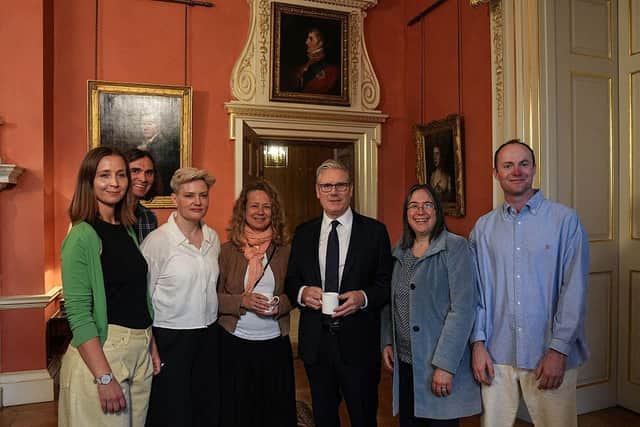

Labour were elected promising change, but too often they appear to be repeating the habits voters had tired of under the Conservatives: ever higher taxes, an overextended state, defence still not treated with the urgency national security requires, and the public consulted after decisions have effectively been made.
Supporters will say that age checks are a practical safeguard. That concern is understandable. Children do need better protection online. But Britain can do that through targeted enforcement against harmful platforms, stronger parental tools, better digital education and clear duties on companies, without building a wider culture of surveillance.
A confident country does not need to choose between safety and freedom. It can protect children, strengthen defence, lower the burden on working people, and still trust its citizens.
Alastair Majury, Dunblane, Stirling
Toothless
Since the late 19th century there have been two signs of any democratically elected government in deep trouble seeking to deflect attention from domestic woes. The first is a crusading foreign policy for some noble cause – usually resulting in war.
The second is declaring a child welfare “emergency” from some hobgoblin or other they'd hitherto cheerfully ignored for years. Handwringing for “vulnerable children” is the favourite straw man of the political scoundrel: none dare criticise it.
Except in this case, one has: campaigner Ian Russell, whose daughter Molly's suicide was blamed on online content, called out those “more interested in playing performative gesture politics with sticking plaster ideas”. Russell said the real problem is that online companies will forever cock a snook at any such legislation, knowing a toothless Ofcom had zero intention of enforcing changes whose supposed prohibitive costs in reality would be “pocket money to platforms making tens of billions every year”.
Mark Boyle, Johnstone, Renfrewshire
Raising heat
I refer to your leader of 15 June: “Scotland on the frontline of Russian threats ‘every day’”.
Recently Ian Proud, a senior UK diplomat for 24 years including more than four in Moscow, predicted that a shooting war between Nato and Russia would start on the high seas.
If Britain and France continue to board tankers suspected of being part of Russia’s “shadow fleet”, he may well be proved right. And if Russia retaliates by bombarding plants here supplying missiles and drone-parts for Ukraine, with the UK invoking Nato's Article 5 in response, will Nato chief Mark Rutte's “Daddy” Trump rush to our rescue ? I think not. One target might even be Rosyth Dockyard, though the local MP Graeme Downie seems happy to see ploughshares beaten into swords for the sake of a few jobs more at Babcock.
George Morton, Rosyth, Fife
Answers please
In his latest pronouncement, Stan Grodynski (Letters, 16 June) denounces myself, Jill Stephenson and Allan Phillips as being only concerned with the inner machinations of the SNP.
Let’s put this to the side for a moment. I am willing to support independence immediately if Mr Grodynski can provide answers to the following questions.
What currency, what central bank, how do we negotiate a return to his answer to Shangri-La, the EU, what about borders (particularly with nasty England, our biggest customer by far) and can he please cut to the chase and answer these questions without any further circumnavigation and bluster? I am here, ready and waiting with my “See you Jimmy” hat, my Harry Lauder walking stick and a flag which has been denigrated for the last 20 years.
So, come on, you’ve had the last 20 years to concoct the answers. By the time I get the answers, I will no doubt be needing the stick!
David Millar, Lauder, Scottish Borders
SNP will shrivel
Just what does the future hold for the Scottish Nationalist cause? We have witnessed the rise and fall of its leaders over the years; I hesitate to make any reference to the fate of Alex Salmond, or indeed to more recent circumstances involving Nicola Sturgeon and her errant husband Peter Murrell.
At the last general election for the Westminster Parliament the number of SNP MPs was reduced to seven. And at the recent Holyrood election the SNPs seats were reduced from 64 to 58, while newcomers to Holyrood, the Reform UK party, acquired 17 seats. It has to be said that the SNP did better than most of their critics expected, but generally their support is on the slide. I would therefore forecast that their influence in Scottish affairs will decline considerably.
Swinney insists on making reference to holding another referendum on the subject of independence. He is completely disillusioned on any such matter; the 2014 referendum was a one-off affair agreed to, most surprisingly, by the prime minister at the time, David Cameron. Alex Salmond must have thought it was his lucky day. There will be no repeat performance.
As time goes by the SNP will inevitably shrivel into insignificance, like most extremist causes.
Robert I G Scott, Northfield, Ceres, Fife
Inquiry needed
John Swinney’s lackeys, the Scottish Greens, bailed him out of a Holyrood inquiry into the disgraceful scandal that is the SNP finances. The Greens’ attempted tactic of including all political parties into any inquiry was a simple but effective diversionary tactic. It is now clear that Westminster, via the Scottish Affairs Committee, should flex its muscles and hold an inquiry into this scandal.
We deserve to know how much public money was spent by the Police over five years, and about any other fraudulent activity that affected the public purse.
My only caveat on this would be the likely appearance of Nicola Sturgeon, who will defend herself by having no “conscious memory” of anything her estranged husband did or said.
Richard Allison, Edinburgh
Generation game
Tim Flinn (Letters,16 June) responds to my request that he lists the dozens of safe and relatively cheap ways of making all the electricity the planet needs.
But in his list he conflates generation with storage, such as pumped hydro storage, batteries, which on any scale need charging, and hydrogen, which also needs electricity for its generation.
He also lists the obsolete, like burning coal, and includes fusion, which for more than 60 years has been said to need another 30 years before it might come on-stream.
As for using lightning, osmotic power generation, and piezoelectric devices, the power these generate falls far, far short of our planetary requirements.
So do microbial fuel cells, although I note that one bacterium used in them experimentally belongs to the genus Shewanella, named after the bacteriologist James Mackay Shewan, head of the Torry Research Station in Aberdeen which studied the preservation of fish, and who I knew well.
Hugh Pennington, Aberdeen
Happy ending
May I make a plea here, following Scotland's winning World Cup football match against Haiti (by the way, the Haitians pronounce it “Ayiti”) that all our correspondents note that a “crescendo” is a growing increase in volume, leading to a climax.
You cannot “reach” a crescendo, as it's a gradual musical path which ends in a climax.
I understand the problem with the word “climax”, but it's the only one which describes the dramatic conclusion of a crescendo! Please remember this.
Brian Bannatyne-Scott, Edinburgh
Deathly coloured
I am always intrigued by, and would love to know more about, newspaper announcements funeral requests by family or the deceased for bright colours to be worn – or specifically pink, blue, tartan etc – and “whatever you want” to honour a life.
The most personal I’ve read in papers was “hats you would wear to the races, Crocs if you have them, and for no black ties”. I would love to have seen the alternatives.
I have not yet decided what request I shall make as I’m not quite ready to pop my Crocs. I’ll let you know.
Elizabeth Hamilton, Edinburgh
Write to The Scotsman
We welcome your thoughts – NO letters submitted elsewhere, please. Write to [email protected] including name, address and phone number – we won't print full details. Keep letters under 300 words, and in the body of the email – no attachments – and avoid 'Letters to the Editor/Readers’ Letters' or similar in your subject line. If referring to an article, include date, page number and heading. No poems.
Comments
Want to join the conversation? Please or to comment on this article.