
Readers' Letters: SNP vow to peg food costs just another daft idea
Reader says once again SNP is ignoring Scotland’s pressing problems in favour of schemes screaming that ‘Scotland is unique’
Would it be too cynical of me to suggest the SNP look at the list of reserved powers, ie those things under UK government control, and decide that picking a fight with Westminster will detract from their utter incompetence in Holyrood?
The latest hare-brained idea is to control the cost of essential food items using public health powers. We’ve been here before with the deposit return scheme that was not compatible with the internal market rules.
If only the SNP would put the same amount of effort into improving our NHS and our education system, rather than wasting our money on lawyers and court fees.

Jane Lax, Aberlour, Moray
Titanic faith?
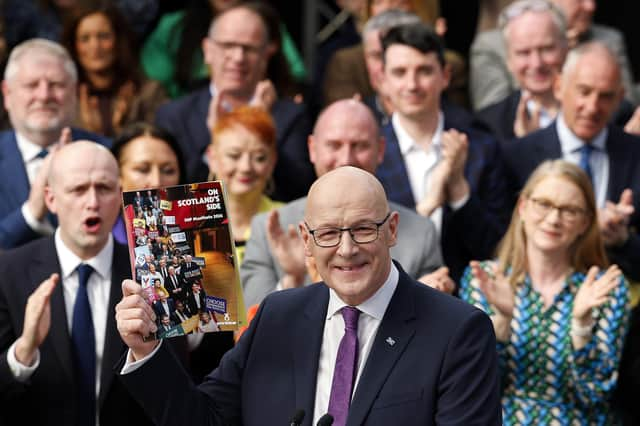
John Swinney is going into this election with the promise to offer “experienced, trusted, leadership” (your report, 16 April).
No fewer than 25 of his MSPs have had enough and are not standing for re-election. Even if all their replacements are also SNP it doesn't exactly convey experience or trust, does it? At best we can expect Swinney to rearrange the chairs of those who are staying on but who never amounted to much.
Bruce Proctor, Stonehaven, Aberdeenshire
Safeguards needed
An interesting article from Henry McLeish (Perspective, 16 April), covering many points, one being the need for proper rules governing referendums, so there are safeguards to ensure serious issues really do have majority support, eg, a vote to leave the EU.
Fifty per cent plus one, perhaps on a low turnout, settles nothing, and is a recipe for future conflict. Brexit should never have gone ahead on 52 per cent – I voted for it – and neither should Scottish independence!
William Ballantine, Bo'ness, West Lothian
Let’s get talking
The introduction by the Tories of the UK Internal Market Act and the further bypassing of Holyrood through Labour’s Local Growth Fund have sounded the death knell for workable devolution in Scotland. With it now generally accepted that post-Brexit Britain is indeed broken, it was not surprising, although long overdue, to read the words of a pro-Union politician promoting the concept of federalism. Beyond the past mutterings of Gordon Brown there has been little serious discussion of this alternative to Scottish independence which, as ex-FM Henry McLeish pointed out in his latest column, was previously mooted by none other than that great British patriot, Winston Churchill. In doing so Henry intelligently moved the debate on self-determination beyond shallow soundbites criticising the SNP and its performance in government (generally without recognition of the prevailing economic climate and UK government investment historically skewed in favour of the south-east of Britain).
The next step is to establish a new Scottish Constitutional Convention (SCC), broadly representing all of the people of Scotland, where every legitimate option, including confederalism, independence, as well as a possible return to direct Westminster control, can be comprehensively debated before objective recommendations are declared. This process should also help to remove the political impasse of Scotland supposedly being in a voluntary union yet having no clear democratic path for withdrawal.
Perhaps Henry could follow the lead of Canon Kenyon Wright and now publicly campaign for the SCC to be established as early as practicable, perhaps with the support of those who also have a more enlightened perspective on advancing Scotland’s future than simply attacking the SNP.
Stan Grodynski, Longniddry, East Lothian
As for defence...
I have not heard the issue of national defence being discussed in the debate about Scottish independence. In such as the BBC Scottish Debate Nights, I would like to see John Swinney questioned on how an independent Scotland would defend itself and respond to various scenarios that will, indeed, already are, emerging. How a nation defends its people is surely the first and most important duty of any government.
Russian vessels are currently loitering in the English Channel and patrolling UK coastal waters, including around Scotland. Under such circumstances there surely has to be a serious discussion about general defence of Scotland, a subject notably avoided by the SNP as yet again they are promoting Scottish independence in their current election campaign.
What is the SNP’s position on defence? Would an independent Scotland have its own armed forces and how would its defence policies square with those of the remainder of the UK? In the event of a threat to the UK there must not be a situation where an independent Scotland might be at odds with a Westminster-based UK government over defence issues, such as deployment of their separate armed forces. Clearly there would therefore have to be some unified defence policies in place.
Defence is a subject which is fast becoming critical; thus John Swinney should be explaining right now how he would ensure the people of an independent Scotland would be defended.
Leslie D Howson, Edinburgh
Maths problem
Scotland's GDP in 2014 was £160 billion and, according to page 208 of their “Scotland's Future” independence manifesto, the SNP were proposing to spend £2.5bn on defence, which is 1.6 per cent of GDP.
Scotland's GDP in 2025 was £223bn so if we were independent and adopted the Nato target of 3.5 per cent of GDP we'd need to spend almost £8bn, not £2.5bn or the £4bn that 1.6 per cent of current GDP suggests. I doubt the SNP’s Stephen Flynn factored this in when he recently attacked the UK's admittedly poor recent record on defence spending.
Allan Sutherland, Stonehaven, Aberdeenshire
Bus blues
On Wednesday CalMac started operating an enhanced service between Ardmhor (Barra) and Eriskay (South Uist) – clearly there is no denying the problems they are having and in the short term moves like this to provide additional options for people traveling to/from Barra should be applauded.
But there is a problem – the increase from five to eight trips per weekday has broken the connection with bus services, which were well coordinated with the previous departures. With the old timetable buses generally arrived 15-30 minutes before each sailing and similarly afterwards, making the journey very easy. Now bus passengers endure massive waits for some sailings, with the 1228 & 1425 arrivals into Eriskay being perfectly timed for you to miss the 1220 & 1420 ferries. There is a similar long wait for onward buses on the other side. You could forgive anyone looking at that timetable to give up and drive if they can. But that leads to even higher strains on the ferries.
At risk of stating the obvious, cars are big and heavy, many more people can fit on each sailing if they do not need to cross with their cars. And for those who do need to drive, ensuring buses/trains are well connected with ferries helps ensure space on ferries is available for those who need to take a vehicle. It is vital that when services are changed like this the impact on onward public transport connections is considered and that maintaining them is a priority. In the long term underlying reliability problems need to be fixed. But in the short term a vital lever CalMac has to increase the number of people traveling on each sailing is to ensure that people do not need to take their car with them.
CalMac should be encouraging this and looking at ways connections between ships and onward public transport can be improved rather than breaking those connections that already exist.
Alex Dhawan, Leeds, West Yorkshire
Just managing
Hugh Pennington’s letter on the benefit of non-medical NHS managers (11 April) reminded me of my firm’s self-deprecating Engineering Manager who had a plaque on the wall behind his desk saying: “He was a great engineer – then they made him a manager”.
But have these senior professional managers, in NHS Scotland or NHS England, ever analysed in credible detail why the UK, despite enjoying comparable billions to other similar countries, generates much poorer outcomes in cardiovascular disease, strokes and cancers, apparently the case for decades?
It was these managers who left the NHS with out-of-date or grossly inadequate basic items of PPE, respirators etc, when Covid struck; and it is noteworthy that our vaccine development and roll-out, described as “an extraordinary feat” in the official UK Inquiry, bypassed normal NHS supply channels.
John Birkett, St Andrews, Fife
Monstrous fun
I would firstly like to take exception to Brian Petrie (Letters, 16 April) with his take on the Greens and the Monster Raving Loony Party. One lot are fine upstanding members of the community with a great sense of humour, while the others want our children to be shown how to take drugs properly, want to abolish prisons where there are maniacs of the worst sort locked up, and they also want to destroy the economy with everything free with no costings – LaLa Land eat your heart out.
Second, Cameron Wyllie (“An SNP school bag, isn’t that every Scottish kid’s dream?”, 16 April) is wasted in his current employ, he should be writing comedy sketches! His humiliation of this latest voting bribe is a masterpiece of prose.
Both these contributions should be up for a Nobel literature prize, mixing horror and hilarity in spades!
David Millar, Lauder, Scottish Borders
Write to The Scotsman
We welcome your thoughts – NO letters submitted elsewhere, please. Write to [email protected] including name, address and phone number – we won't print full details. Keep letters under 300 words, and in the body of the email – no attachments – and avoid 'Letters to the Editor/Readers’ Letters' or similar in your subject line. If referring to an article, include date, page number and heading. No poems.
Comments
Want to join the conversation? Please or to comment on this article.