
Readers’ Letters: Scots have a right to demand answers on SNP finances oversight
Readers want to know why SNP higher-ups seem to have had such a loose hold on party finances
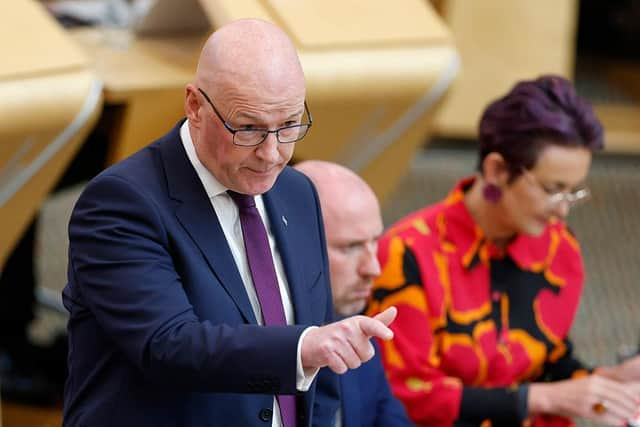
John Swinney is a public servant. We pay his wages. It is simply not good enough for him to dismiss the genuine questions of the general public concerning the Peter Murrell affair.
Nicola Sturgeon's refusal to answer Police Scotland's questions over an extended time period is not the transparency we ought to expect, far from it. Mr Swinney is compounding this situation by trying to simply ignore this. Does he really think this tactic will assuage deep public concern? Scots have a right to demand answers in this case. We are simply not getting them.
Government must be seen to be competent for it to function as intended. Mr Swinney needs to address this urgently.

Gerald Edwards, Glasgow
Why the delay?
The Scotsman is absolutely right to call for an Holyrood inquiry into Peter Murrell’s crimes, but unsurprisingly, John Swinney wants nothing to do with it.
Further, an inquiry would also find out exactly why his court appearance was “delayed” until just after the Scottish election. It is beyond doubt that had Mr Murrell appeared in court to plead guilty just prior to the election this would have had an impact on voting intentions.
We as voters are entitled to know who knew what and when and in particular how this decision to delay came about. It is abundantly clear that the SNP leadership, both past and present, are desperate to close this scandal down—they must not be allowed to do so.
Richard Allison, Edinburgh
Finance failures
The First Minister says he, personally, feels “betrayed” in response to the Murrell shopping spree. At no point, from when the news first broke, has the First Minister thought to shine a light on his own shortcomings or the paucity of the skill set within his party, with regard to this debacle.
Designing a set of internal controls over the cash flows of the party finances is not a complex task. The community bake sale can do it. The local tennis club can do it. That the people who purport to run the country, and are chomping at the bit to garner unfettered control of “Scotland Ltd” cannot even pretend to manage it is a very scary and shocking position indeed.
How do we think these people will do at designing and building a central bank, setting up their own tax regime, managing all the cash inflows and outflows of the country’s Treasury, introducing a new currency, issuing bonds and managing the levels of debt to secure access back to the EU? No chance!
Robert Ross, North Berwick, East Lothian
Beyond a joke
When First Minister John Swinney was asked if a “no comment” interview with the police by Nicola Sturgeon was helpful he replied that he had “no comment to offer”.
You really could not make this up.
Jim Houston, Edinburgh
Pursed lips
The fact that the SNP appears to have little control of their party’s finances gives little confidence to the electorate that Scotland’s finances are under control. The electorate deserves better.
D Neale, Edinburgh
Signature move
I find it strange that it appears that large payments could be made from the SNP bank account over one signature. Even small businesses insist on two signatures on cheques. If the SNP in fact required two signatures what has the second person been thinking?
Ian Lewis, Edinburgh
Pipe dream
Colin McAllister refers to the lack of professional competency of those who govern us in both the UK and Holyrood parliaments (Letters, 26 May). Unlike most professions (doctors, dentists, lawyers etc.), MPs and MSPs can assume public office, more critically a cabinet responsibility, with little or no experience or qualifications in the brief to which they have been assigned. One has only to look at the background of our current ministerial cabinet in Holyrood for confirmation.
The ethos of democracy is that the electorate is, in theory, able to discern the competency of those whom they elect. In practice this is left to the local party machine selecting the candidate. Ideally, candidates put forward to stand in elections, should have already evidenced the necessary competencies to hold public office, preferably at cabinet level. Sadly though, too many uninspiring politicians have slipped through this safety net.
Rather than the Prime or First Minister unilaterally appointing his cabinet, perhaps we first need an independent professional panel to assess the potential and skill set of prospective candidates, to guide them in appointing suitable candidates. Just a pipe dream, I hasten to add!
Alastair Neilson, Edinburgh
Labour priorities
Labour government commitments were; the new workers' rights laws; the net zero acceleration and phasing out of the British oil and gas industry; the uplift of the minimum wage beyond inflation; and the non-dom changes.
The Prime Minister and the Chancellor should have said right at the outset: “These are commitments which economic circumstances have rendered unwise to proceed with.” The priority is growth. That comes with a vibrant private sector which has suffered years of economic instability and we are going all out for making business feel respected and supported.
While I would like to claim these thoughts as my own, they are in fact those of former Labour prime minister Tony Blair. Perhaps the current government should take heed.
Alan Gall, Edinburgh
Parties over?
Tony Blair's essay contends the Labour Party lacks a coherent plan and must adopt a “Radical Centre” agenda to address technological and geopolitical shifts. He proposes a policy platform focused on pro-business growth, planning reform, energy security, workforce retraining for AI, welfare reform, healthcare modernisation and tighter immigration controls. We need a radical reform of our political party system.
Political parties have evolved from democratic tools into rigid machines that prioritise power over people, turning governance into a toxic, perpetual campaign. Abolishing them in favour of individual candidates would revitalise democracy by forcing accountability back onto representatives rather than anonymous party platforms.
Currently, voters often select “colours” rather than qualified individuals, leading to a parliament of interchangeable units obedient to party whips rather than constituents. A party-less system, where candidates run on individual merit, breaks this gridlock and reduces partisan polarisation, fostering pragmatic solutions over ideological dogma. It removes the influence of corporate funding often funnelled through central party structures, allowing for a more diverse, transparent government.
Without the safety net of a party, representatives would need to innovate, speak their own minds, and build direct, trustworthy relationships with constituents to secure re-election. Shifting to a system of individual candidates removes the “package deal” of politics, enabling voters to hold representatives truly accountable for their specific actions rather than the failings of a collective, national party.
Doug Clark, Currie, Edinburgh
Football crazies
Admirable sentiments from R R Brough (Letters, 26 May) regarding the conclusion to the Premier League football season. However, I wouldn’t hold my breath on getting any meaningful action. You see, Scottish football is a maze of grey areas, dead ends, loopholes and stools to fall between; in other words bureaucratic obfuscation.
Firstly, there’s the SFA. They are the overarching body that governs(?) all aspects of football in Scotland. I’m not sure, specifically, what they do other than take the credit when the national team occasionally qualifies for a multi-national tournament.
Secondly, there’s the SPFL. In essence they are a private company that runs the four men’s senior leagues. They are responsible to their members, and guess who the major “shareholders” are? Yes it’s the Old Firm. You need only refer back to the way the SPFL handled the premature closing of the 20/21, or “Covid”, season to get a hint about their stance on the closure of this Premier League season; and by recalling the following thought-provoking or decision-making words, which they might take as a precedent.
“Some people are on the pitch! They think it’s all over! It is now!” – Kenneth Wolstenholme, 1966 World Cup Final.
Thirdly, there’s the Scottish Referees’ Association (SRA). Their members have a difficult job, and all football fans respect and understand this. However, since the introduction of VAR this has seemingly highlighted the, possibly already inherent, refereeing misunderstandings of how a game of football physically plays out, and of the laws of physics.
All of this brings us back to the SFA, SPFL and SRA, so we’re no further forward. I’m getting a bit confused myself.
David J Mackenzie, Inverness
Noah more
So Noah is now the most popular boy’s name in Scotland. With husbands tending to be the ones who pick their son’s name it looks like bad news for Mrs Scooby and Mrs Sark.
Robert Menzies, Falkirk
Write to The Scotsman
We welcome your thoughts – NO letters submitted elsewhere, please. Write to [email protected] including name, address and phone number – we won't print full details. Keep letters under 300 words, and in the body of the email – no attachments – and avoid 'Letters to the Editor/Readers’ Letters' or similar in your subject line. If referring to an article, include date, page number and heading. No poems.
Comments
Want to join the conversation? Please or to comment on this article.