
Readers' letters: Scotland must keep its child poverty promises
A campaigner urges Scotland’s politicians to grasp the nettle of child poverty
People in Scotland believe that a promise is a promise. And when that promise is made to children, it’s even more important that we keep to our word.
But the Poverty in Scotland 2026 report (Scotsman, 5 October) shows that our political leaders are on course to break their poverty pledges to Scotland’s children enshrined in the Child Poverty (Scotland) Act 2017.
Its publication coincides with the launch of Challenge Poverty Week – when hundreds of organisations and thousands of individuals across Scotland come together to raise their collective voice against the injustice of poverty and inequality.
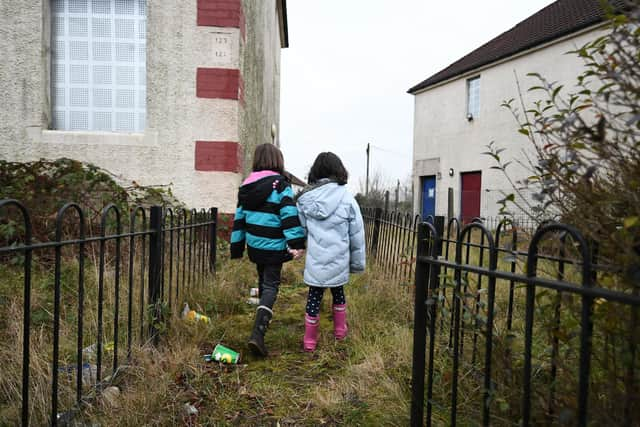

People know what needs to be done: stronger social security, fair work, real Living Wages, affordable and accessible childcare, and investment in the vital services that children and families rely on.
The solutions are well understood. And we have the resources to do it. In real terms, the UK economy is around three times larger than it was in 1960. We can use that massive wealth to build a better future for all our children, and a better society for all of us.
Peter Kelly, Chief Executive, The Poverty Alliance, Glasgow
Defining mission
Shirley-Anne Somerville claims that “Eradicating child poverty is the Scottish government’s defining mission”. Independence from the UK is the SNP's defining mission, to the detriment of all other issues.
Hector Maclean, Kirriemuir, Angus
Own goal
It’s difficult to imagine a bigger own goal than the one the Green Party of England and Wales scored for themselves by passing a motion that declares the Greens as an “anti-Zionist” party, classes Zionists as racist and calls for the abolition of the state of Israel. The motion was pushed by a pro-Palestine activists group called ‘Greens for Palestine’ who promote the establishment of a single Palestinian state.
This sparked outrage not only within the UK but also internationally and especially within the European Green Party, the umbrella organisation of Green parties across Europe.
This was echoed by the co-leader of the German Greens, who also condemned the resolution by stating: “The resolution that was passed there is in my view unbearable and unacceptable. It contradicts everything Bündnis90/Die Grünen (Alliance90/The Greens) in Germany stand for and it contradicts what the European Green Party stands for.” He added: “We have a broadly shared view within the European Green Party that the right of Israel to exist stands and must not be touched.”
By making the abolition of the state of Israel official party policy, the UK Greens couldn’t be more out of step with their European counterparts.
To illustrate why it is imperative that the Jewish people have their own homeland, let’s assume a country called Israel had existed before 1933, a country that accepted Jewish people from all over the world as a matter of course. A country where European Jews could have escaped the Nazis safely and without question. It seems fair to assume that the persecution of Jewish people by the Nazis might have had a very different outcome, had such a country existed.
All eyes are now on the Scottish Greens and whether or not they will follow in the steps of the European and German Greens.I won’t hold my breath.
Regina Erich, Stonehaven, Aberdeenshire
Honest debate
I am writing out of growing concern at the increasingly common claim that Zionism is inherently racist.
Zionism, at its core, is the belief that the Jewish people have the right to national self-determination in their historic homeland. Like any political movement, individual policies, governments and interpretations of Zionism can and should be debated. But reducing Zionism itself to “racism” erases Jewish history, identity and the centuries-long connection of Jewish communities to the land of Israel.
Criticism of the Israeli government is legitimate. Opposition to particular policies is legitimate. Supporting Gazan rights is legitimate. None of those positions requires denying Jewish people the same principle of self-determination routinely afforded to other peoples.
The accusation that Zionism is automatically racist also risks creating an impossible standard for Jewish people: they are told they may express their identity, history and connection to Israel only if they first renounce a central element of Jewish national consciousness.
There is also an important distinction between challenging political ideas and demonising those who hold them. When “Zionist” is used as a blanket insult political criticism can quickly cross into prejudice.
None of this means that Zionism should be beyond criticism. It means the debate should be intellectually honest. Israel, Gazans, borders, settlements, security, war and human rights are complicated subjects deserving serious scrutiny – not slogans that reduce an entire people and their national movement to a single accusation.
If we genuinely want a future based on coexistence, equality and mutual recognition, then we must be capable of recognising both Gazan dignity and Jewish self-determination. Calling Zionism “racism” does not advance that conversation. Too often, it simply shuts it down.
Ryan Mendelson, Glasgow
Data destruction
The proposed AI data centre for Chapelcross, Dumfries (Scotsman, 6 October), about 0.2 square miles (or 80 football pitches) in area, apparently will require a power input of 1 gigawatt. That’s the average output of about 600 of the largest on-shore wind turbines covering some 60 square miles of our beautiful countryside – plus of course the necessary grid system. To me that is so horrendous that I’m almost glad that I very likely won't be here to witness it. Two of the latest generation of Rolls-Royce Small Modular Reactors would be a far better supply system and will have a lifetime of at least twice that of wind turbines.
Stephen Gethins’ claim of “Scotland’s remarkable renewable energy potential” and the usual referral to nuclear waste are both a bit nonsensical, so let’s hope that the Tory intention to impose the same law on energy provision on all parts of the UK (Scotsman, 5 October) comes to pass.
A McCormick, Terregles, Dumfries
Nuclear option
The Conservatives plan to legislate to override the SNP’s opposition to nuclear power, thus enabling Small Modular Reactors to be built in Scotland and located at places such as Hunterston, Torrness and Dounreay, all of which have or have had nuclear capability.
What a breath of fresh air that would be – a sensible policy that enhances our energy security, bringing tax revenue from the jobs that would follow. Maybe even helping to close the SNP’s £5 billion black hole. Strange how much of a fuss there was before the last election of the UK government’s supposed £22bn black hole, but so little is made of the SNP’s black hole, which is effectively more than double that in relative terms.
It’s a pity that the Conservatives are unlikely to win that election because at a UK level and a Scottish level we need a good doze of commonsense policies. We certainly are not going to get that with the current level of debate, and the lack of challenge to the SNP.
Maybe the Conservatives should go one stage further and propose a referendum on abolishing Holyrood? Now that would set the cat amongst the pigeons of our self-serving, overpaid, under-qualified MSPs.
Brian Barbour, Haddington, East Lothian
Crofting questions
I would like to ask a very simple question about the Crofting Commission: how much does it cost the taxpayer to send letters to crofters warning of potential legal consequences if they do not respond?
I recently received correspondence from the Commission which I found intimidating in its tone. I can challenge it and ask questions – but my immediate thought was: what if the person receiving this was an 80-year-old crofter living alone?
This isn’t an organisation operating on pennies. The Crofting Commission had a budget of approximately £4.9 million in 2025/26, with around £4.2m spent on wages and salaries. Its budget for 2026/27 is approximately £5.7m. That’s public money. Yet what I cannot find in the published figures is the answer to a much simpler questions. How much does this enforcement process actually cost? How many of these letters are sent every year? How many staff hours are spent preparing them, dealing with replies and following them up? And how much public money is ultimately spent pursuing crofters through these procedures?
This isn't about refusing legitimate regulation. Crofting needs regulation. It's about proportionality, communication and accountability for public money.
If the taxpayer is funding an organisation to the tune of millions of pounds a year, crofters and taxpayers are entitled to ask whether that money is being used effectively — and whether threatening legal consequences is really the best way for a public body to communicate with the people it exists to serve.
Bridget Nicholson, Isle of Barra
Lack of integrity
The most corrupt US President ever complains about “corrupt” midterms, continuing to sow doubt about the integrity of these elections
Integrity is not an attribute I would link with this President of the United States.
Doug Morrison, Tenterden, Kent
Write to The Scotsman
We welcome your thoughts – NO letters submitted elsewhere, please. Write to [email protected] including name, address and phone number – we won’t print full details. Keep letters under 300 words, and in the body of the email – no attachments – and avoid ‘Letters to the Editor/Readers’ Letters’ or similar in your subject line. If referring to an article, include date, page number and heading. No poems.
Comments
Want to join the conversation? Please or to comment on this article.